

























































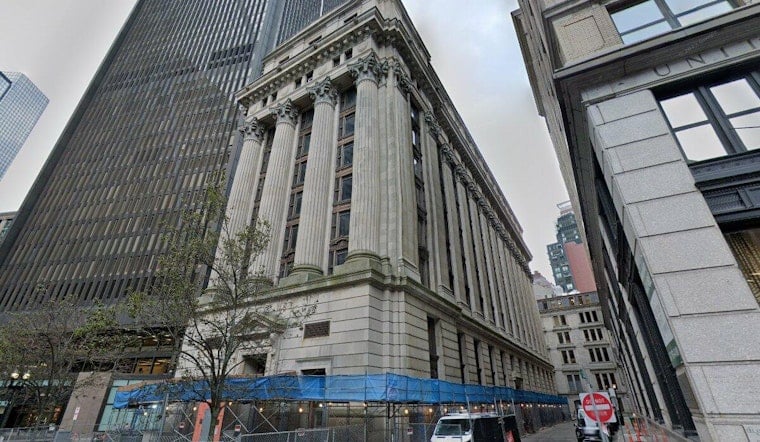
A 175,000-square-foot Beacon Hill office building that once housed coal-fired boilers is now running entirely on electricity, capping a five-year renovation that transformed 26 Court Street into an all-electric, fossil fuel-free municipal workplace. The 11-story structure, dating to 1912, now serves as the operational base for city agencies including the Mayor's Office of Housing and the Mayor's Office of Climate Resiliency, after sitting vacant during deep retrofits that stripped out the infrastructure tied to its old coal-burning heating system.
The project, completed by architecture firm CambridgeSeven, preserved 89 percent of the building's original limestone, brick, and cast stone structure, according to The Construction Specifier. The neoclassical revival facade — originally designed by architect Edward T. P. Graham when the building opened as the City Hall Annex — was restored with its cornices and stone ornamentation intact, while the original windows were swapped for high-performance glazing. The retrofit is on track for LEED Platinum certification, per the same account.
Stefanie Greenfield, a CambridgeSeven principal, led the project's design effort. Inside, designers exposed the building's original riveted steel columns and added durable wood accents and terrazzo flooring to the redesigned lobby and office floors. The ground floor now includes a public bid room, a gallery corridor, and a public meeting room, giving residents new points of access to a building that had long functioned purely as internal office space.
Swapping Coal Infrastructure for a New Transformer Vault
The retrofit's most consequential change happened out of sight: a new transformer vault replaced infrastructure tied to the building's former coal-fired boilers, according to the Construction Specifier report. That electrical work dovetailed with mechanical upgrades — new insulation, updated mechanical systems, air-source heat pumps, and energy recovery ventilation — engineered by RFS Engineering, which also built in a telecom node designed to provide multi-gigabit network support to more than 30 downstream Boston municipal buildings and public schools. Integrating a custom medium-voltage transformer vault into the historic shell required extensive utility coordination, the firm notes.
Outside, the project team widened the sidewalk to create a universally accessible plaza featuring historic granite slabs, accessible ramps, EV charging stations, bike racks, and flagpoles. Building Conservation Associates served as the preservation consultant on the project, which followed National Park Service guidelines throughout — a requirement for reconciling deep energy retrofits with a building whose exterior carries genuine historic weight.
A Property With Four Centuries of Boston History
Boston has owned the 26 Court Street parcel continuously since the 1630s, making it the city's oldest continuously city-owned property. Long before the current 1912 structure or its later stint housing the Boston School Department, the site held Boston's first jail, where pirate Captain William Kidd was imprisoned in the 1690s before his execution in London — a colonial history connected to a site that, according to CambridgeSeven, was a setting for Nathaniel Hawthorne's *The Scarlet Letter*.
In 1836, that prison gave way to a courthouse, which became a landmark anti-slavery site in 1851 when abolitionists stormed the building to rescue escaped slave Shadrach Minkins. The courthouse was replaced by the present building in 1912. The site also has a long history tied to the justice system.
Why Boston Retrofitted Rather Than Rebuilt
The all-electric conversion directly answers Mayor Michelle Wu's July 2023 executive order banning fossil fuel combustion in new municipal buildings and major renovations, according to the Sabin Center for Climate Change Law. The executive order also addresses emissions from municipal operations and the city's owned building space.
Research from the American Institute of Architects and the National Trust for Historic Preservation indicates building reuse avoids between 50 and 75 percent of the embodied carbon emissions tied to constructing equivalent new buildings. Retrofitting 26 Court Street specifically cut carbon dioxide emissions by 69 percent compared with new construction, an outcome CambridgeSeven frames as central to the project's environmental case for reuse over demolition.
The building's reopening also lands as a flagship demonstration ahead of Boston's Building Emissions Reduction and Disclosure Ordinance, or BERDO 2.0, which requires covered non-residential buildings over 20,000 square feet to meet steadily lowering emissions caps reaching net-zero by 2050, backed by daily fines up to $1,000 or Alternative Compliance Payments of $234 per metric ton of CO2e, according to NuWatt. Boston's own recent green financing milestone at Winthrop Center reflects the same BERDO-driven pressure now reshaping the city's commercial building stock, and Boston's climate initiatives more broadly reflect the city's broader climate goals. City capital project records show 26 Court Street reopened to municipal staff and the public on a rolling basis starting in November 2025 and continuing through spring 2026, allowing agencies to resume in-person constituent services gradually rather than all at once.





