

























































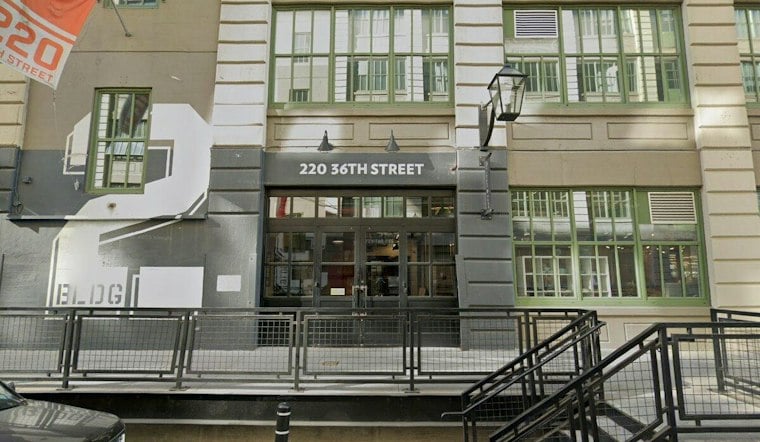
Beyond Reach Labs, a Brooklyn aerospace startup, has opened a 16,000-square-foot research and manufacturing facility inside Industry City in Sunset Park. The company is developing deployable solar arrays for satellites, commercial space stations and orbital data centers. Its patent-pending Flarewing architecture is designed to stow compactly for launch and expand in orbit to roughly the length of a football field.
According to Pulse 2.0, the company says Flarewing generates up to 10 times more power per launch than traditional solar panels while minimizing launch volume, addressing vibration issues that have historically limited how large deployable orbital arrays can safely get. The structural design was built specifically to solve what the industry calls the Size, Weight, and Power bottleneck — traditional satellite panels tend to become structurally floppy and prone to destructive vibrations as they scale up. CTO Pele Collins, who has a SpaceX background, discussed the company's stamped-metal flat-pack mechanism in a May interview with Deeptech Decoded.
Three Sizes, One Football-Field Ceiling
Flarewing will come in three configurations ranging in output from 8 kilowatts to 200 kilowatts, with the largest systems deploying to areas of as much as 625 square meters, per Pulse 2.0's reporting. The entry-level Flarewing-S weighs 9 kilograms and stows into a container roughly 1.0 by 0.25 by 0.08 meters before expanding to 30 square meters and generating up to 8 kilowatts, according to Payload Space. The mid-size Flarewing-M weighs 29 kilograms, stows into a 3.0 by 0.25 by 0.10-meter envelope, and deploys 180 square meters to produce up to 55 kilowatts, the outlet reports.
The largest model, Flarewing-L, weighs 109 kilograms and stows into a 6.0 by 0.29 by 0.13-meter package before unfolding to 625 square meters and supplying up to 200 kilowatts — enough to support commercial space stations and orbital computing infrastructure, per the same outlet. Beyond Reach Labs plans to complete ground qualification of the smaller Flarewing-S system by the end of this year, with customer integration beginning in early 2027. Ground qualification of the mid-sized Flarewing-M is targeted for the second quarter of 2027, followed by qualification of the infrastructure-scale Flarewing-L before the end of that year, Payload Space reports.
Y Combinator Participation and a Wave of Letters of Intent
The startup raised a $10 million seed round in July, according to Payload Space. Separately, after participating in Y Combinator's Winter 2026 cohort, Beyond Reach Labs had secured $342.6 million in letters of intent from customers, Payload Space reported. The letters do not represent completed sales.
CEO Mitchell Fogelson researched NASA-funded kilometer-scale space structures for his Carnegie Mellon PhD and has collaborated with Collins since 2013, according to Innovation Works. Fogelson said Beyond Reach Labs is developing power infrastructure for future space stations and orbital data centers, according to Pulse 2.0.
Why a Space Hardware Company Chose Brooklyn
Space hardware manufacturing in the United States has historically concentrated in Southern California since the Apollo era, making Beyond Reach Labs' Brooklyn facility a rare East Coast aerospace hub, according to a report from North American Clean Energy. Grumman Aerospace, notably, built the Apollo lunar module used to carry astronauts from lunar orbit to the moon's surface, per a report from NASA. The company discovered Industry City through Ultra Robotics and was drawn by the complex's oversized freight elevators, heavy floor-loading capabilities and roughly 50 megawatts of available power, North American Clean Energy reported.
Jeff Fein said Industry City provided Beyond Reach Labs with industrial power, freight infrastructure and room to build hardware in New York City, according to Pulse 2.0's original report. The complex spans 6 million square feet across 16 interconnected industrial buildings along Sunset Park's waterfront and houses more than 700 businesses and approximately 8,500 people, according to Pulse 2.0. Beyond Reach Labs is now expanding its workforce at the site as it targets production of at least 10 units per day by the end of 2027, as noted by Payload.
Sunset Park's Industrial Context
Beyond Reach Labs is expanding in Sunset Park. According to the New York State Office of the State Comptroller, private-sector employment in Sunset Park reached 39,920 jobs in 2015 after growing 9.9 percent from 2014 to 2015. Manufacturing accounted for 4,500 of those jobs, or more than 11 percent of neighborhood employment, the comptroller reported.
Industry City's current campus reflects a redevelopment of an older industrial site.
Industry City is an address for industry and culture in Sunset Park. For Beyond Reach Labs, though, the appeal is more industrial than cultural: oversized elevators, heavy floor loads and enough electrical capacity to test hardware bound for orbit, all without leaving New York City.



