

























































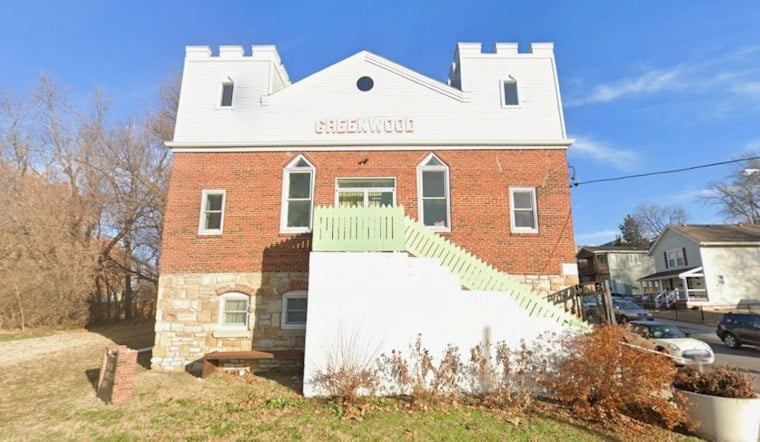
A century-old Baptist church on Kansas City's Westside has been home to the musician who spent nearly three years turning it into one of the city's few dedicated listening rooms. Calvin Arsenia was under contract to purchase Greenwood Social Hall for $725,000, with closing set for July 30, 2026, keeping the second-floor performance space at 1750 Belleview Avenue in artist hands.
Arsenia, a harpist and singer who moved into Greenwood nearly three years before the deal closed, launched a public crowdfunding campaign to help cover the acquisition, according to Kansas City Magazine. That campaign raised more than $100,000, with local community members and donors from as far as New York and Los Angeles chipping in to help him purchase the building, the magazine reported. The venue's own building fund page notes the contract to buy the building preceded the official deed transfer this summer.
From Church Pews to a Listening Room
The building started life in 1927 as Greenwood Baptist Church. For decades it served as a site of Black congregation, organization and cultural life, including worship services, community meetings, musical performances, weddings and funerals, per Kansas City Magazine.
The building was renovated by the Bottoms Up Collective, with Jamie Jeffries identified as the renovator. Honig, who according to Kansas City Magazine became the youngest living artist to have work acquired by the Whitney Museum of American Art at age 22, lived in the building for almost eight years and called it her home. “The space was in severe disrepair when she arrived,” the magazine reported, citing Honig. Looking back on handing the building off, Honig told the magazine, “I feel like I planted the seed, and he is just growing the garden.”
An Artist-First Business Model
Arsenia, who plays stringed instruments and piano and recorded his 2017 album “Live At Greenwood” in the space, was among the first artists to use the renovated hall that year, per Kansas City Magazine. He took over as director and leaseholder in late 2023 on the recommendation of musician Mike Dillon, and has since built what the venue's building-fund page describes as an artist-first model: between December 2023 and July 2026, Greenwood Social Hall hosted 302 events and sold 3,863 tickets, paying out 70% of ticket revenue directly to performing artists.
Greenwood's programming is centered on local creatives and artist resources. The renovation revealed the building's original vaulted ceiling and exposed beams. Artist Ross Redmon's “Passenger Migration” comprises one hundred porcelain birds. The space also retains traces of its residential chapter; Honig lived in the building, which had two basement apartments.
Expanding Access Through Grants and Grounding in History
In June 2025, the Live Music Society named Greenwood Social Hall a “Music In Action” grant recipient to fund “The House Of Outlyre Legacy,” an outreach initiative that brings free concerts to local schools and family matinees to the venue, according to Live Music Society. The organization describes the hall's curatorial mission as explicitly focused on platforming queer, BIPOC, and female musicians, storytellers, and visual artists, with a broader emphasis on deep listening and intimate audience connection.
That mission is rooted in the neighborhood's own history. African-American communities first established a presence in Kansas City's Westside after the Civil War, drawn by jobs in the adjacent West Bottoms railyards and meatpacking plants, before founding institutions like Greenwood Baptist Church in 1927, according to ArcGIS StoryMaps. The building later reopened as an arts space. The New York Times covered Greenwood in 2018, Kansas City Magazine reported.
A Rare Foothold Amid Gentrification
The purchase lands against a backdrop of demographic change in the Westside. The neighborhood's Latino population fell from 70% in 2000 to below 50% by 2023, as developers and rising property values increased tax burdens on long-term residents, according to KCUR. In that context, the effort to keep Greenwood, a historically Black cultural landmark, in artist hands carries added significance.
At Greenwood, Arsenia now hosts performances, workshops and storytelling events alongside concerts.





