

























































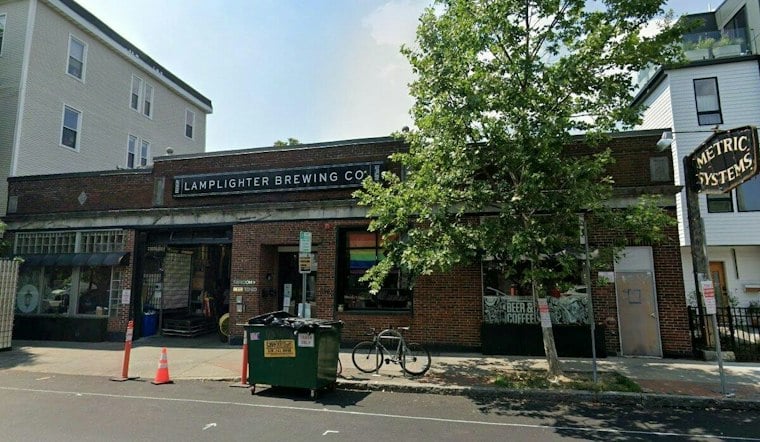
Lamplighter Brewing Co.'s co-founders are seeking regulatory approval to hand ownership of the Cambridge brewery over to the roughly 60 people who work there, announced Monday as the culmination of a plan the pair has quietly worked on for years. Cayla Marvil and AC Jones, who co-founded the brewery and remain its current owners, are pursuing the employee-ownership conversion for a business built on two Cambridge taprooms, a production facility, and its Pepita Coffee Co. operations.
The announcement, reported by NBC Boston, comes just seven months after Lamplighter's roughly 45 workers voted to unionize with United Food and Commercial Workers Local 1445, making it the first craft brewery workforce in Massachusetts to successfully organize, according to Working Mass. That outlet reported the unionization drive followed management's decision not to voluntarily recognize the union, pushing workers to a formal vote instead.
Marvil and Jones had actually begun exploring the idea of transferring ownership to their workers back in 2022, as they started planning to eventually step back from day-to-day operations, according to a Cambridge Day report cited by CS Indie. The founders reportedly shared that timeline in an internal company email before formally introducing the ownership plan to staff, framing the move as a multi-year succession strategy rather than a sudden shift.
From Auto Shop to Two-Location Brewery
Lamplighter opened its flagship, 10,000-square-foot facility in a former auto repair shop in Cambridge's The Port neighborhood back in 2016. The brewery later expanded in February 2022 with a second location, a 7,000-square-foot production taproom called Lamplighter CX in Cambridge Crossing, with both spots serving as taprooms, per the same account. Among the beers on offer is Rabbit Rabbit, a hazy New England double IPA.
Before launching the brewery, Marvil and Jones completed formal brewing educations at the Siebel Institute of Technology after identifying a scarcity of craft breweries in Cambridge, a startup process that took roughly three years of planning and buildout, according to Patriot Software. The pair's efforts eventually drew national attention: Marvil and Jones were named to Forbes' “30 Under 30” Food & Drink list in December 2019, after growing the company's revenue into seven figures within four years of opening, with Marvil noting revenue reached $6 million during that stretch, according to a profile referenced by Stanford Graduate School of Business.
The workforce eligible for ownership has grown considerably alongside the brewery's expansion. Lamplighter now employs approximately 60 people across its two Cambridge taprooms, production staff, and Pepita Coffee Co. operations, up from 38 employees in 2018, per the same reporting.
Part of a Broader Cambridge Push
The proposed conversion also lines up with active municipal and state efforts to promote worker ownership as a way to keep small businesses rooted locally. Cambridge's Community Development Department hosted a small business succession workshop in May 2025 focused specifically on employee ownership as a strategy to prevent local business closures, illustrating how city departments and state agencies have actively promoted worker-ownership models.
Other Cambridge food and beverage businesses have already made similar transitions. Circus Cooperative Cafe was formed in September 2023 by four former workers of Darwin's Ltd. after that cafe chain closed following unionization, while Boston TechCollective in Inman Square converted to worker ownership back in 2013. State lawmakers created the Massachusetts Center for Employee Ownership, known as MassCEO, in 2022 and have funded it to provide grants and technical assistance to educate business owners on worker cooperatives and Employee Stock Ownership Plans, according to Cambridge Day.
The employee-ownership model isn't new to Massachusetts craft brewing, either. Harpoon Brewery, a Greater Boston craft brewing pioneer, converted 48 percent of its ownership to an Employee Stock Ownership Plan in August 2014 when co-founder Rich Doyle stepped down as CEO, according to Vermont Business Magazine. That move made Harpoon one of the earliest major regional craft breweries to adopt the structure, well over a decade before Lamplighter's own announcement.
What remains to be seen is how Lamplighter's new employee-ownership structure will interact with the recently formed UFCW Local 1445 bargaining unit, as workers navigate becoming both unionized employees and company owners simultaneously. Neither the union nor the founders have detailed how those dual roles will be structured going forward.




