

























































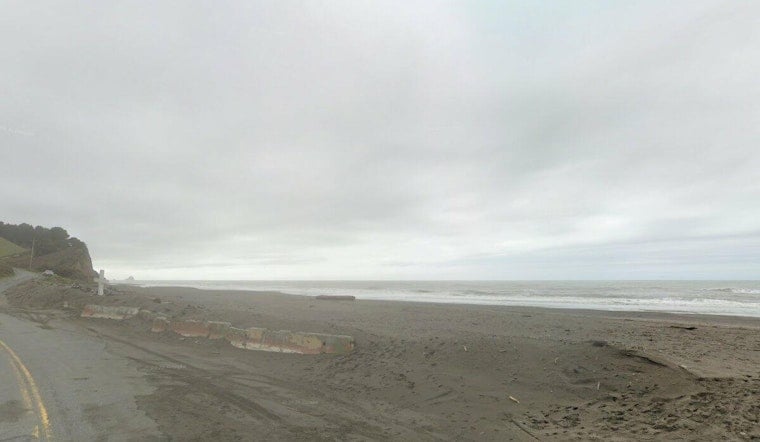
A stretch of Centerville Road about five miles west of Ferndale is crumbling into the Pacific, and Humboldt County has a fix ready to go: an elevated roadway and approximately 880 feet of rock armoring to hold back the waves. But the permit the county needs from the California Coastal Commission comes with a condition officials say amounts to a hostage situation — a permanent ban on driving onto Centerville Beach.
The Coastal Commission is scheduled to vote on Coastal Development Permit No. 1-24-1028 at a hearing in Eureka on September 9, according to Redheaded Blackbelt. Commission engineers have determined that Centerville Road is at risk of destruction by erosion within five years, a timeline that has pushed the county to seek emergency-style repairs funded through federal disaster relief tied to a 2017 storm damage declaration. The road segment has needed repeated attention: county crews cleared it six separate times between October 2025 and January 2026 alone, according to a county filing cited in the same report.
The stakes go beyond pavement. Losing the road would cut off access to eight rural residences, surrounding agricultural operations, and miles of Lost Coast shoreline, according to Lost Coast Outpost. Humboldt County had explored an inland rerouting option between 2019 and 2023, approaching a private landowner about shifting the road away from the eroding bluff, but the landowner rejected the proposed route, leaving the county with no alternative but to armor the existing corridor.
Why the State Says the Road Doesn't Qualify for Armoring
The legal snag centers on California Coastal Act Section 30235, which generally restricts shoreline armoring to structures that existed before the Coastal Act took effect on January 1, 1977. Commission staff found that the Centerville Road project does not meet that standard test for shoreline armoring, per the Redheaded Blackbelt report — a standard the California Court of Appeal affirmed in December 2024 in Casa Mira Homeowners Association v. California Coastal Commission, according to the Surfrider Foundation.
Rather than deny the permit outright, commission staff recommended approval with conditions, reasoning that denial would conflict with the Coastal Act's separate requirement to protect public beach access. The compromise: let the county build its rock revetment and raise the roadway by as much as 10 feet, but install a permanent vehicle barrier — a gate, guardrails, boulders, and posts — that would bar cars, trucks, and ATVs from driving past a new parking lot onto the beach itself.
The application has faced delays. The county, meanwhile, says it has performed repeated maintenance repairs on the road without state permits in the interim, unwilling to simply keep patching, closing, and clearing the route while the permit languished.
Parking Lot Shrinks From 100 Spaces to 13
The scale of change is stark. In the 1940s, the former Centerville Beach parking lot accommodated about 100 vehicles; today's informal parking area handles roughly 10. Under the county's current plan, a new parking lot — with one space reserved for people with disabilities — would replace informal parking, alongside a paved ramp, drainage pipes, benches, picnic tables, and bike racks.
Commission staff have concluded that an ADA parking space plus a beach wheelchair would satisfy public access requirements even without vehicle access onto the sand. Walking and beach wheelchair access would remain open around the clock and free of charge under the plan, and county emergency and maintenance vehicles would still be allowed on the beach.
Humboldt County First District Supervisor Rex Bohn pushed back hard on the framing, saying the Coastal Commission wants to hold the road repair permit hostage to close beach access, according to the Redheaded Blackbelt report. Hank Seemann, representing county public works, has argued that beach parking is essential for coastal recreation access for seniors and people with physical disabilities, a case he plans to make again ahead of next week's hearing.
Plovers, Dune Erosion, and a Conservation Group's Complaint
Supporters of the vehicle ban point to environmental damage from unpermitted driving. Sources describe vehicle impacts on dunes, private property, and snowy-plover habitat. A federally threatened species, the western snowy plover is central to the case commission staff make for the ban, along with a separate 80-acre public access easement north of the park that is already restricted to foot traffic only.
According to California State Parks’ 2017 Oceano Dunes SVRA Least Tern report, an estimated 352,127 street-legal vehicles and 94,726 off-highway vehicles were driven on the shoreline and dunes in the designated riding area in 2016. California State Parks’ Oceano Dunes SVRA Soil Conservation Plan 2024 says the Southern Exclosure’s 6, 7, 8, and Boneyard areas are fenced and closed to entry year-round to protect nesting western snowy plover.
County policy restricts driving on public beaches to the waveslope. The state's proposed vehicle barrier would impose an additional restriction if the permit is approved as staff recommend.
Not everyone framing the ban as purely about habitat agrees the process has been fair. Jennifer Savage has raised concerns about public notice, beach erosion caused by the rock armoring itself, and the project's legal eligibility for shoreline protection in the first place, and has asked the Coastal Commission to delay the vote rather than act on September 9.
A Stopgap, Not a Permanent Fix
Even if commissioners approve the project next week, county engineers have designed the revetment and elevated roadway as a temporary measure — projected to prevent wave overtopping only until roughly 2050, according to Lost Coast Outpost. That leaves the deeper question of long-term coastal retreat along this stretch of the Lost Coast unresolved, with no permanent inland route currently available after the earlier landowner rejection.
The beach carries history well beyond this fight. A California Historical Landmark cross monument on the bluffs above Centerville Beach honors the 38 people who died when the mail steamship SS Northerner ran aground on January 6, 1860, according to California Beaches. The same stretch of coast once hosted NAVFAC Centerville Beach, a 37-acre U.S. Navy undersea-surveillance facility that operated from 1958 until its 1993 decommissioning, per Wikipedia, with some of that former Navy land later transferred for public access and open space trails. The eroding bluffs also expose the Rio Dell Formation.
For now, the fight comes down to the September 9 hearing in Eureka, giving residents, conservation advocates, and county officials a final window to weigh in before commissioners decide whether saving the road means giving up the drive.




