

























































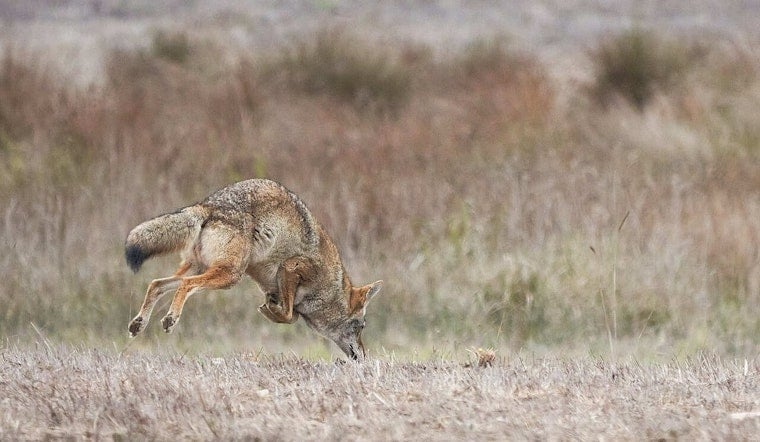
A bird survey in the San Fernando Valley took an unexpected turn last Saturday when Alexander DeBarros spotted a coyote trotting through Chatsworth Nature Preserve with a Greater Roadrunner clamped in its mouth. DeBarros snapped a couple of quick photos to confirm the bird's identity before the coyote ran over a hill and disappeared, leaving behind a striking real-world echo of one of animation's most famous rivalries.
DeBarros was conducting a bird survey with the Los Angeles Department of Water and Power on August 29 when he made the sighting, according to KFOR.com. He shares his birding adventures on Instagram under the handle @hollywood_birder, and he's been studying birds since he was 10 years old. He also leads monthly bird walks with the San Fernando Valley Audubon Society and offers private birding tours around Los Angeles and elsewhere in Southern California.
“Nature is all around, even in unexpected places such as Los Angeles,” DeBarros said, per the outlet's report. The remark captures the strange thrill of the encounter: a predator-prey pairing most people know only from Saturday morning cartoons, playing out for real in a protected patch of wildland tucked into the northwest Valley.
A Coincidence Timed to a Movie Release
The sighting happened the same weekend that Coyote vs. Acme, the latest big-screen take on the Wile E. Coyote and Road Runner rivalry, hit theaters — a coincidence not lost on those who heard about it. Brian Mainolfi, an animator who worked with Chuck Jones, the director who created the Wile E. Coyote and Road Runner characters alongside writer Michael Maltese for Warner Bros. Cartoons in 1949, described the timing as kismet, the same account notes.
Mainolfi said that, per his own online search, he was unable to find a verified photograph showing a real coyote actually consuming a Greater Roadrunner. KTLA reported that it had not independently verified whether DeBarros's image was the first photograph documenting such an encounter, leaving that distinction unresolved.
The Cartoon Got the Physics Backward
Chuck Jones's cartoons famously flipped the real balance of power between these two desert dwellers for laughs, but the biology tells a very different story. Greater Roadrunners top out at running speeds of roughly 15 to 20 mph, while wild coyotes can sprint up to 43 mph, according to the Cornell Lab of Ornithology — meaning a real coyote is more than twice as fast as its cartoon nemesis was ever depicted losing to. Roadrunners generally rely on ground evasion, using their long tails as rudders for sharp turns, and the same source notes they can manage only brief, low-altitude bursts of flight to reach a perch or dodge an attacking predator.
That speed gap makes a vulnerable Greater Roadrunner viable prey for a hungry coyote, and coyotes themselves are opportunistic feeders that typically go after whatever small or medium-sized mammals are readily available. The California Department of Fish and Wildlife describes coyotes as native omnivorous predators that help keep rodent and small mammal populations in check while also opportunistically taking birds, eggs, reptiles, and fruit across both urban and wildland settings.
Why the Preserve Puts Predator and Prey Together
Chatsworth Nature Preserve, the 1,325-acre protected open space where the encounter unfolded, sits on the site of the former 1918 Chatsworth Reservoir and was designated protected land under Los Angeles City Ordinance No. 169723 in 1994. The reservoir was decommissioned after suffering structural damage in the 1971 Sylmar earthquake, according to background compiled on the site's history. Today the preserve's oak woodlands, chaparral, and Ecology Pond support more than 200 bird species, including resident Greater Roadrunners, and the land functions as a wildlife corridor linking the Simi Hills and Santa Susana Mountains, per the Chatsworth Nature Preserve Coalition.
That corridor role matters because it lets both predator and prey move through habitat that development has otherwise fragmented across the Valley. Research from the National Park Service's L.A. Urban Coyote Project, which analyzed more than 3,200 scat samples across 27 local sites, found that human-provided food — trash, fallen fruit, outdoor pets — makes up 60% to 75% of urban coyote diets in Los Angeles, as reported by LAist. Coyotes are classified as nongame mammals under Title 14 of the California Code of Regulations §472, meaning they may be taken year-round without bag limits, subject to trapping restrictions and mandatory non-lead ammunition, according to a report in the California Fish and Wildlife Journal.
A Bird With Deep Roots in Southwest Lore
Long before it became a cartoon punching bag, the Greater Roadrunner held a revered place in Indigenous Pueblo cultures across the Southwest, admired for its endurance and speed. Its distinctive X-shaped footprint, which conceals which direction the bird actually traveled, was treated as a sacred symbol meant to mislead evil spirits, according to background from Cool Green Science.
The Chatsworth sighting adds to a run of coyote encounters across Los Angeles this year, including a Studio City coyote's capture for treatment of a facial growth after ranging across a 2.5-mile neighborhood for over a year. Whether or not DeBarros's photograph turns out to be the first of its kind, it offers a rare, unscripted glimpse of a desert rivalry that cartoons got backward but nature never did.





