

























































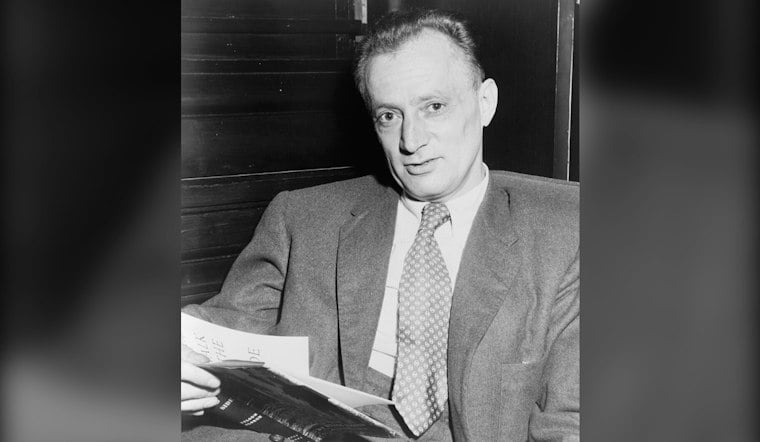
Three Chicago taverns are hosting readings, music and a cash bar this weekend to mark 75 years since Nelson Algren published Chicago: City on the Make, the slim, cynical prose poem that once got dismissed by the city's own newspaper as a rat's nest of complaints and now gets celebrated as a defining portrait of the city. The tour opens Friday at 7 p.m. and wraps up Sunday at 5 p.m., moving between a South Side neighborhood bar, a bohemian Old Town institution, and a Lincoln Park music venue with a stage built for exactly this kind of night.
The event was created by Paul Durica and Bill Savage, two figures who have spent years trying to keep Algren's name alive in Chicago's cultural memory. As Chicago Tribune columnist Rick Kogan reports, Durica runs Pocket Guide to Hell tours and now serves as director of exhibitions at the Chicago History Museum, while Savage teaches Chicago history, literature and culture as a professor at Northwestern University and has long emphasized Algren in his classes. Durica told Kogan the tavern crawl is simply another way to make sure Algren is remembered.
That mission has deep roots. Durica launched Pocket Guide to Hell in 2008 as a University of Chicago graduate student, building a reputation for unconventional public-history stunts that once restaged the city's 1855 Lager Beer Riot as a dodgeball game, according to UChicago Magazine. Savage, meanwhile, co-annotated the 50th-anniversary edition of City on the Make with David Schmittgens for the University of Chicago Press in 2001, a volume that also carried an introduction from Chicago oral historian Studs Terkel, per Wikipedia's entry on the book. The volume also included annotations.
From Bernice's to the Hideout, a Tavern Tour Traces a Life
The crawl begins Friday at Bernice's Tavern, 3238 S. Halsted St., before moving Saturday at 1 p.m. to the Old Town Ale House at 209 W. North Ave., and finishing Sunday at 5 p.m. at the Hideout, 1354 W. Wabansia Ave. Tickets run from five to twenty dollars, and each stop has a cash bar. Durica and Savage will provide readings from City on the Make along with historical and biographical background, joined by readers Lester Munson, Liz Garibay, Tim Tuten, Gregorio Gomez Aguayo, Dmitry Samarov and Mario Smith, plus music and other surprises, according to Kogan's column.
The Old Town Ale House has hosted this kind of literary gathering before. Established in 1958 and sitting across from The Second City, the bar became a bohemian haven for journalists and performers, and film critic Roger Ebert once called it the best bar in the world that he knew about, according to the Old Town Ale House. Its walls are still lined with satirical portraits painted by owner Bruce Elliott, a detail the Tribune column also notes about the venue.
At Sunday's final stop, the Hideout's stage will host the last round of readings. Ethan D'Ercole is set to sell a limited-edition poster there, and Savage plans to bring along the original Holiday magazine in which portions of City first appeared, along with items from his personal Algren collection, per Kogan's reporting.
A Book Chicago Once Hated, Now Chicago's Own
City on the Make did not start out beloved. It first ran in truncated form in the October 1951 issue of Holiday travel magazine, after editors there requested cuts to make the piece less opinionated and more respectful of the city's pioneers, according to Time Out. Doubleday then released the full, unedited 88-page prose poem as a standalone book later that year. Chicago's civic establishment did not take kindly to it: the Chicago Daily News dismissed Algren's portrait of the city as a Case for Ra(n)t Control, per Wikipedia's history of the book, a reaction rooted in Algren's focus on corrupt politicians, hustlers and skid row figures rather than the boosterish travel writing civic elites expected.
Central to that portrait was Algren's treatment of the 1919 Black Sox scandal, in which eight White Sox players were accused of taking bribes to throw the World Series. Algren, who idolized the White Sox according to Kogan's column, used the scandal in City on the Make as a metaphor for a city that operated, in his telling, as a rigged ball game — a symbol, Wikipedia's account of the book notes, of how Chicago consistently betrayed its dreamers and its working class.
Bill Savage has argued that the book's staying power comes from what it still gets right. He has said that Algren and Carl Sandburg captured elements of Chicago that still exist today. The Chicago-area brewery Hop Butcher for the World has crafted four beers inspired by City on the Make, according to Wikipedia's entry on the book.
The Man Behind the Book
Algren himself lived much of the material he wrote about. He made his home at 1523 W. Wabansia Ave. before that building was razed to make way for the northbound lanes of the Kennedy Expressway, Kogan's column notes. He left Chicago in 1975 and died in 1981 of a heart attack in Sag Harbor on Long Island. Mary Wisniewski, who wrote the 2016 biography Algren: A Life, has said that few of Algren's friends thought he was an alcoholic, though he did sometimes drink too much.
Algren's personal life extended well beyond Chicago's taverns. He wooed French writer and feminist Simone de Beauvoir, whom he met in Chicago in February 1947, beginning a 17-year transatlantic romance; she later dedicated her 1954 Goncourt Prize-winning novel The Mandarins to him and was buried in Paris in 1986 wearing a silver ring he had given her, according to Literary Hub. Their relationship ultimately foundered because neither would relocate permanently — de Beauvoir tied to Paris for her writing, Algren convinced he could only write about Chicago.
At the peak of his career, Algren's reputation reached well past Chicago. His 1949 novel The Man with the Golden Arm won the inaugural National Book Award for Fiction in March 1950, presented at a ceremony by former First Lady Eleanor Roosevelt, per the Wikipedia entry on Algren. That national stature is part of Algren's legacy, even as City on the Make quietly found its permanent home in Chicago's own affections.
The anniversary celebration extends beyond the three taverns, too. A related event will mark the 25th anniversary of the 2001 edition of City on the Make, and some participants plan to visit the Nelson Algren Museum of Miller Beach in Indiana next Saturday, with Dick Bales and Mary Wisniewski involved in the event plans, according to Kogan's column. The museum is the planned destination for that visit.
Whether at a Bridgeport bar or a museum on the Indiana shore, the image Algren left behind of Chicago has proven durable. As he wrote in City on the Make, between streetcar stops stretch the streets where the shadow of the tavern and the shadow of the church form a dark and double-walled dead end.





