

























































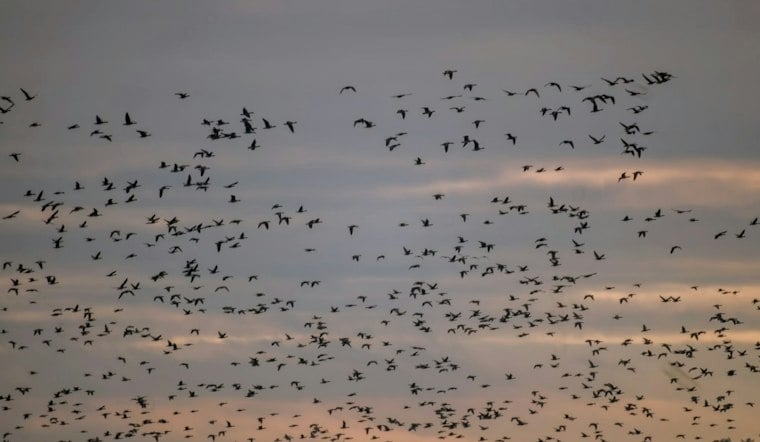
Chicago officials have issued a bird migration alert asking residents and building managers to turn off or dim unnecessary exterior lights between 11 p.m. and 6 a.m. over the next three nights, as nearly 300 million birds are expected to take flight across the United States. Cool, dry weather is encouraging birds to travel southward overnight, and Chicago and the Great Lakes sit along one of North America's busiest flyways.
The alert, first reported by NBC Chicago, cites figures from Chicago Animal Care and Control estimating nearly 300 million birds will be aloft over the country in the coming days, part of a broader wave of more than 825 million birds expected to migrate across the nation in the days ahead. More than 150 million birds have already traversed Illinois this season alone, according to the same report, as flocks head toward their winter homes. Data behind the alert comes from BirdCast, a tracking project spearheaded by Cornell and other organizations that models migration volume using weather radar.
Bright lights can attract and disorient birds in flight, increasing the risk of collisions that injure or kill them, and officials are asking high-rise residents and workplace occupants to close blinds and curtains so birds can more clearly see their path through the city skyline and surrounding suburbs. Closing blinds also reduces light pollution more broadly. Residents and property owners are being asked not to illuminate lobbies, fountains, or plants that can attract birds toward glass.
Why Chicago Is Ground Zero for Collision Risk
The urgency behind these seasonal alerts is rooted in hard data: a 2019 study led by the Cornell Lab of Ornithology, published in Frontiers in Ecology and the Environment, ranked Chicago as the single most dangerous U.S. city for migratory birds in both spring and fall, largely due to its light pollution and position on the Mississippi Flyway, according to the Cornell Chronicle. Houston and Dallas ranked second and third. An estimated 5 million birds representing roughly 250 species pass through the Chicago urban corridor each year during their seasonal migrations, per BOMA Chicago.
That scale of movement has produced grim precedent. On the night of October 4 to 5, 2023, the McCormick Place Lakeside Center alone recorded nearly 1,000 bird fatalities during an unusual migration event involving stormy weather and event lighting, according to the American Bird Conservancy. Hoodline covered that same migration wave in an earlier report on a massive bird surge.
A Retrofit That Cut Deaths by 95 Percent
McCormick Place responded to that mass-casualty night with a $1.2 million installation of bird-safe dot pattern film across 120,000 square feet of glass, completed in summer 2024. The retrofit reduced bird collision deaths at the building by approximately 98.6% during the fall 2024 migration season, according to FacilitiesNet, with recorded fatalities dropping from 1,280 in fall 2023 to just 18 in fall 2024. Hoodline previously detailed that project in a piece on McCormick Place's glass retrofit.
Research from the Field Museum backs the logic behind dimming lights during migration. A study based on more than 40,000 collected birds found that extinguishing half a building's lights during nocturnal migration reduces collision deaths by up to 11 times in spring and 6 times in fall, per the Field Museum.
Voluntary Guidelines Meet a Push for Mandates
Chicago's light-reduction efforts are not new. Lights Out Chicago has operated since 2000 and encourages building managers to extinguish decorative upper-story lights after 11 p.m. during peak migration windows. Those guidelines run seasonally from March 15 to June 15 and again from August 15 to November 15.
More than two decades later, the city is weighing whether voluntary compliance is enough. In July 2026, the Chicago City Council discharged a proposed mandatory Bird-Friendly Building Ordinance out of committee limbo to the Zoning Committee, advancing legislation that would require bird-safe glass and lighting standards for new construction and major renovations, according to WTTW News. The measure was introduced by Alderperson Maria Hadden and has support from architect Jeanne Gang. The proposal would establish bird-safe glass and lighting standards for new construction and major renovations in Chicago.
The Toll on the Ground
The stakes of getting the lighting right are steep. During one event, volunteer patrols from Chicago Bird Collision Monitors found 700 to 800 birds in a one-square-mile area, according to the Chicago Bird Alliance. The monitors also work with rescue partners on surviving birds. Nationally, building collisions cause losses of up to one billion birds annually. For the next three nights, Chicago-area residents are being asked to do their part by simply flipping a switch.





