

























































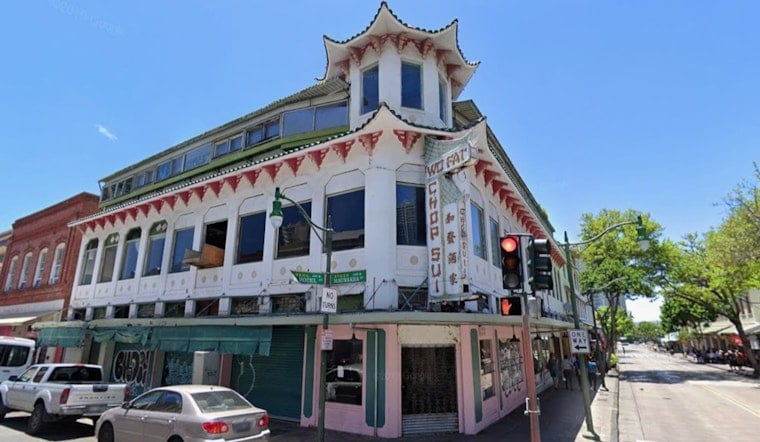
The century-old Wo Fat Building at the corner of Maunakea and Hotel streets in Honolulu's Chinatown has new owners, real estate investors Ave Kwok and Del Fujinaka, who bought the long-vacant landmark in July 2026 for $2 million. The pair now plans to convert the building's upper floors into residential units while filling the ground floor with retail shops, a restaurant and bar space, and a museum dedicated to the building's own history.
According to Hawaiʻi Public Radio, the buyers have already spent $800,000 on renovations, and Kwok plans to spend another $3.5 million to complete the project. The new owners have reserved a quarter of the planned residential units for tenants and have lined up 11 potential ground-floor retailers, per the same report.
A Building That Has Outlasted Fires and False Starts
The current three-story concrete structure was rebuilt nearly 90 years ago to its present form, replacing earlier iterations of Wo Fat that survived Chinatown's devastating fires in 1886 and 1900, according to Honolulu Civil Beat. That outlet reports the building, designed by Wahiawā-born, Cornell-educated architect Yuk Tong Char, opened in March 1938 as the third version of Wo Fat following those blazes. The building has existed for more than 100 years and once housed a restaurant that first opened in 1882 as Wo Fat Chop Suey, operating as Honolulu's oldest Chinese restaurant until it permanently closed in 2005, according to the U.S. National Park Service.
The building's fame extends well beyond Chinatown's streets. Television writer and producer Leonard Freeman named the arch-villain Wo Fat in the original Hawaii Five-O series directly after dining at the restaurant, a character who appeared from the 1968 pilot through the 1980 finale and was later revived in the 2010 reboot.
A Rocky Path Through Ownership
The road to this sale wound through a failed redevelopment attempt. A group of investors that included former University of Hawaiʻi football coach June Jones bought the shuttered restaurant building in 2017 for $4 million, planning to renovate and restore it with roughly two dozen hotel rooms upstairs and a restaurant and bar reopening on the ground floor. That plan collapsed in February 2023 when developers stopped paying general contractor White Sands Construction Inc., which was owed $3.5 million for completed work and filed a mechanic's lien, per Civil Beat's reporting, and the renovation and restoration never materialized. White Sands Construction ended up owning the building before selling it to Kwok and Fujinaka.
Mayor Rick Blangiardi had publicly floated a different outcome in August 2025, announcing the city was negotiating with private investors to buy the Wo Fat building for municipal affordable housing, per Civil Beat. That municipal acquisition never came together before Kwok and Fujinaka closed on the private purchase in July 2026.
Navigating Historic Preservation Rules
Because the Wo Fat Building sits within the Chinatown Historic District, added to the National Register of Historic Places in January 1973, any renovation must comply with both municipal design rules and federal rehabilitation guidelines, per documentation from the U.S. National Park Service. Hawaiʻi Public Radio's editor-in-chief for Pacific Business News, Janis Magin, reported that the Wo Fat project is currently going through that permitting process.
Part of a Broader Chinatown Shakeup
The Wo Fat sale lands amid a wave of property moves reshaping Honolulu's Chinatown. The city closed on a $4.52 million purchase of a mostly vacant 42-unit apartment building at 175 N. Pauahi Street in April 2026, led by Honolulu's Department of Housing and Land Management, to convert it into affordable housing. The following month, Bank of Hawaii bought the 308-space Mark's Garage property on Nuuanu Avenue for $16.5 million to turn it into employee parking, a deal that let seller Mobile Infrastructure pay down line-of-credit debt.
Vacancy remains a stubborn problem elsewhere in the neighborhood. In December 2025, Mayor Blangiardi urged Taiwan's government to redevelop or demolish the aging four-acre Chinatown Cultural Plaza on Beretania Street, calling the complex, where more than half the storefronts sit empty, a public safety problem. Meanwhile, street-level revival continues nearby: Hotel Street's Tchin Tchin Bar, on the same corridor as the Wo Fat Building, is reopening in September 2026 as a wine, whiskey and cigar lounge after closing in May following 11 years in business.





