

























































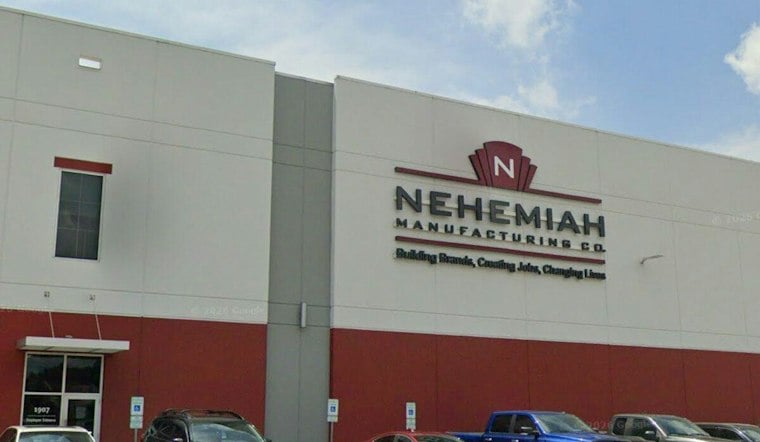
Nehemiah Manufacturing runs a Cincinnati production and distribution operation for familiar household brands while employing people who often face barriers to conventional hiring. Kristin Donahue, who spent nearly a decade cycling in and out of jail during an addiction battle, is among those workers; she now helps manage products as they are made, packaged, sorted and shipped.
Donahue works at Nehemiah Manufacturing's Cincinnati operation, which partners with Procter & Gamble to produce those familiar household brands, according to WKRC. That P&G relationship traces back to the company's founding in 2009, when former Procter & Gamble executive Dan Meyer and fellow consumer packaged goods veteran Richard Palmer launched Nehemiah with a P&G license for Pampers Kandoo products before expanding into other major household brands, according to the Council for Inclusive Capitalism. Meyer spent 16 years at P&G before striking out on his own to build a company designed around a very different kind of workforce.
Donahue said Nehemiah gave her an opportunity to rebuild without being defined by her past, telling the station that the company does not judge or define its workers by what came before them. She had no formal education when she joined the company, and since then she's earned her GED, bought a house and gotten married — milestones she says she would not have reached without the job, per the same WKRC report.
A Workforce Built on Second Chances
Donahue's story reflects a much larger pattern at the company. More than 80% of Nehemiah Manufacturing's workforce consists of second-chance employees — people with felony conviction records, active substance recovery histories, or long gaps in employment, according to a report from Marella Porter TV. The factory was established specifically to stimulate economic growth in Cincinnati's urban core, and Nehemiah backs up that mission with mentoring, life-skills coaching and a support network for workers who might otherwise be overlooked because of their record, per WKRC's reporting.
Local Reentry Support Beyond the Factory
Official Hamilton County resources illustrate the practical barriers that can accompany reentry. According to the Hamilton County Office of Reentry, the county's One-Stop Resource Center connects residents with employment, housing, substance-abuse and mental-health services, as well as help with record sealing or expungement. The office also describes a Gap Housing Model that gives eligible participants 90 days of free housing, along with wraparound services, life-skills coaching and employment assistance. Those programs provide a local support framework for people working to stabilize their lives after incarceration or during recovery.
Nehemiah maintains an annual employee turnover rate of roughly 15%, according to reporting cited by the Wall Street Journal. The company also provides on-site social workers and life-coaching programs to support its workforce.
Expanding on the West Side
Nehemiah's model has also translated into growth. In February, the company announced plans for a $6 million facility expansion on Evans Street in Cincinnati's Lower Price Hill to accommodate its growing production and warehouse needs, Marella Porter TV reported. Lower Price Hill is a historic Cincinnati neighborhood where Nehemiah deliberately sited its facilities to maximize local job access for residents.
The company's influence has also spread beyond its own factory floor. Nehemiah co-founded the Beacon of Hope Business Alliance in 2016 to help other Cincinnati-area employers adopt second-chance hiring practices, and the coalition returned to Nehemiah's direct management in late 2025 after several years under Cincinnati Works, according to the Workforce Innovation Center. The coalition has connected dozens of companies and thousands of individuals to work.
Ohio's Legal Path Toward a Clean Slate
Donahue is now working toward getting her own criminal record expunged, WKRC reported, continuing to push toward a clean record and a brighter future. She has a formal legal pathway to do that: under Ohio Senate Bill 288, which took effect in April 2023, the state established a formal expungement process that permanently erases eligible conviction records and shortens court waiting periods for applicants, according to Towards Employment. Expungement destroys court files entirely, a stronger remedy than record sealing, which merely hides files from public view.
Ohio has also built legal protections meant to encourage employers to take a chance on workers like Donahue. Under Ohio Revised Code Section 2953.25, courts can issue a Certificate of Qualification for Employment, which lifts statutory employment barriers and shields employers from negligent hiring lawsuits when they hire someone with a conviction, according to OhioMeansJobs Adams & Brown. The certificate can lift statutory employment barriers for people with convictions. Separately, Ohio Revised Code Section 9.73 mandates ban-the-box restrictions for public sector hiring, barring state and local government agencies from asking about criminal history on initial job applications, per Employment Law Ohio.
A Statewide Drop in Reoffending
Those policy shifts sit alongside Ohio's broader reoffending numbers. According to the Ohio Department of Rehabilitation and Correction's 2025 report, the state's three-year return-to-prison rate for new criminal convictions stood at 17.9%. State officials point to expanded community re-entry programming.
The stakes behind that trend are national in scale. More than one in three U.S. adults has a criminal record. A lack of stable post-release employment is widely cited as a major driver of reincarceration nationally, which is precisely the gap Nehemiah's model was built to close for workers like Donahue.





