

























































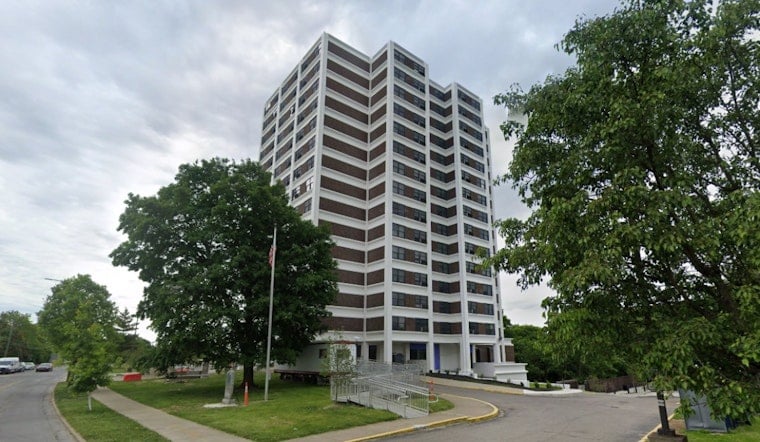
A 15-story apartment tower visible from Interstate 75 on Cincinnati's West Side just wrapped up a $50 million top-to-bottom renovation, capping a 20-month gut rehabilitation that transformed a building once considered a demolition prospect into a modernized home for 140 households of seniors and disabled residents.
The Cincinnati Metropolitan Housing Authority completed the overhaul of Marquette Manor, according to Local 12, replacing the building's flooring, electrical systems, and plumbing while renovating kitchens, bathrooms, outdoor space, and shared community and exercise rooms. The station reports that Gregory Johnson, CEO of the housing authority, said the renovation addressed the building's structural basics, and the work is expected to buy the tower another 15 years before additional major repairs are needed. The exterior was also repainted as part of the project, per the same account.
Marquette Manor sits in English Woods, and the tower is the last high-rise standing on the site after CMHA demolished more than 700 surrounding public housing units built in the 1940s following an intense legal dispute with residents in the mid-2000s, according to background compiled from the Wikipedia entry on English Woods. That history explains why the 15-floor tower had stood isolated on the 86-acre site for years, its fate uncertain, before the rehabilitation effort took shape.
How HUD's RAD Program Paid for the Rebuild
The $50 million project was financed through the U.S. Department of Housing and Urban Development's Rental Assistance Demonstration program, which converts traditional public housing units into Section 8 Project-Based Rental Assistance so agencies can borrow private debt and equity for major repairs, according to Affordable Housing Online. Congress created RAD specifically to help housing authorities work through backlogged capital repairs without relying solely on scarce federal grant dollars.
Under the RAD framework, tenant rent payments at Marquette Manor stay capped at 30% of adjusted gross household income, preserving affordability for low-income seniors and disabled residents whose average base rent had previously run around $218 a month, the same source notes. HUD's rules require that existing tenants keep their housing subsidies after a building is rehabilitated, meaning residents were not priced out by the upgrades.
Construction moved in floor-by-floor phases rather than emptying the building all at once. CMHA held an open house for the 15th floor in July 2025, where 39 returning residents toured upgraded kitchens and enlarged bathrooms fitted with bathtubs, according to the Cincinnati Metropolitan Housing Authority. That phased approach let residents move back into finished floors as work continued elsewhere in the tower.
Part of a Billion-Dollar Portfolio Overhaul
Marquette Manor's renovation is one piece of a larger CMHA push to invest $1 billion into modernizing its housing portfolio across Hamilton County, with more than $250 million in capital projects already completed or underway, the agency says. CMHA is one of Hamilton County's largest residential developers, and it is running a similar RAD-funded gut rehabilitation at Beechwood, a 13-story, 146-unit senior complex in Avondale built in 1969, where construction began in March 2025.
Nationally, public housing authorities face an estimated capital repair backlog exceeding $45 billion, and federal data cited by CMHA shows more than 10,000 public housing units are lost each year to severe disrepair when traditional capital funds fall short. That backdrop helps explain why CMHA and other agencies have turned to RAD conversions rather than waiting on federal capital grants that rarely keep pace with aging buildings.
Marquette Manor is built to serve elderly residents and people with disabilities specifically: 139 of its 140 one-bedroom units are built or adapted to meet federal accessibility guidelines, according to the Affordable Housing Hub. Accessible affordable units carry long waitlists across Hamilton County, underscoring the stakes of preserving rather than demolishing a building like this one.
Mayor Aftab Pureval joined CMHA leadership to celebrate the tower's reopening on August 28, marking the formal completion of the renovation. CMHA currently manages roughly 4,000 traditional public housing units, oversees Housing Choice Vouchers for about 10,000 households, and manages another 1,600 affordable units through its Touchstone Property Services division, reflecting the agency's broad footprint as one of Ohio's earliest housing authorities, established in 1933.
The Marquette Manor project comes amid an active local debate over how CMHA funds its repair backlog. Hoodline previously reported on tenant pushback over a City West unit selloff tied to a separate $200 million rehabilitation plan, illustrating how the agency has pursued multiple financing strategies, including property sales, to fund the broader modernization of its aging high-rises.





