

























































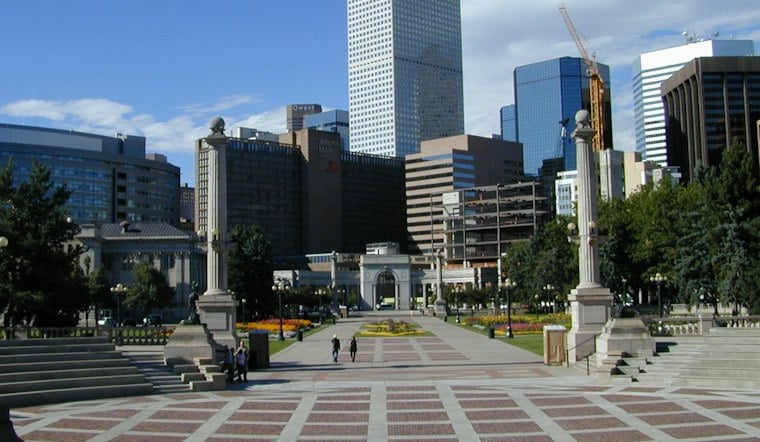
Denver’s roughly $50 million Civic Center Park renovation is designed to improve access throughout the park and add a memorial to the Gang of 19. The Studio Gang project includes changes to the Greek Theater and a new south-side entrance from 14th Avenue Parkway, according to Westword.
The redesign will change the theater’s orientation so it can be fully accessible for the first time in its 100-year history, Westword reported. A walkway into the park and theater will include a large medallion honoring the Gang of 19 and bearing the words “We Will Ride.”
The reported funding package includes $30 million from the Downtown Development Authority, $4 million from Elevate Denver and a $1.8 million Mellon Foundation grant for monuments. Westword also reported that Jenna Harris, a downtown parks program manager for Denver’s Department of Parks & Recreation, said the activists’ history surfaced during research connected to Civic Center’s 2012 designation as a National Historic Landmark.
The protest behind the memorial
The memorial recognizes a July 1978 action in which 19 disabled activists blocked two Regional Transportation District buses at Broadway and Colfax Avenue. Led by Rev. Wade Blank, the group demanded wheelchair lifts on buses and chanted “We will ride,” according to RTD-Denver.
Accounts vary about the action’s duration and the number of buses involved in the broader dispute. RTD describes protesters stopping buses on July 5 and 6, while another RTD account characterizes the standoff as lasting 24 hours. NPR reported that the activists sought lifts on more than 200 newly ordered buses; RTD has described a recent order of 250 buses without lifts. Westword reported that RTD had only 10 accessible buses at the time: Westword.
Police arrested two personal-care attendants, Bill Roem and Lisa Wheeler, rather than the wheelchair users; Westword reported that the charges were later dropped. The action followed a lawsuit filed by attorney John Holland on behalf of Atlantis, which Blank had co-founded with Barry Rosenberg. NPR reported that Holland and Blank lost the case, while Westword reported that RTD later agreed to retrofit 213 buses with wheelchair lifts as part of a settlement.
A local fight with wider effects
The Gang of 19 became the core of the organization now known as American Disabled for Attendant Programs Today, or ADAPT. Their activism contributed to a broader disability-rights movement and to changes in public transportation and facilities, according to Rocky Mountain PBS: Rocky Mountain PBS.
Seven years after the protest, RTD became the first metropolitan region in the country to provide wheelchair-accessible service on all local buses, according to RTD: RTD. The agency rededicated a plaque at Civic Center Station in 2023 and has said it plans another commemoration on the protest’s 50th anniversary.
RTD’s current accessibility work includes an advisory group and responsibility for bus-stop upkeep and accessibility improvements, although Westword reported that the agency owns less than 2 percent of the region’s bus stops. Westword also reported that Councilmember Chris Hinds, who uses a wheelchair, expects the redesign to make the Greek Theater easier to reach. The new entrance is expected to open next fall.
Accessibility beyond Civic Center
The Gang of 19 memorial would address a historic transportation-access fight, but RTD’s current assessment identifies significant barriers that remain across the region. According to RTD’s 2026 Bus Stop Infrastructure and Accessibility Assessment, approximately 65% of bus stops did not meet accessibility sufficiency standards, and bringing the system to baseline accessibility was estimated to cost about $130 million. RTD says improvements require coordination among the agency, cities, counties, CDOT, private developers and other partners because stops are spread across multiple jurisdictions. Denver’s planned memorial also fits within a broader effort to preserve disability-rights history in public places, while taking a distinct form. Temple University’s Institute on Disabilities says a disability-rights movement history timeline was installed in 2019 at Philadelphia’s City Hall Courtyard and the Parkway Central Library; Denver’s project is instead a memorial to the specific local group whose protest is being commemorated.



