

























































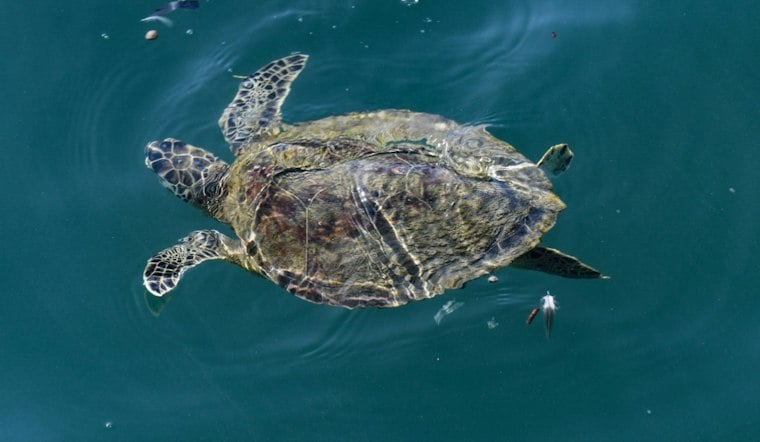
A juvenile green sea turtle named Bowtie was scheduled to swim back into the Atlantic Ocean on Wednesday, September 16, 2026, at Lori Wilson Park in Cocoa Beach, marking the planned end of a monthlong recovery from two embedded fishing hooks. The turtle had arrived at a Brevard County rehabilitation center in mid-August in otherwise good health, save for the hooks lodged in its neck and esophagus.
Bowtie's ordeal began when a fisherman accidentally hooked the turtle at Jetty Park Pier in Port Canaveral and reported the incident, according to Brevard Zoo. The turtle was brought to the East Coast Zoological Foundation's Sea Turtle Healing Center, where veterinary surgeons used a specialized video endoscope to extract one hook lodged deep within Bowtie's esophagus, while a second hook embedded under its neck was removed immediately, per the zoo's account of the case posted at Brevard Zoo's website.
A Recovery That Moved Fast
Bowtie recovered quickly once the hooks were out, and the rehabilitation center's staff cleared the turtle for release before the month was through. The zoo's account notes that Bowtie's care was supported in part by the Protect Wild Dolphins Alliance, funded through Florida's Protect Marine Wildlife specialty license plate grant program — one of several funding streams that keep the rehabilitation facility running.
Bowtie's incident occurred at Jetty Park Pier. In March, another juvenile green sea turtle named Soggy Bottom was rescued after becoming entangled in fishing line; that turtle was rehabilitated and released back into the ocean in June, the zoo's report on the case states. Fishing gear poses a threat to sea turtles, as Bowtie's case illustrates.
Why Reporting a Hooked Turtle Matters
Wildlife officials stress the importance of what happened in the moments right after the hook went in. Rather than cutting the fishing line, the angler alerted wildlife authorities immediately.
Anglers and beachgoers in Brevard County who hook or discover a distressed sea turtle are instructed to call an emergency hotline at 321-206-0646, monitored from sunrise to sunset by the volunteer Sea Turtle Preservation Society, which asks callers to leave information and documents strandings. Green sea turtles carry strict legal protections in Florida, covered under both the federal Endangered Species Act and the state's Marine Turtle Protection Act, which makes it illegal to harass, harm, capture, or possess any sea turtle, nest, or egg, according to the Florida Fish and Wildlife Conservation Commission.
A Population Rebound Brings More Turtles Near Piers
The steady stream of hooked and entangled turtles arriving at Brevard Zoo is, in part, a byproduct of a conservation success story. Florida's green sea turtle nesting population has climbed roughly eightyfold since standardized tracking began in 1989, rising from 464 clutches to an annual average exceeding 30,000 nests in recent years, per the state wildlife commission's nesting data. Bowtie was found at Jetty Park Pier.
The facility has admitted sea turtles and cared for hatchlings. The center has operated since April 2014 and has released rehabilitated sea turtles.
More Capacity On the Way at Port Canaveral
Bowtie's release adds to a growing list of Space Coast turtle stories this year; Brevard Zoo also released 56 rescued hatchlings offshore last month. The region's rescue infrastructure is also set to expand: the East Coast Zoological Foundation is preparing to break ground on December 2 on the $140 million Bowen Aquarium and Conservation Center at Port Canaveral, which will include an expanded sea turtle and manatee care complex, as Hoodline previously reported. For now, the combination of the Sea Turtle Preservation Society's hotline, the Sea Turtle Healing Center's surgical tools, and quick-thinking anglers like the one who called in Bowtie's hooking remains the safety net keeping turtles like Bowtie swimming free.





