

























































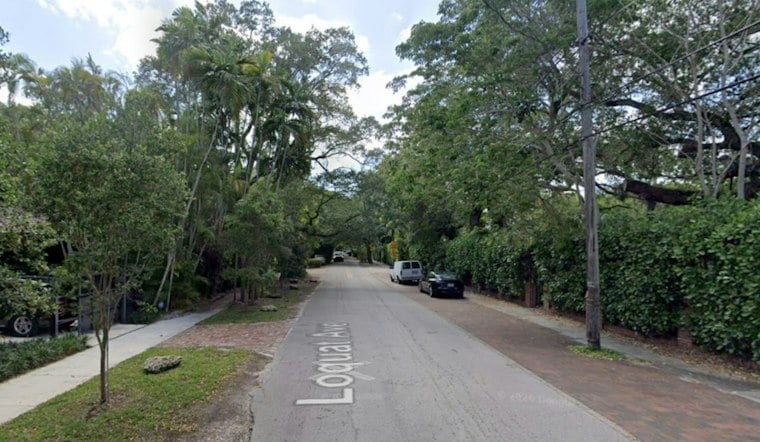
A South Grove homeowner has until September 25 to fix a hedge the City of Miami says blocks drivers' view of a stop sign, one of roughly 20 active tree-removal appeals across Coconut Grove where city officials say sight visibility is emerging as the deciding factor. Michiel Johan van de Kreeke, who lives near Loquat Avenue and Linden Lane, received several city notices in February alleging that his hedge obstructs motorists' view of the intersection's stop sign, and he plans to appeal the citation.
Van de Kreeke's case is detailed in reporting from WLRN Public Media, which republished an original report from Coconut Grove Spotlight. The city's sight-visibility regulations restrict vegetation, fences, walls and other objects between 2.5 feet and 10 feet high from creating what the code calls a material impediment to visibility, with the protected sight triangles extending from 5 feet to 25 feet along roadway edges. City officials maintain the rules exist to protect drivers, cyclists and pedestrians from traffic hazards.
Van de Kreeke has already trimmed a tunnel through his hedge so drivers can see the stop sign, and the city separately directed him to remove several objects caught in the greenery. He says removing the hedge entirely would undermine South Grove's neighborhood character. According to van de Kreeke, Javier Gonzalez — who serves as Coconut Grove constituent liaison for District 2 Commissioner Damian Pardo — told him the citations stemmed from complaints by nearby residents.
A Pattern Beyond One Hedge
Van de Kreeke isn't alone. Roy Mathew received a code-enforcement citation covering his fence, gravel pathway, hedges, shrubs and alleged obstruction of motorists' view, despite having maintained his South Grove property for 26 years without similar scrutiny, per the same account. Roy and Lata Mathew maintain native plants extending toward the street, and a formal notice issued August 26 cited obstructed required visibility along with unpermitted fencing and unpermitted plantings in the public right of way.
Sandy Moise has reported that property owners and developers are increasingly invoking sight visibility to justify removing trees, and she said a tree within a sight triangle does not necessarily need to be removed — arguing the rule is being applied excessively to vegetation. Coconut Grove residents and tree advocates more broadly say the city is increasingly leaning on traffic-safety rules to scrutinize established greenery. Land-use attorney David Winker disclosed that sight visibility was cited as an issue in most of the roughly 20 active tree-removal appeals pending before the city, according to WLRN.
A Decades-Old Pine Comes Down in North Grove
The tension isn't limited to hedges. The city removed a decades-old Australian pine from the public right of way at Jefferson Street and Inagua Avenue in North Grove this year, a tree that had provided habitat for hawks, parrots, migratory birds, squirrels and other wildlife. Marlene Erven said the removal was heartbreaking. The Australian pine is classified by the Florida Fish and Wildlife Conservation Commission as a Category I prohibited invasive species, legally barring its sale or planting statewide despite the habitat mature specimens can provide, a designation that leaves the city little room to preserve non-native trees in its rights-of-way.
In North Grove, neighbors appealed a city tree-removal permit in May after a property owner sought to clear a mature Cassia fistula — commonly known as a golden shower tree — to build a new home. An environmental resources division reviewing officer recommended denying that application, saying the tree should be grandfathered from removal because of its age under the sight-visibility requirement. The city also faces concerns over the pending removal of a mature oak at Northeast 64th Street and Northeast Seventh Avenue in Legion Park.
Canopy Losses Add Pressure to Every Decision
The disputes are playing out against a backdrop of rapid canopy loss. Satellite and urban forestry data analyzed by Florida International University found Coconut Grove's tree canopy cover fell nine percentage points between 2016 and 2020, dropping to just under one-third of the neighborhood's land area, according to Coconut Grove Spotlight. City permit records reviewed by that outlet show officials approved the removal of 894 trees in Coconut Grove over an 18-month span between 2023 and 2024, driven largely by residential lot clearances for luxury single-family redevelopment.
Countywide, the picture is similarly strained. A 2022 assessment by FIU's GIS Center found Miami-Dade County's overall urban tree canopy stood at roughly 20%, well below the county's 30% goal set to help mitigate severe urban heat, as reported by FIU News. Chris Baraloto, director of FIU's International Center for Tropical Botany and a 2026 appointee to Miami's Tree Ordinance Advisory Committee, has noted that while Coconut Grove features high street-tree species diversity, a disproportionate share of actual canopy cooling comes from a small number of mature native live oaks and gumbo limbos — trees that can't simply be replaced with palms.
Financial penalties for unauthorized tree removal remain limited under city code, which caps fines at $500 per tree for residential property owners and $1,000 per tree for commercial developers, with proceeds going into the city's tree mitigation trust fund, as Hoodline has previously reported. Urban forestry advocates have criticized those caps as an ineffective deterrent given Coconut Grove property values. The Miami City Commission considered a controversial proposal in October 2024 to relax restrictions on the Tree Trust Fund and shift half its balance into the general operating account, according to Coconut Grove Spotlight, underscoring ongoing tension over how millions in unspent mitigation fees are managed.
A city spokesperson did not respond to requests for comment about recent enforcement actions and the visibility-triangle rules, per WLRN's reporting. For now, van de Kreeke has until September 25 to correct his cited violations or obtain the required permits, while Coconut Grove's broader reckoning between traffic-safety code and its vanishing canopy continues to play out appeal by appeal.


