

























































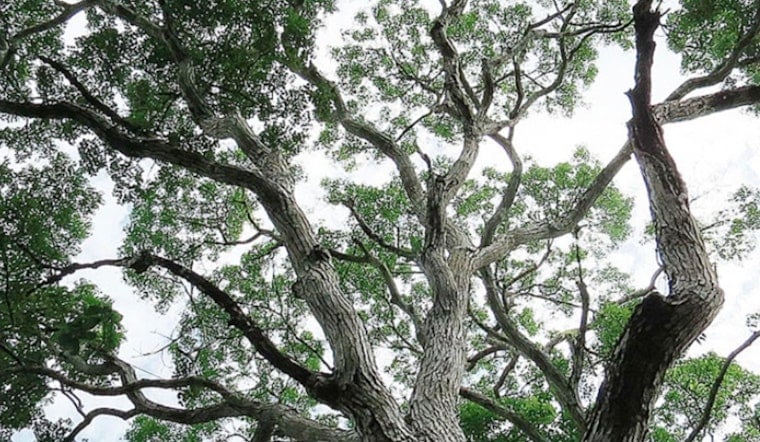
Nearly a dozen mature mahogany trees along Interstate 95 near Northwest 31st Street in Miami were cut down to stumps sometime before Thursday, leaving behind a scene that stunned nearby residents and triggered an investigation by city officials and the Florida Department of Transportation. Photos taken before the cutting showed the mature trees lining the highway corridor, a stark contrast to the bare stumps that remained afterward.
Sandy Moise, a member of Sierra Club Miami, said she was stunned by the aftermath near I-95 and Northwest 31st Street, describing the scene to CBS News Miami as something that felt unreal. “I thought I was witnessing a zombie apocalypse,” Moise said, adding that an investigation into the tree removal is now underway. The trees are a threatened plant species in Florida and are protected under state law, according to the outlet's report.
West Indian mahogany, or Swietenia mahagoni, is formally listed on Florida's Regulated Plant Index as a state-threatened species, and unauthorized harvesting, destroying, or transporting of the tree is strictly prohibited under Florida Statute § 581.185. South Florida sits at the northernmost edge of the species' natural range, where wild populations were historically decimated by heavy logging before the 1900s for furniture-making and shipbuilding, according to the Florida Native Plant Society. That history has left cultivated urban trees like the ones along I-95 as crucial refuge populations for the species.
A License Plate and an Open Question
Miami officials say they have a license plate connected to the tree removal and are working with FDOT to identify who is responsible. Alexandra Acero told the station the tree removal seemed strange, and that the vehicle involved did not appear to be city-owned. She said she hopes officials are able to identify those responsible for the cutting.
Miami Commissioner Christine King said the trees were cut down illegally and confirmed the property falls under FDOT's jurisdiction rather than the city's. Per the same report, FDOT had not ordered the removal of the trees. King said whoever removed the trees must be held accountable, adding that severe penalties must be imposed and that replacement of the trees is non-negotiable.
Roadside tree removal along interstates is sometimes tied to improving visibility for commercial signage. Under Florida Statute § 479.106, unauthorized cutting or removal of trees on state highway rights-of-way carries administrative penalties of up to $1,000 per sign facing, along with mandatory mitigation replanting. FDOT regulates flora within its rights-of-way and requires formal approval before any clearing occurs. Whether the I-95 cutting was connected to nearby billboard visibility or another commercial interest remains an open question in the investigation.
Why These Trees Matter for Storm Resilience
West Indian mahogany is a fast-growing shade tree capable of reaching 40 to 60 feet in height with a 50-foot canopy spread, and it carries the highest possible hurricane wind-resistance rating among South Florida trees, according to UF/IFAS Gardening Solutions. Its deep root system is one reason the species is frequently chosen for highway medians, where trees must withstand extreme storm winds. Losing nearly a dozen mature specimens along a high-speed corridor erases decades of canopy growth and storm protection in a single stroke.
The incident lands as Miami-Dade County pushes to expand its urban tree canopy. A Draft Urban Forestry Plan released in July 2024 set a target of 30% countywide canopy coverage to combat extreme urban heat and manage stormwater runoff, as Hoodline previously reported. Losses like the one along I-95 work directly against that goal, since transportation corridor canopy is part of what the county is trying to protect and expand.
Part of a Broader Pattern
This is not the only recent case of alleged illegal tree removal in Miami. In August, Miami police launched a criminal forgery investigation after tree service workers allegedly used fraudulently forged consent documents to cut down a 100-year-old oak tree in the Buena Vista West neighborhood, a case Hoodline covered in its report on the forged oak tree removal. Local residents and authorities appear increasingly willing to pursue criminal charges for unauthorized canopy destruction rather than treat it as a routine code violation.
Within Miami city limits, unpermitted tree removals are capped at $500 per tree for residential property owners and $1,000 per tree for commercial developers, with fine revenue going into the city's tree mitigation trust fund, according to the Coconut Grove Spotlight. Local urban forestry advocates have criticized those capped fines as an insufficient deterrent against deliberate illegal cutting. But because the I-95 trees stood on state right-of-way rather than municipal or private land, the case falls outside that city fine schedule and instead hinges on state statutes governing threatened species and highway vegetation management.
State law also complicates enforcement in a different way. Under Florida Statute § 163.045, local governments are preempted from requiring permits or mitigation for tree removals on single-family residential property when an arborist documents safety risks, according to UF/IFAS Extension. That preemption does not extend to public rights-of-way or state-threatened species on state land, which is why the I-95 mahoganies remain squarely under FDOT and state oversight rather than the more permissive residential rules.
Rebuilding what was lost will take far longer than it took to cut it down. Miami-Dade County's 25-year-old Adopt-a-Tree initiative has distributed nearly 250,000 free native saplings to homeowners to help rebuild lost canopy, as Hoodline detailed in its coverage of the program's recent giveaway event. Even with that kind of investment, replacing fully mature shade trees with young saplings takes decades to recover the ecosystem services the I-95 mahoganies once provided.



.jpg)