

























































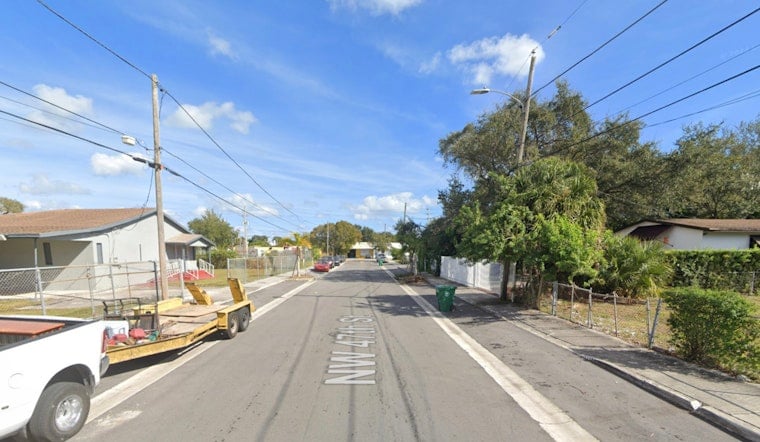
Stefan Pizzi and Adriana Ocampo say they came home to find their backyard oak tree gone, and now they say the paperwork that allowed it to happen was forged. The couple, who own a duplex at 220 Northwest 47th Street in Miami's Buena Vista West neighborhood, say tree service workers cut down a 100-year-old oak that stood 45 feet tall with a canopy spanning more than 50 feet. What started as a neighborhood dispute over a beloved shade tree has since escalated into a criminal forgery investigation by the Miami Police Department.
According to reporting by The Real Deal, tree service workers entered Pizzi's backyard in April 2025 and removed the oak along with roughly four dozen smaller trees along the property line. Pizzi alleges that the signatures on JF Property Holdings' consent letter for the removal permit were forged, and he says he and Ocampo never authorized the oak's removal. The Real Deal's Francisco Alvarado reported that JF Property Holdings had submitted a notarized document to the city to obtain the tree removal permit. Albert Serra and William Rios are named as principals of JF Property Holdings, which had developed a two-story cube home next door at 226 Northwest 47th Street.
The forgery allegations aren't limited to Pizzi's property. Cristobal Flanagan said in December 2024 that his father, Thomas Flanagan — who was living in Chile at the time — never signed a letter consenting to the removal of a Brazilian pepper tree, according to the same report.
A Lawsuit Narrowed, But Not Dismissed
Pizzi and Ocampo, who bought the three-bedroom property for $655,000 in 2023, sued JF Property, William Rios, Ricardo Cabrera, RC Construction and Investments, and Jorge Rousseau, seeking $1.5 million in damages. In July, Miami-Dade Circuit Court Judge Daryl Trawick partially dismissed the suit, ruling that Pizzi and Ocampo lacked standing on the fraud and forgery count because the alleged fraud — submitting a forged document to obtain a city permit — was legally committed against the City of Miami rather than the homeowners themselves, the outlet reported. Trawick did allow the trespassing and conversion counts to proceed.
Pizzi told the outlet the home's interior temperature exceeded 90 degrees after the tree canopy disappeared, and he said the house became noticeably hotter without the shade the oak once provided. He also said the tree removal left the duplex vulnerable to termites, which then infested the property. Rios has said JF Property held a valid tree removal permit and has allegedly offered to plant new trees on Pizzi's property; in a message cited by the outlet, Rios allegedly wrote that ultimately, they are just looking to find a resolution satisfactory for all parties. Jason Giller, who represents Rios and JF Property Holdings, called Pizzi's claims bogus.
Miami Police Open a Forgery Investigation
Pizzi filed a criminal complaint against JF Property's principals in April, and the Miami Police Department is now investigating the alleged forgery, according to the report. Under Florida law, both forgery and uttering a forged instrument are third-degree felonies, each carrying up to five years in state prison and a $5,000 fine upon conviction, according to the Sammis Law Firm. City code requires a permit from Miami's Environmental Resources Division before any specimen tree — defined under Chapter 17 as one with a trunk diameter of 18 inches or greater — can be removed, relocated, or heavily pruned, per the City of Miami.
The company behind the project has deep roots in Miami's spec-home market. LVR Investments, managed by William Rios and Lisset Vazquez-Rios, holds a portfolio of 48 residential properties and vacant lots across the city, underscoring the scale of development activity tied to the builder.
A Citywide Pattern of Contested Permits
Pizzi's case lands amid mounting scrutiny of how Miami approves tree removals. Reporting by WLRN found that the city's Building Department quietly began shifting toward paperwork-focused approvals with fewer pre-approval site visits starting in early 2024, a change critics argue weakened oversight and allowed flawed or fraudulent applications to slip through. Environmental advocacy group Miami Canopy Watch has tracked 172 tree permit applications currently in the city's processing pipeline, with 14 approved removal permits under active administrative appeal by residents.
Buena Vista isn't the only Miami neighborhood pushing back. In June, developer Grupo T&C withdrew its application to cut down four native, state-threatened mahogany trees at its Edge House project in Edgewater after community rallies and a formal appeal from neighborhood preservationists. Research from Florida International University, cited during community demonstrations, has highlighted how mature urban tree canopies help reduce extreme heat and absorb stormwater runoff in Miami neighborhoods — a point Hoodline previously reported on when residents petitioned City Hall for a moratorium on developer tree removal permits.
In May, the Miami City Commission voted to establish a 10-member Tree Ordinance Advisory Committee, appointing two residents per commission district to partner with Florida State University's Consensus Center on a full overhaul of the city's tree preservation laws. Buena Vista, where the disputed property sits, is a historic Miami neighborhood dating to the 1920s known for its mature banyan and oak canopy near the Miami Design District — the kind of tree cover now at the center of a citywide reckoning over development, heat, and public trust in the permitting process.





