

























































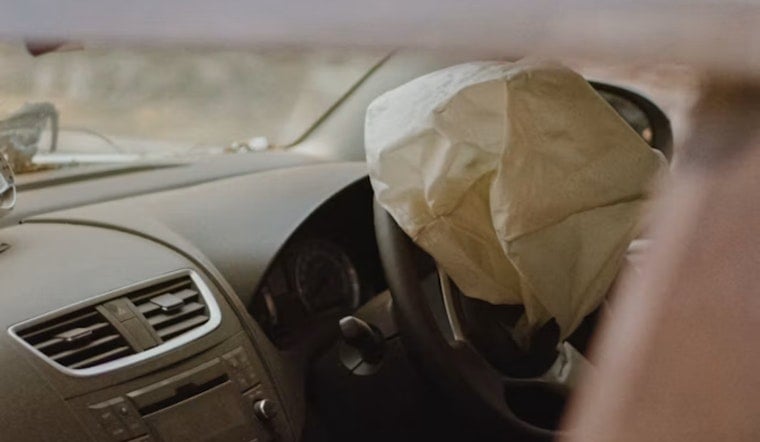
A motorist was killed in Dallas on Aug. 27 when a banned Chinese-made replacement air bag inflator malfunctioned in what should have been a survivable crash, becoming the 11th documented U.S. death tied to the substandard component and the first fatality reported since federal regulators outlawed the parts in April 2026. The National Highway Traffic Safety Administration said the driver was killed in a 2018 Chevrolet Equinox.
The crash brings the total number of incidents involving the inflators to 13, according to The Detroit News, which reported that the banned inflators had already been linked to deaths in 10 crashes before the Texas death. The inflators were made in China by Jilin Province Detiannuo Automobile Safety System Co. Ltd., known as DTN, and NHTSA has said they malfunctioned in otherwise survivable crashes, sending large metal fragments into drivers' chests, necks, eyes and faces.
General Motors vehicles account for the bulk of the toll. GM-related crashes now number 10, involving eight fatalities and two serious injuries, and those incidents mostly involved Chevrolet Malibus, the report notes. The last fatal crash before the Texas death involved a 2020 Chevrolet Malibu in Clarksdale, Mississippi, in February 2026. GM did not immediately comment on Thursday.
A Pattern Stretching Back to 2023
Incidents involving the inflators were first reported starting in May 2023, and three deaths have also occurred in Hyundai Sonata incidents, the same report states. NHTSA issued an urgent warning to vehicle owners and repair shops in January 2026, and the agency has repeatedly urged owners of vehicles involved in a crash with an airbag deployment since 2020 to have their vehicles inspected.
Federal officials framed the danger in blunt terms. NHTSA said whoever is bringing the inflators into the country and installing them is putting American families in danger, according to the same account. DTN has pushed back on that characterization, stating it cannot be proven that the questioned inflators were manufactured by the company, that it cannot be proven the accidents were caused by defective inflators, and that it has never directly sold the questioned inflators to the U.S. market.
Why VIN Checks Won't Catch These Parts
The reason the danger has proven so hard to track is structural: because DTN inflators enter vehicles as aftermarket replacement parts installed during post-collision repairs rather than as original factory equipment, standard VIN recall lookups cannot alert buyers that a used car contains one, according to Autobody News. NHTSA has said physical inspection by a qualified mechanic is required to verify an airbag unit's origin, since the components are effectively invisible to any digital record search.
NHTSA's investigation found that nearly all documented DTN inflator explosions involved used vehicles with salvage or rebuilt titles that had undergone non-dealership repairs following prior airbag deployments dating back to 2020. That pattern points to a specific vector: cars restored outside authorized dealer networks after an earlier crash, then resold without any indication of what part was installed inside the steering wheel.
Federal regulators have also warned vehicle owners not to try to physically inspect or disassemble their own steering wheels, cautioning that active electrical wiring can trigger lethal high-force deployments during a DIY inspection attempt. Technical guidance NHTSA released in April 2026 noted that affected inflators are stamped with the serial sequence DTN60DB on the cap and carry barcode labels starting with 144415654 on the electrical connector side, markings that remain visible without full disassembly — identification best left to a professional.
An Unprecedented Federal Ban and a Record Verdict
On April 29, 2026, NHTSA issued a mandatory defect recall order banning the importation and sale of DTN60DB inflators, the agency's first forced equipment recall order in more than two decades, according to Vehicle Safety. The move was unusually aggressive for an agency that typically coordinates voluntary recalls with manufacturers rather than issuing forced bans against foreign parts suppliers, and it followed NHTSA's decision in October 2025 to skip its standard Preliminary Evaluation phase entirely and escalate directly to a formal Engineering Analysis given the mortality risk.
The financial reckoning has already begun in civil court. A Broward County, Florida jury awarded $603 million, including $360 million in punitive damages, to the estate of 22-year-old Destiny Byassee in June 2026 after finding DTN liable for her death in an exploding replacement airbag during a minor crash, per Judgments Watchlist. DTN did not send a corporate representative to attend the Florida trial.
The grey market that fed the crisis is also being squeezed. eBay announced in late August that it will ban all sales of standalone airbags and airbag inflators across its platform effective Sept. 24, 2026, following mounting federal scrutiny, as replacement DTN inflators frequently entered the supply chain through online resellers. Industry advisories have noted that factory-certified replacement airbag assemblies routinely cost $1,000 or more, while unauthorized shops and online sellers offered counterfeit modules with DTN inflators for as little as $100 — a price gap that has incentivized budget repair shops and salvage builders to install unverified parts.
Federal safety records show NHTSA received its first formal Vehicle Owner Questionnaire tied to a fatal DTN driver-side inflator rupture in June 2023, following the death of a driver in a 2020 Chevrolet Malibu. The investigation has expanded steadily since, adding fatal ruptures tied to the same component family right up through last week's Dallas crash. A ruptured DTN inflator killed an Oakland karaoke mainstay in Hayward, California, one of the earlier cases that pushed regulators toward the ban now in effect.





