

























































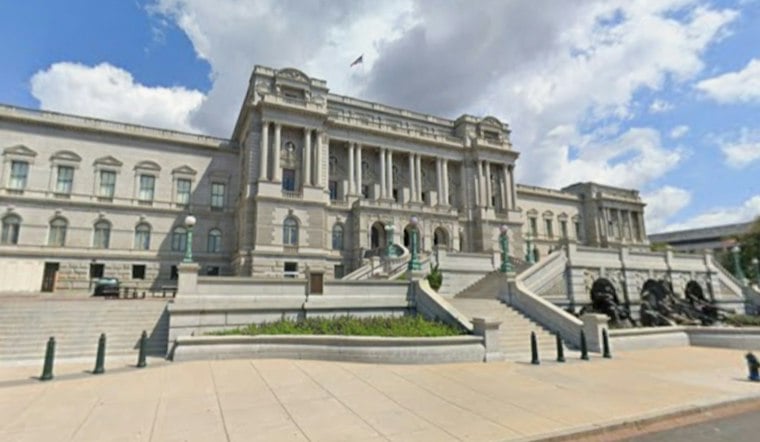
A brick fragment dug from the ground of a former machine shop. A street sign rescued from a ghetto. A map drawn entirely from memory. These are among the few physical traces left of Luboml, a once-thriving Jewish market town now folded into the artifacts of a new Library of Congress exhibition that opened to the public on Thursday, Sept. 17, 2026.
The exhibition, called “Alive in Many Hands: The American Folklife Center at 50,” includes a hand-drawn map of Luboml, an 1873 map, a brick fragment and a street sign, according to Washington Jewish Week. The 19th- and 20th-century items come from the Aaron Ziegelman Foundation Collection, which the Library of Congress acquired in 2002 and which documents everyday Jewish life in the pre-World War II world, per the same report. As reported by the Baltimore Jewish Times, the show also features oral history interviews collected by the Aaron Ziegelman Foundation, recounting the experiences of people who once called Luboml home.
Nicole Saylor, director of the Library of Congress American Folklife Center, said the items included in the exhibition rose to the top because of their historic importance and cultural memory. “Very few things remain physically from this place that no longer exists,” Saylor said, according to Washington Jewish Week.
A Market Town That Grew Into a Jewish Stronghold
Jews first settled in Luboml, located about 200 miles southeast of Warsaw, in the latter half of the 14th century, the exhibition materials show. The town became a prosperous market center, and by 1897 its Jewish population had grown to more than 3,200 — almost three-fourths of the total population, per Washington Jewish Week. A separate accounting from sztetl.org.pl puts that same 1897 figure at 3,247 residents, or 72.6% of the town, and notes that by 1921 Luboml's 3,141 Jewish inhabitants made up 95% of the population.
Jewish residents eventually made up more than 90% of the population and sustained an active cultural and religious life, the exhibition materials indicate. Zionism grew increasingly popular in town, and Luboml supported two Hebrew-language schools along with a small yeshiva, according to sztetl.org.pl. The Jewish Virtual Library describes the interwar years as a period of astonishing cultural ferment and change in the shtetl, as secular and Zionist influences grew alongside older religious traditions.
Escape, Occupation and a Single Day of Slaughter
As antisemitism and the Nazi threat disrupted life in Luboml during the 1930s, some Jewish residents emigrated to Palestine and others to the United States, per Washington Jewish Week. German forces established a ghetto in Luboml on Dec. 5, 1941, according to U.S. Holocaust Memorial Museum records documenting survivor Nathan Sobel, who was born in the town in January 1929.
German Nazis carried out killings in 1941, and in October 1942 subjected the town's Jewish population to a final extermination over one week. More than 1,000 Jews were fatally shot on Oct. 1, 1942, Saylor said, per Washington Jewish Week — a massacre that brought an end to six centuries of Jewish life in Luboml. Only 51 Jewish residents out of a population of about 4,000 survived the Holocaust, according to Saylor's account in the same report. Luboml is now part of Ukraine, and no Jews currently live in the town.
Objects Recovered From a Vanished Place
Among the artifacts is a Nazi-era directional sign that the Nazis had whitewashed and posted on the first house outside the Jewish ghetto at an intersection — described as the only one from Luboml known to still exist, Washington Jewish Week reports. Few maps of the town survived at all; the exhibition pairs the 1873 map with a second one drawn entirely from memory, depicting Luboml as it looked in 1939.
The brick fragment on display traces back to 2003, when former Luboml residents returned to the town to film a documentary and photographer Mikola Dzei dug up two brick fragments on the grounds of a former machine shop, according to the same account. Dzei gave one of those fragments to Abe Getman, who had escaped Luboml in 1942 and lost many family members to the Nazi occupation.
The broader Ziegelman collection extends beyond what's on display in Washington. Materials about the collection are available on Luboml.org. A companion page on the same site provides additional information.
Remembering a Town Through Documents and Stamps
Some of the surviving relics of Luboml predate the war entirely. The town's prewar history is also documented through surviving materials.
Communities like Luboml also live on through memorial volumes about their fallen hometowns. That tradition of memory-keeping mirrors what the Library of Congress exhibition now attempts with Luboml's maps, oral histories and salvaged fragments — an effort to keep a vanished place, in Saylor's words, alive in cultural memory even though almost nothing of it physically remains.



