

























































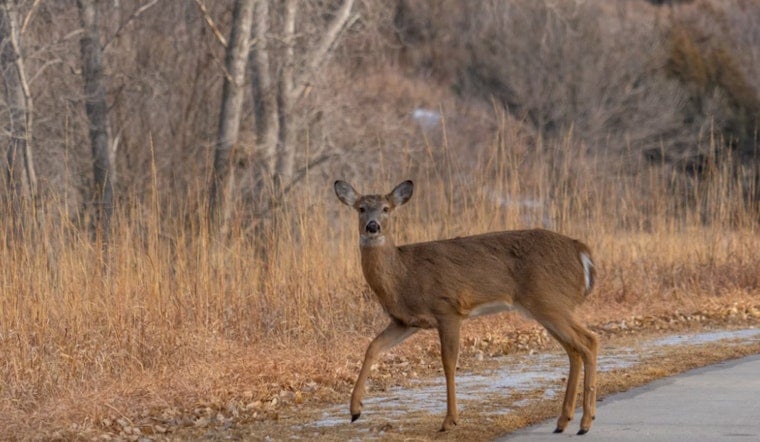
A Trinity County sheriff's deputy responding to a late-night vehicle-versus-deer call got the shock of his shift when the doe he believed was dead suddenly sprang up and bolted into the woods. Dashcam video of the August 28 encounter, released by the sheriff's office, captures the deputy's startled reaction as the animal that appeared lifeless moments earlier took off running.
The footage, first reported by FOX 26 Houston, shows the deputy approaching what looked like a dead doe along a rural East Texas roadside during the nighttime patrol call. According to NTD Television, the incident occurred in Trinity County, Texas, and was released by Sheriff Woody Wallace as part of the department's routine practice of sharing dashcam video and community updates with rural East Texas residents. In the footage, the deer that had appeared motionless suddenly reveals itself to have been playing possum all along, springing to life and scaring the deputy before disappearing into the trees.
Why the Deer Looked Dead in the First Place
The startling turnaround has a biological explanation. Deer that are struck or grazed by vehicles frequently experience what's known as tonic immobility, or severe physical disorientation, a fear-induced freeze response or concussion that can make an animal appear dead before it abruptly regains consciousness, according to research shared on Facebook. Wildlife handlers note that stunned deer often lie fetal or motionless before suddenly bolting, a pattern that closely matches what unfolded on the Trinity County roadside.
The Trinity County case is not the first time this phenomenon has caught law enforcement off guard. In a widely reported 2016 incident in Adams County, Wisconsin, a driver loaded what he believed was a dead deer into his car trunk, only for the animal to wake up and bound into the woods the moment a responding deputy opened the trunk, according to WBIR. Squad car footage from that call similarly captured the deer's unexpected escape, underscoring that a stunned deer reviving during a police response is a known, if rare, occurrence in rural law enforcement.
What Texas Law Says About Roadside Deer
The moment also touches on a legal gray area familiar to Texas drivers. It is illegal under state law for drivers or residents to harvest, possess, or take home roadkill game animals, including white-tailed deer, according to 95.5 KLAQ. Texas updated its wildlife laws in 2007 specifically to close a loophole that let poachers claim illegal kills were simply roadkill.
Separately, Texas Parks and Wildlife Code Section 61.060 provides a legal defense for humanely dispatching a mortally wounded game animal, or one behaving erratically in a way that poses a substantial risk of serious harm, per FindLaw. That defense only applies if the animal wasn't mortally wounded through the person's own illegal conduct. The Texas Parks and Wildlife Department instructs motorists who come across injured roadside deer not to approach or touch them, since the animals' behavior can be unpredictable, and to instead notify game wardens or sheriff dispatch. The agency also notes that deceased animals on state highways are cleared by the Texas Department of Transportation rather than game wardens.
A Common and Costly Hazard on Texas Roads
Encounters like the one in Trinity County are far from rare. Texas Department of Transportation records show the state logs between 8,000 and 18,000 reported animal-vehicle collisions each year, with the numbers climbing during the autumn mating season from October through December as reduced daylight and seasonal animal movement raise the risk on rural roads. Nationally, the toll is steep: Insurance Institute for Highway Safety data shows animal-vehicle crashes cause roughly 200 human deaths and more than a billion dollars in property damage across the country annually, with white-tailed deer involved in the vast majority of fatal incidents. Federal crash data also indicates nearly half of all fatal collisions involving animals or fixed objects happen at night.
AAA Texas traffic safety guidance urges drivers not to swerve when a deer appears in the road, since swerving on rural two-lane roads often causes worse crashes than simply hitting the animal. The organization instead recommends maintaining lane control and braking firmly, noting that swerving into oncoming traffic or off the shoulder accounts for a large share of severe deer-related injury crashes. For the Trinity County deputy, the encounter ended without harm, but it served as a reminder that what looks still and lifeless on a dark roadside isn't always what it seems.



