

























































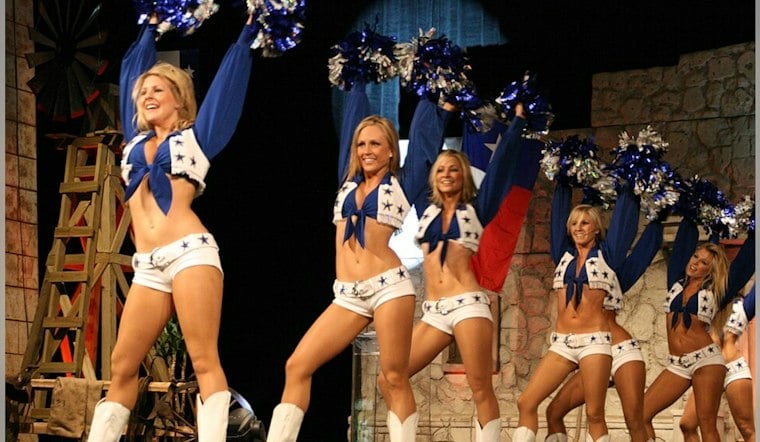
Dee Brock, the founding director who transformed a handful of pom-pom-waving teenagers into the internationally famous Dallas Cowboys Cheerleaders, died Wednesday morning at 96. Her grandson, Craig Brock, shared the news on social media, according to a family announcement. Brock had spent decades as both a sports entertainment pioneer and a career Texas educator before her passing.
Brock was an Oklahoma native who grew up in East Texas, and she was working as a teacher and part-time model when Dallas Cowboys general manager Tex Schramm approached her in the 1960s about forming a new kind of cheerleading squad, according to CBS Texas. Before that all-female squad took shape, Brock had already been directing the CowBelles & Beaux, a co-ed group of Dallas-Fort Worth high schoolers formed in September 1961 who wore white button-down shirts, as reported by WFAA. That earlier group gave Brock the foundation she would later build into a national phenomenon.
From a Legal Pad Sketch to a Global Uniform
The station's report notes Brock brought the CowBelles & Beaux to Super Bowl V in January 1971, marking the group's first appearance on a national championship stage. The uniform that would eventually become one of the most recognizable outfits in American sports started as a rough concept Brock sketched on a legal pad, according to documentary director Greg Whiteley, who interviewed her for the Netflix series America's Sweethearts, which chronicles a Dallas Cowboys Cheerleaders season. Dallas designer Paula Van Wagoner then formalized that blue-and-white design, and seamstress Leveta Crager hand-sewed the garments for more than two decades, per the same account detailed in a piece from Medium writer Makenna Jonker.
Brock also worked to convince Schramm to racially integrate the squad, a decision she pushed through in 1965 during a turbulent era for Texas civil rights. Sixteen-year-old Eunice Taylor-Cicero joined as one of the squad's first two African American cheerleaders as a result, according to firsthand testimony reported by KLTV. The move placed Brock's game-day entertainment squad ahead of much of the broader culture around it at a time when integration in Dallas remained deeply contested.
A Parallel Career Building Texas Education
Cheerleading was never Brock's only calling. In 1966, while teaching at Thomas Jefferson High School in Dallas, she helped establish El Centro College, which opened as the first campus of the Dallas County Community College District, according to Wikipedia. Brock held a PhD in literature, having earned her bachelor's degree in 1950 and master's degree in 1956 in English literature from the University of North Texas before completing her doctorate in education there in 1985.
After stepping away from the Cowboys, Brock worked as senior vice president of educational programming at PBS. Her work in educational programming continued her career in education beyond Dallas.
A Tyler Luncheon and Earlier Tribute
A Women’s History Month luncheon was held in Tyler. An earlier tribute came in June 2022, when current Dallas Cowboys Cheerleaders Director Kelli Finglass and active team members visited Brock at her East Texas home to mark the team's 60th anniversary, presenting her with a bedazzled lifetime achievement game football.
Finglass, who has held a leadership role with the squad since 1991, said Brock's leadership, imagination and commitment to excellence shaped the team and inspired generations. The Dallas Cowboys Cheerleaders organization honored Brock as its founding director following news of her death. Whiteley, the documentary director who spent time interviewing Brock for America's Sweethearts, said she deserved a place in the Cowboys Ring of Honor.
A Missing Name in the Ring of Honor
Whiteley's comment lands against a stark fact: the Dallas Cowboys Ring of Honor, created in 1975 to recognize individuals who significantly shaped the franchise, currently includes zero female inductees, according to Wikipedia. Brock built a squad that became one of the most recognized brands in American sports and helped integrate that squad during a fraught period in Texas history, yet the franchise's formal honor roll has never included a woman.
Her passing arrives as the modern Dallas Cowboys Cheerleaders remain a recognizable entertainment brand. But those later chapters trace back to the squad Brock first assembled, uniformed from a sketch on a legal pad and, from the start, built to look more like the community it represented than the era around it demanded.





