

























































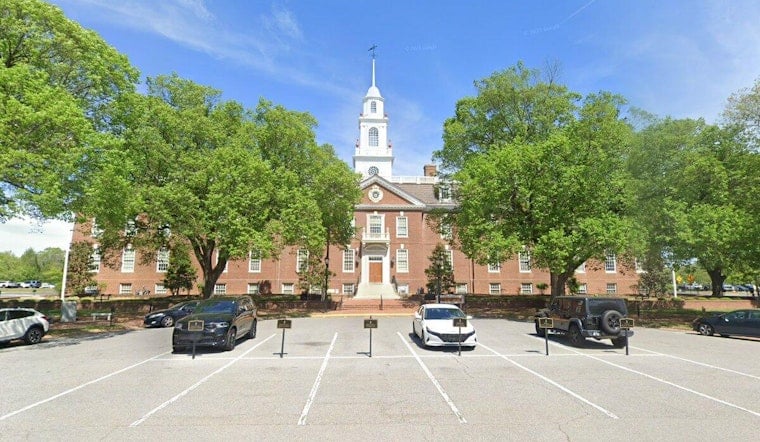
Governor Matt Meyer signed three gun safety bills into law Thursday, creating a new state dealer licensing system, a lawful path for owners of unserialized firearms to register them, and a permanent state office dedicated to gun violence prevention. The package touches nearly every corner of Delaware's firearm retail and enforcement landscape, from how gun shops keep records to what happens to so-called ghost guns already in circulation.
Under Senate Bill 300, firearm stores that sell or transfer more than 10 guns a year must now obtain a new state dealer license, complete mandatory state police training every two years, install surveillance cameras that can clearly capture every gun buyer and seller, and keep detailed records of all sales and transfers, according to NBC10 Philadelphia. The dealer licensing requirement does not take effect until 2029, giving retailers years to comply, though two of the three new laws took effect immediately upon signing.
State Senator Dave Sokola, a Democrat from Newark, has pointed to a stark staffing gap behind the push: just three ATF agents are responsible for overseeing Delaware's 137 federally licensed firearm dealers, he said. That thin federal presence tracks with a 2023 Department of Justice Inspector General report cited during legislative debate, which found more than 2,000 active federal firearm licensees nationwide had gone over a decade without an ATF compliance inspection while the agency revokes less than 1% of dealer licenses annually, according to the Delaware State House Majority Caucus.
Local Sales Data Fuels the Push for Oversight
ATF tracing data released by state officials showed that of 6,626 crime guns recovered in Delaware between 2017 and 2021, roughly two-thirds originated from in-state dealers, and nearly 62% were recovered within 25 miles of where they were sold, per the Delaware Senate Democrats. The same data set showed Delaware supplied 12.2% of crime guns recovered in Maryland and 8.9% of those recovered in Pennsylvania during that period, underscoring the state's role as a regional source in Mid-Atlantic gun trafficking.
Supporters say the measures, taken together, will make Delaware safer. Meyer framed the effort as deliberate rather than incidental, saying, “These three bills are not an accident it's a strategy.” He also pushed back on criticism that the law targets legitimate business owners, saying, “This is not about putting law abiding dealers out of business. This is about protecting families and our communities.”
Gun Shop Owners and Advocates Push Back
Not everyone is on board. The Delaware State Sportsmen's Association opposed the new measures, arguing they will burden responsible gun owners and gun stores without reducing violent crime. Jeff Hague, the group's president, argued the state should instead prosecute more existing gun charges rather than layering on new dealer rules.
Hague also raised concerns about how the dealer law assigns responsibility. He said dealers should not ultimately be held responsible if customers later illegally give or sell guns to someone else, noting that federally licensed dealers already require customers to complete the necessary background-check paperwork. He argued the dealer law effectively requires FFLs to predict a purchaser's future behavior, and he questioned whether aspects of the laws are constitutional. Hague also argued the new measures will not stop people who are intent on committing crimes in the first place.
The bill's path to Meyer's desk included notable compromises. During negotiations in June, lawmakers amended Senate Bill 300 to strip out a proposed state firearm registry provision and settled on a flat annual dealer licensing fee of $300, changes made to address pushback from firearm retailers and gun-rights organizations, according to Spotlight Delaware. Opponents had argued the original registry provision was unconstitutional and would have placed heavy financial burdens on small shop owners.
A Compliance Path for Ghost Gun Owners
The second law, House Bill 418, creates a lawful path for people who possess unserialized firearms, frames, or receivers, commonly known as ghost guns, to bring them into compliance. The law establishes a six-month window during which individuals who legally acquired those guns before the law's enactment can either have them serialized by a federally licensed dealer or render them permanently inoperable, per CoastTV. Delaware first banned ghost guns in 2021, but the new statute sets clear legal definitions for permanent inoperability to close enforcement gaps left by the earlier ban.
Lawmakers introduced the ghost gun bill partly to provide what Spotlight Delaware describes as an exit path for firearm owners amid ongoing federal litigation in *Rigby v. Jennings*, a case challenging Delaware's ban on unserialized firearms under the Second Amendment. Several of the state's gun control statutes enacted in recent years currently face pending challenges in federal court, the outlet reports.
Violence Prevention Office Gets Permanent Status
The third measure, House Bill 369, formally codifies Delaware's Office of Gun Violence Prevention and Community Safety in state statute, housing it within the Department of Safety and Homeland Security, according to WBOC. The office was originally created by executive order in May 2025, and codifying it in law is intended to secure its funding and authority regardless of future administrations, since executive orders can be reversed by a governor's successor.
The new laws build on a broader push in Delaware to tighten firearm regulations that stretches back at least to 2024, when then-Governor John Carney signed a permit-to-purchase law requiring residents to obtain a permit before buying a handgun, a law that survived a federal dismissal motion that October, according to Delaware Public Media. Despite that multi-year legislative push, Everytown for Gun Safety ranks Delaware 10th nationally for gun law strength while the state still records an average of 133 firearm-related deaths per year, a toll close to the national average.
Local enforcement of Delaware's existing gun statutes has continued to make headlines even as the new laws take shape. Hoodline previously reported on a New Castle County foot patrol that netted a loaded handgun on a teen, and on a multi-agency sweep that resulted in over 100 arrests across Delaware and Maryland. Those cases illustrate the on-the-ground enforcement backdrop against which the new dealer licensing, ghost gun compliance, and violence prevention statutes now take effect.


