

























































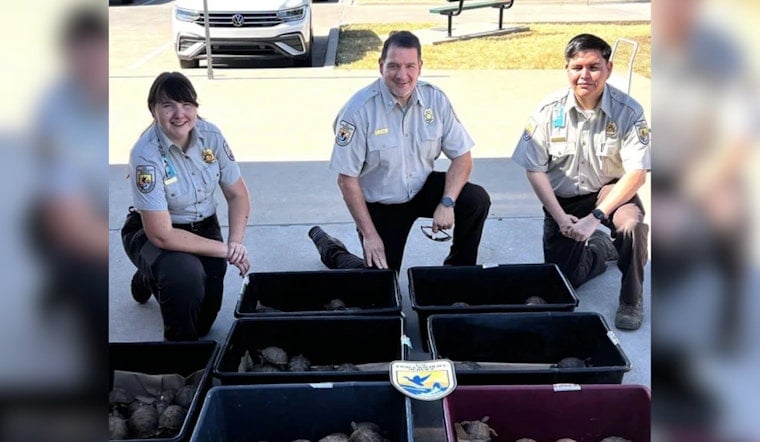
A FedEx store employee in Denton, Texas, flagged an unusual walk-in shipment attempt this week, and what turned up inside stunned local animal control officers: 191 live turtles and tortoises, according to the shelter, allegedly bound for China. City of Denton Animal Services took the animals into custody and quickly looped in federal wildlife authorities, kicking off an investigation into who tried to send them overseas and why.
Denton Animal Services says FedEx staff contacted the shelter about the attempted shipment, and the animals were later transferred to the Dallas Zoo, which is now safely housing them, according to CBS News Texas. As reported by FOX 4 News Dallas-Fort Worth, Denton Animal Services initially recovered the 191 animals on September 1, after FedEx store staff reported that an unidentified individual had attempted to ship the live turtles and tortoises through their location to China. The identity of the person who dropped off the package has not been made public.
Why FedEx Flagged the Package
The attempted shipment ran headlong into FedEx's own shipping rules. Under FedEx's live animal shipping policies, live reptile shipments are restricted to pre-approved commercial business accounts using specialized Priority Overnight service, and walk-in retail customers are prohibited from shipping live animals at store locations. That corporate compliance rule appears to be exactly what tipped off employees at the Denton store and prompted them to alert the shelter rather than process the package.
Once notified, the City of Denton Animal Services took the turtles and tortoises into custody and contacted the U.S. Fish and Wildlife Service, which has since opened an investigation. Denton Animal Services described the episode as “business not as usual,” and said the rescue shows how its animal services team supports the community. The shelter thanked the U.S. Fish and Wildlife Service for its quick support and partnership, and expressed gratitude toward what it called animal welfare colleagues who help coordinate responses in unique situations.
A Familiar Pattern for Federal Wildlife Investigators
The Denton case fits into a broader pattern federal agents have been chasing for years. Court records reviewed in connection with a related Department of Justice case show that federal agents working under U.S. Fish and Wildlife Service’s Operation Terrapene intercepted 222 packages containing roughly 850 native box turtles bound for Hong Kong, where rare North American turtles can fetch black-market prices up to $2,000 per animal. Investigators in past cases have found smugglers stuffing live turtles into taped socks inside shipping boxes to keep the animals still and avoid detection, according to federal court filings from separate U.S. Fish and Wildlife Service prosecutions.
The stakes for anyone caught exporting wildlife illegally are steep. Under the federal Lacey Act, exporting, transporting, or falsely labeling wildlife in violation of state or federal law is a federal offense punishable by up to five years in prison, fines as high as $250,000 for individuals or $500,000 for corporations, and asset forfeiture, according to the Animal Legal & Historical Center. In December 2025, the Department of Justice reported that a federal judge sentenced a smuggler to two years in prison under the Lacey Act for mailing hundreds of live turtles and snakes to Hong Kong in boxes falsely labeled as plastic toys.
State Protections and the Scale of the Trade
Texas law adds another layer of protection for the animals potentially involved. Under Texas Parks and Wildlife Department regulations, commercial collection and sale of native freshwater turtles from public waters is illegal, and species such as Eastern box turtles are fully protected from collection or possession without specialized state permits. The scale of the broader export trade is staggering: a Texas State University study cited in federal wildlife records estimated that 126 million freshwater turtles were exported from the United States to Asian markets between 2002 and 2012, prompting federal inspectors to dedicate roughly half of their illegal turtle monitoring efforts to outgoing overseas shipments.
The ecological toll of that trade compounds over time. Native North American box turtles take 10 to 20 years to reach reproductive maturity, according to biological research cited by wildlife conservation institutions, meaning the removal of wild adult turtles from their habitats inflicts damage that can span generations. Hoodline has previously reported on a related case, in which a Louisiana man poached Florida turtles and funneled them into a separate export scheme.
Dallas Zoo's Role in the Rescue
The Dallas Zoo's involvement is not a first for the institution. The zoo maintains a longstanding conservation partnership with the Turtle Survival Alliance and the Association of Zoos & Aquariums, and previously deployed veterinary staff and provided emergency housing during large-scale international tortoise confiscation operations in 2018. That experience made it a natural landing spot for the 191 animals recovered in Denton while the federal investigation continues.
For now, the exact species involved, the animals' health status, and whether investigators have identified a suspect or a point of origin remain open questions. The U.S. Fish and Wildlife Service's investigation is ongoing, and no charges have been announced in connection with the attempted Denton shipment.




