

























































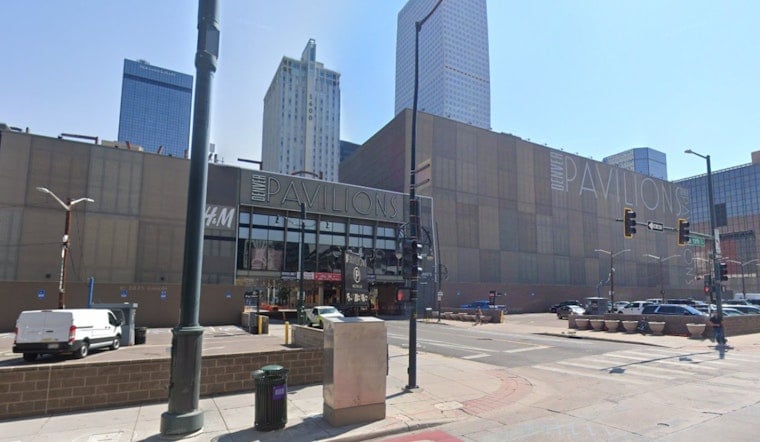
A massive new mural now covers the Denver Pavilions building at Welton and Tremont streets, wrapping up Monday morning after six weeks of round-the-clock work by Denver artist Olive Moya and her team. The finished piece spans 47,000 square feet — roughly the size of 10 basketball courts — making it one of the largest murals in Colorado and the biggest project of Moya's career.
Moya and her six-person crew worked 12-hour days, seven days a week, for six weeks to complete the installation, according to the Denver Gazette. Anne-Laure Lemaitre confirmed the same grueling schedule, and Moya described the moment of finishing in simple terms: “It feels kind of unreal, actually, that it's finally done.” The mural stretches 97 feet tall by 265 feet long on the Tremont Place side and 55 feet tall by 251 feet long along Welton Street, reaching its highest point at 97 feet.
From a Sketch on Paper to a Six-Week Sprint
Work on the wall began July 13, after the Denver Downtown Development Authority board approved removal of a vinyl display in June that had covered the facade. Once the old vinyl image came down, the wall received grid dots and preliminary sketching before painting started in earnest. Moya said she began the design process the old-fashioned way, sketching the concept on a piece of paper before scaling it up to the building's full dimensions.
That scaling process turned out to be the project's biggest hurdle. Moya said translating her vision to such a large scale was challenging, and the most complex part came down to timing — getting the sketch finished while the wall was still being caulked and paint was being mixed around her. The mural itself is filled with swooping lines, shapes, abstract hearts, and multicolored clouds, and Moya said the design incorporates the historical context of the site, including research into why the mall was originally built and an acknowledgment that the land first belonged to Native Americans.
Themes of Change Painted Onto a Gray Corner
Moya said the mural's central themes are change and evolving shapes over time, reflecting what she called the inevitability of change and evolution. She noted the surrounding area is predominantly gray, tan, and beige, and said the new artwork brings more color and life to a corner of downtown that badly needed it. Denverites and visitors have already stopped beneath the mural to admire its scale and take pictures.
Moya's other murals can already be found around the Denver area, including in RiNo, Baker, Cherry Creek, Englewood, Wheat Ridge, and Broomfield. Before this project, she also co-created the indoor mural “I Invent It, My Hands Draw a Cloud” for the Denver Art Museum's Martin Building renovation in 2021, giving her prior experience with high-profile civic commissions before tackling the Pavilions facade. She holds a Bachelor of Fine Arts from Otis College of Art and Design, and describes her style as abstract storytelling, drawing structural inspiration from painter Frank Stella's concept of narrative geometry along with her background in lettering and illustration, according to Mile High CRE.
What Replaced a Tribute to Clyfford Still
The vinyl banner that previously hung on the facade depicted works by Clyfford Still, the pioneering Abstract Expressionist who left his entire uncollected estate to Denver on the condition the city build him a dedicated museum — a promise fulfilled when the Clyfford Still Museum opened in 2011 holding more than 3,100 of his works. Swapping that tribute for Moya's contemporary piece marks a visible shift in how the Pavilions block presents itself to downtown.
The mural's original scope only called for painting the Welton side of the building, and its budget started at $300,000. Costs rose once the Tremont section was added to the project, though Moya declined to provide specifics on compensation, saying only that her team was fairly compensated. An updated total cost for the expanded project was not available at publication.
Part of a Bigger Bet on the Pavilions Block
The mural is one piece of a larger capital improvements package at Denver Pavilions, funded through revenues generated by the property's parking and commercial lease operations. That spending follows the Denver Downtown Development Authority's approval in May 2026 of a $2.7 million allocation out of an $8 million maintenance fund, covering $2.4 million in parking garage repairs, $350,000 in roof fixes, signage updates, and the 15th Street mural replacement, according to the City and County of Denver. The mural was commissioned by the Downtown Development Authority in formal collaboration with Denver Arts & Venues, the municipal agency that oversees the city's public art program.
These upgrades trace back to the Downtown Development Authority's $37 million acquisition of the Denver Pavilions in December 2025, after former owner Gart Properties defaulted on its loan, as Colorado Politics reported. The authority also bought two adjacent surface parking lots for $23 million, consolidating the entire two-block footprint under public ownership. That deal was made possible by Ballot Measure 6A, passed by Denver voters in November 2024, which expanded local tax increment financing and could unlock up to $570 million for future downtown revitalization.
A Facelift Amid Bigger Questions About the Site's Future
The mural's debut lands alongside the final phases of a $170-million-plus overhaul of the neighboring 16th Street Mall, an effort aimed at reversing years of foot-traffic declines and retail vacancies tied to prolonged construction and pandemic disruptions. Together, the projects represent an attempt to inject visible momentum into Upper Downtown Denver even as the Pavilions' long-term future remains unsettled.
An Urban Land Institute advisory panel brought in by city officials in April 2026 called the Pavilions' current open-air mall design obsolete and suggested demolishing much of the structure to make way for a revenue-generating public park and two high-rise residential towers, per the Denver Gazette. That tension between short-term placemaking and radical redevelopment is visible just steps away, where developers this year entered the design phase for the proposed Spiral Tower, a 673-foot twisting observation tower topped by a 70-foot orb planned for a parking lot immediately adjacent to the Pavilions, as per Hoodline. Whether Moya's mural becomes a lasting fixture of the block or a temporary bright spot ahead of a bigger overhaul remains an open question tied to how the city ultimately resolves competing visions for the site.




