

























































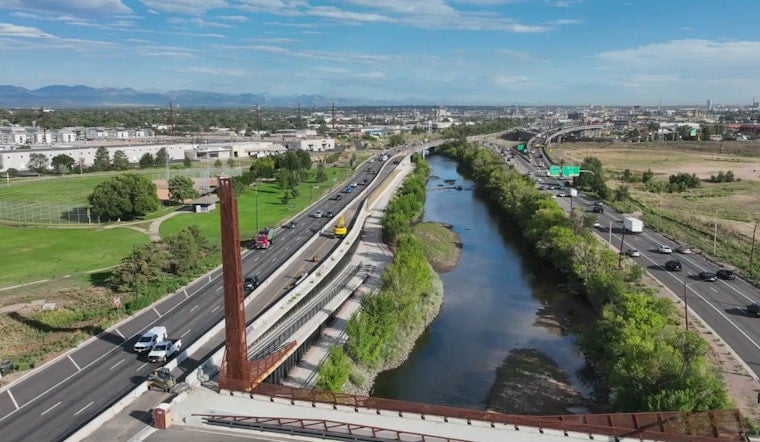
A stretch of the South Platte River Trail that had been closed for six years because of a collapsing timber retaining wall is finally open again in Denver, though city officials say the broader effort to modernize the corridor will keep crews working for years to come. The reopened segment runs between Johnson Habitat Park, at 610 S. Jason St., and Mississippi Avenue, an area where the aging wall had begun leaning over the bike path and made the trail unsafe for users.
The retaining wall, built of timber roughly 50 years ago, began to fail because of natural wear, forcing the closure of the popular trail section back in 2020, according to The Denver Post. Cyclists were rerouted onto Jason Street during the closure, and the city eventually added bike lanes there to accommodate the detour. The $7 million construction project that just wrapped up shored up and widened the South Platte River Trail bike path, replacing the failing wall with what Denver trails planning manager Adam Lind described as a beautiful new concrete retaining wall.
Lind, whose comments were reported by the Post, said the project was everybody's least favorite construction project of the last decade — a reflection of how long the closure dragged on. Phase 1 of the improvements began in September 2025 after being delayed by permitting, design, and approval issues, and Lind said a new concrete trail would open by the end of summer.
A Corridor Built From Disaster, Still Under Repair
The 11.5-mile South Platte River Trail traces its origins back to the catastrophic Great South Platte River Flood of June 16, 1965, which killed 21 people and caused more than $500 million in damage. That disaster prompted then-State Senator Joe Shoemaker to found the Greenway Foundation in 1974 to reclaim the polluted, industrial river corridor into public parkland, according to the Greenway Foundation, which says it has since directed more than $130 million into riverfront revitalization work.
Because the river was channelized and developed decades before modern structural engineering standards existed, aging infrastructure like the failed timber wall remains an ongoing challenge along the corridor. Denver Parks & Recreation is now investing about $35 million in South Platte River Trail projects overall, part of a 13-segment master initiative that the city says will stretch from Carpio-Sanguinette Park near 53rd Avenue in northern Denver south to the Dartmouth Avenue city border, with individual phases coordinated through 2030.
What Full Buildout Still Looks Like
Even with the dangerous section reopened, the trail changes are divided into four sections, and phase 2 will add solar lighting and other amenities. Future improvements planned for the corridor could include upgraded trail cross sections, new bridges and wayfinding signage, and the current project will add up to 12 feet of concrete plus 4 feet of crusher fines — crushed gravel and rock meant to buffer cyclists and pedestrians from the river banks. Once complete, the trail will measure 12 to 16 feet wide, meeting regional trail standards, though the city says full buildout won't be finished until late 2028 or early 2029.
Denver's ability to fund this kind of long-running work traces back to Ballot Measure 2A, a 0.25% dedicated parks and open space sales tax that Denver voters approved in November 2018 to establish the Parks Legacy Fund. Those special revenue funds are voter-approved money the city has used to expand and maintain the park system under its Game Plan for a Healthy City, per the City and County of Denver.
Bigger Plans Downstream
One of the next major phases is a $12.9 million overhaul of the trail between Bayaud Avenue and Phil Milstein Park, split between $1.3 million for engineering design running from 2024 through 2026 and $11.6 million for construction slated for 2026 through 2027, supported by Denver Regional Council of Governments grant funding. That segment is also getting an expansion and includes a new pedestrian and bicycle bridge designed to shift the trail away from Interstate 25, relocating it to the west side of the river. City planners are separately studying the feasibility of a new trail or shared-use path along South Platte River Drive between Grant-Frontier Park and Florida Avenue.
The upgrades appear to be paying off in usage. Denver's Healthy River Corridor Study found that South Platte River Trail segments upgraded with widened concrete paths and improved bicycle and pedestrian infrastructure saw a 10% increase in average daily usage compared to unimproved sections, based on counter data collected in 2020 and 2021. The trail also connects into a larger 35-mile regional network stretching from Chatfield State Park in Littleton, where it's known as the Mary Carter Greenway, north to the Elaine T. Valente Open Space in Thornton — a corridor where the Oxford trailhead alone logged nearly 129,000 users in 2024, according to Visit Denver.
Stakes for Nearby Neighborhoods
The trail's reliability matters most in neighborhoods like Sun Valley, where the city has found 30% of households rely on public transit and 17% carpool for daily commutes — both well above citywide averages — while 58% of households earn less than $10,000 annually. For those residents, off-street trail connectivity functions as a vital transportation link, not just a recreational amenity, making long-term detours onto residential streets like South Jason Street more than a minor inconvenience.
The corridor has also drawn attention for reasons beyond construction and commuting. Colorado Parks and Wildlife officials noted last month that the South Platte River Trail acts as a critical greenway for wildlife, allowing animals like black bears to travel undetected from foothill habitats 15 miles into dense Denver neighborhoods such as Platt Park. Wildlife officers tranquilized a 1.5-year-old male bear in a tree near Harvard Gulch Trail last month, a case Hoodline previously reported underscored just how far the corridor stretches into the city's core.
The South Platte trail work is also part of a wider citywide push. In June 2026, Denver Parks and Recreation launched a similar upgrade on the Goldsmith Gulch Trail near Bible Park, replacing aging asphalt with modern concrete to improve durability and accessibility — one piece of a broader effort to modernize Denver's roughly 100-mile off-street trail system, according to the Denver Regional Council of Governments. That project, like the South Platte work, required temporary detours onto adjacent residential streets while construction was underway.





