

























































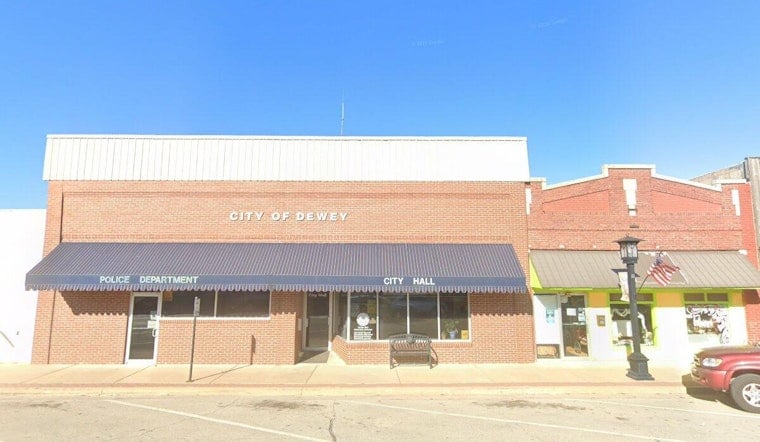
A Dewey police officer died from a self-inflicted gunshot wound at the department's own station on Monday, September 7, just as a Washington County sheriff's deputy arrived to serve the officer with a protective order. The Dewey Police Department, which employs just 11 sworn officers and one civilian staffer in the small Washington County town roughly 50 miles north of Tulsa, closed its station the following day as it worked through the aftermath.
Washington County Undersheriff Jon Copeland confirmed the sequence of events on September 8, telling The Wiley Post that the deputy was in the process of serving the order at the Dewey police station when the officer died. According to News On 6, the Washington County Sheriff's Office says the officer was under investigation for alleged crimes at the time the protective order was served, and the sheriff's office continues its own criminal investigation separately from the state inquiry into the death.
The Washington County District Attorney's Office requested that the Oklahoma State Bureau of Investigation handle the inquiry into the officer's death, and OSBI Public Information Manager Hunter McKee clarified on September 8 that the bureau's role is narrow. Per the same account, the OSBI investigation is strictly limited to examining the circumstances of the officer's death and does not extend to any underlying criminal allegations against him. News On 6 reports the investigation remains ongoing and that more information will be released at a later time.
Station Closes, Support Offered to Deputy
Following the death, the Dewey Police Department closed its station on September 8, rerouting incoming calls while it regrouped. The Wiley Post's report notes that mental health support resources were made available both to the deputy who had been serving the protective order and to others affected within the department.
The scale of the disruption is notable given the department's size. With only 11 sworn officers covering a town of about 3,500 residents, the loss of even one officer under these circumstances represents a significant strain on daily operations, according to background maintained by the Dewey Police Department.
Federal Law Made the Order Career-Ending on Its Own
Separate from the criminal allegations, the protective order itself carried immediate legal weight the moment it was served. Under 18 U.S.C. § 922(g)(8), individuals subject to a qualifying domestic violence protective order are federally barred from receiving or possessing firearms and ammunition, according to the U.S. Department of Justice.
That restriction applies even to active-duty officers. The federal Lautenberg Amendment eliminated the public-interest and official-duty exemptions that once let law enforcement personnel keep carrying a service weapon despite a qualifying order, per the Military Law Center. In practical terms, being served with a qualifying protective order strips an officer of the legal right to carry a firearm for duty purposes the instant it takes effect, meaning that for a department as small as Dewey's, the order alone would have ended the officer's active police duties on the spot.
Not the Town's First Protective-Order Tragedy
This is not the first time the enforcement of a protective order in Dewey has ended in violence. In February 2020, OSBI agents investigated a murder-suicide in the town after a man who had been evicted from a local home under a protective order returned with a firearm, killed a resident, and then died from a self-inflicted gunshot wound, according to Bartlesville Radio.
Nationally, officer suicide has drawn increasing federal attention. The FBI launched its Law Enforcement Suicide Data Collection program in January 2022 under the Law Enforcement Suicide Data Collection Act of 2020, creating a voluntary national system to track suicides and attempted suicides among public safety officers. A 2024 study from the CNA Corporation examining data from 2016 through 2022 found that officer suicide deaths peaked nationally at 234 in 2019, with research consistently showing law enforcement officers face a higher risk of dying by suicide than from line-of-duty violence.
The Dewey case follows other recent instances of OSBI scrutiny of active Oklahoma officers. Hoodline reported last month that state agents were investigating an Alva police officer and his wife over allegations they drained more than $74,000 from an elderly housemate's bank accounts. What specific allegations prompted the protective order against the Dewey officer remains unclear, as officials have stressed that the OSBI's current investigation is confined to the death itself rather than any underlying criminal conduct.



