

























































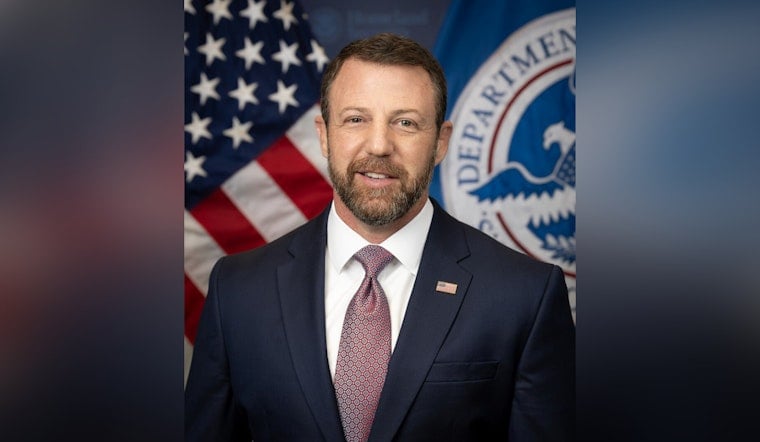
Homeland Security Secretary Markwayne Mullin announced Tuesday that Immigration and Customs Enforcement arrested 2,100 people across New York City, Long Island and the Hudson Valley over roughly a month, in an operation federal officials have dubbed Operation Rotten Apple. The sweep ran from July 27 to August 29, and Mullin used a news conference in New York to frame it as a rebuke of the city and state's sanctuary policies.
According to PIX11, Mullin used the announcement to criticize Mayor Zohran Mamdani and Gov. Kathy Hochul directly, casting the operation as part of a broader Trump administration effort to target New York over its resistance to federal immigration enforcement. ICE Field Office Director Ken Genalo, who joined Mullin at the press conference, described the operation as “precise and effective” and said it was personal to him, per the same report.
A Pattern of Escalating Federal Pressure
Mullin was confirmed by the Senate in a 54-45 vote in March, becoming the ninth Secretary of Homeland Security and succeeding Kristi Noem, according to Ballotpedia. Since taking over, ICE leadership has pushed field offices toward a benchmark of 2,000 arrests per day nationwide, a directive that drove total monthly arrests to 43,138 in June, per TRAC Immigration. Operation Rotten Apple followed closely on the heels of a similar push in the Washington, D.C. region: DHS said its Operation Safe Community in Virginia and Maryland produced more than 1,300 arrests over a 14-day span in August.
DHS's public messaging around these operations has consistently emphasized violent offenders and public safety threats. But national detention data tells a more complicated story. As Hoodline previously reported on record July arrest totals, TRAC data showed that 70.6% of the 65,765 people held in ICE detention nationwide as of July had no criminal convictions at all. It remains unclear what share of the 2,100 people arrested in Operation Rotten Apple had violent criminal histories versus civil immigration violations, and neither Mullin nor Genalo detailed that breakdown at the news conference.
Why ICE Has Shifted to Street-Level Sweeps
The tactical shift toward operations like Rotten Apple traces back to New York's own legal architecture. City law, specifically Administrative Code sections 9-131 and 14-154, bars municipal law enforcement and correctional staff from honoring ICE civil detainer requests unless federal agents present a signed judicial warrant and the individual has a violent or serious conviction within the past five years, according to the Office of the New York City Comptroller. Separately, the state's Protect Our Courts Act bars federal agents from making warrantless civil immigration arrests on people attending, traveling to, or returning from state courthouse proceedings.
Those barriers have pushed ICE away from custodial handoffs and toward direct neighborhood arrests. Research from UC Berkeley's Goldman School of Public Policy found that community arrests grew from 17% to 47% of all ICE arrests nationwide as detainer cooperation declined in sanctuary jurisdictions, a trend the same Goldman School research also links to jurisdictions like New York. A federal judge dismissed a Justice Department lawsuit under Attorney General Pamela Bondi in November 2025 that had sought to invalidate the Protect Our Courts Act, according to the New York Immigration Coalition.
Congressional Scrutiny and Local Fallout
House Judiciary Committee leaders sent letters to New York City district attorneys and police officials in May demanding sanctuary compliance records, asserting that the NYPD honored zero ICE detainers between July 2021 and September 2024, according to the U.S. House Judiciary Committee. The political friction has been building for months; Hoodline has tracked clashes over detainer laws between ICE and Mamdani following the release of a high-profile detainee earlier this year.
The human toll of these operations has extended beyond adults with criminal histories. Federal records analyzed by the Deportation Data Project found that at least 151 children in New York City were taken into custody during routine or high-risk ICE check-ins between January and October of last year, with 26 Federal Plaza in lower Manhattan frequently serving as a site for immediate detentions. It remains unresolved how many of the 2,100 people arrested during Operation Rotten Apple were taken through similar check-in appointments versus street encounters, and how municipal agencies responded to federal requests throughout the five-week operation.





.jpg)