

























































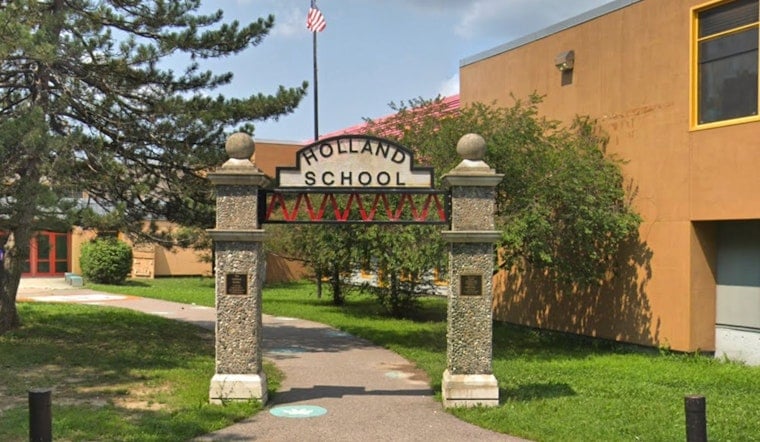
Twelve years after landing among the worst-performing schools in Massachusetts, John P. Holland Elementary School in Dorchester is starting the new school year under full Boston Public Schools control for the first time since 2014. The K-6 school on Olney Street celebrated both the fresh academic year and the formal end of its state receivership, closing a chapter that began when it was labeled a Level 5 school and handed over to outside management.
Holland entered state receivership in 2014 and spent more than a decade under the nonprofit UP Education Network, which operated the school as UP Academy Holland School, according to WBZ NewsRadio. The arrangement placed the school under outside management during receivership.
The Massachusetts Department of Elementary and Secondary Education voted in December 2025 to allow Holland to exit receivership, a decision that followed years of assessment. The school was evaluated on academic progress and matriculation over four years before state officials signed off. Department Commissioner Pedro Martinez reported that Holland met 90 percent of its annual improvement targets in the state's 2025 accountability results, a benchmark the department used to justify ending state control.
A Historic First for Massachusetts Schools
A Historic First for Massachusetts Schools Hillary Casson discussed Holland's successful improvement and return to district governance in an August 2026 opinion article for Commonwealth Beacon. The outcome illustrates one path for a school under state intervention to remain open while improving. By 2026, Holland ranked second among Dorchester schools in English Language Arts growth and stood among the top Boston Public Schools overall for both ELA and math growth, according to the same account.
Standardized assessment data published in August showed Holland's third-grade students outperformed district and state averages in math proficiency among comparable high-needs schools, while the school's multilingual learners exceeded district and state growth averages on ACCESS tests. Principal Amelia Massoud-Tastor said the school saw growth last year and over the last few years, per WBZ NewsRadio. The school later reverted from UP Education Network management to district governance.
A Sharp Contrast With Dever Elementary's Closure
A Sharp Contrast With Dever Elementary's Closure Not every Boston school under state receivership since 2014 reached the same outcome. Paul A. Dever Elementary School, which entered state receivership around the same time as Holland, was closed by Boston Public Schools in June, the Dorchester Reporter reported. The divergent paths of the two Dorchester schools underscore how uneven the results of state intervention have been across the district.
Boston Public Schools Superintendent Mary Skipper and Mayor Michelle Wu both welcomed students back to Holland for the new school year. Wu noted that the school had replaced pencils with water bottle stickers because students no longer recognized what pencils were, a detail she shared while marking the occasion. The transition also included exit assurances and district monitoring for the school.
Wider Boston School Performance Still Lags
Holland's turnaround arrives against a sobering backdrop. More than 40 Boston Public Schools continued to perform in the bottom 10 percent of public schools statewide as of 2026, according to Commonwealth Beacon. That figure raises open questions about whether district leadership can replicate Holland's practices elsewhere, and how Boston Public Schools will manage the new exit assurances framework now governing the school's operations.
Holland was not the only Boston school to see its state status shift around the same time. At the December 2025 state board meeting where Holland's receivership exit was announced, the state education department also declared that Boston's Dearborn STEM Academy in Roxbury was transitioning out of underperforming status, according to the Boston Teachers Union. Boston Public Schools previously rolled out a special education and inclusion overhaul amid state takeover fears, part of a broader push to meet state benchmarks across the district.




