

























































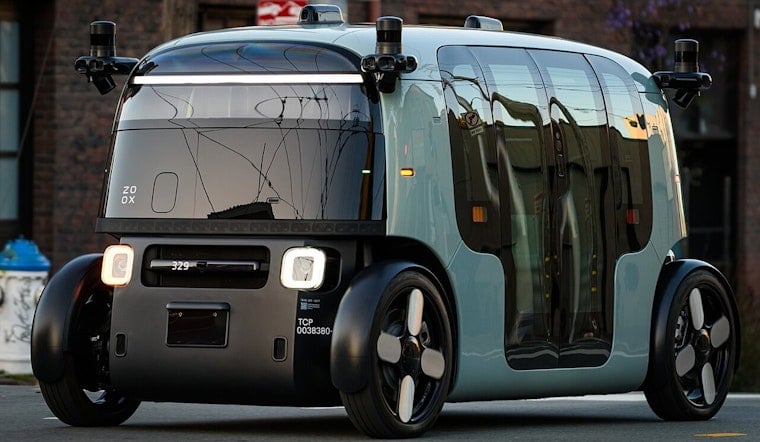
A driverless Zoox vehicle was struck from behind by a Ford 4Runner at the intersection of Decatur Boulevard and Russell Road around 11 a.m. on August 25, with no riders aboard the robotaxi at the time of the crash, according to Zoox. The collision landed in the middle of the intersection and remains under further investigation.
Kourtney Wagner, who witnessed the scene, said the Ford 4Runner hit the Zoox car from behind while it sat in the intersection, and told KLAS 8 News Now that people will need to adjust to autonomous vehicles and the different driving habits they bring to the road. Zoox says its vehicle had come to a stop to yield to an oncoming emergency vehicle when the other driver struck it from behind. Wagner also said she observed unusual traffic patterns at that intersection.
The crash comes as Zoox has rapidly expanded its footprint in Las Vegas. The company transitioned its fleet of roughly 50 to 65 custom-built robotaxis from free demonstration rides to paid commercial service on August 10, then extended paid pick-up and drop-off service to Harry Reid International Airport terminals in early September, per reporting from TechShots. Zoox's four-passenger electric vehicles are purpose-built without steering wheels or pedals, and the company now picks up and drops off travelers directly at the airport.
A Familiar Scene on Las Vegas Roads
This is not the first time a driverless vehicle has ended up on the wrong end of a rear-end collision in the Las Vegas Valley. In an earlier Hoodline report, an unoccupied Waymo robotaxi operating driverless near Sunset Road and Polaris Avenue in July 2026 was struck when a human-driven SUV lost control, hit the Waymo vehicle, and then knocked down a power pole, according to Waymo. Emergency responders transported the SUV's occupants to a local hospital following that crash.
Spencer Penn, commenting on the broader rollout of self-driving vehicles, said the technology is still new and that vehicles like Zoox's will inevitably be involved in accidents, but noted they appear to have fewer crashes than human drivers. The challenge, he said, is that autonomous vehicle technology remains unfamiliar to many drivers sharing the road with it.
Federal Oversight and a History of Software Fixes
Zoox's Las Vegas operations run under a two-year federal exemption granted by NHTSA in July 2026, covering up to 2,500 custom driverless vehicles that lack traditional manual controls — the agency's first major commercial exemption of its kind for purpose-built robotaxis, according to Venture Atlas. That regulatory allowance requires the vehicles to meet alternative safety standards in place of conventional controls.
The company has also filed multiple safety recalls with federal regulators over the past year and a half. In March 2025, Zoox issued a voluntary recall covering 258 autonomous vehicles after software bugs caused unexpected hard braking when the system encountered cyclists or fast-approaching rear traffic, following a federal investigation into two rear-end motorcycle collisions, per NHTSA records. Then in December 2025, Zoox filed another recall for 332 test vehicles and robotaxis after identifying software glitches that caused vehicles to cross lane lines unnecessarily near intersections and potentially stop in front of oncoming traffic — a defect NHTSA says was resolved through an over-the-air update.
Federal filings cited in August 2026 show Zoox's robotaxis have been involved in at least 52 reportable crashes in Nevada during ongoing driverless testing and public deployment, according to a report shared by Las Vegas Locally on Facebook. Those federal crash reports capture incidents regardless of whether the autonomous vehicle or a human driver was found to be at fault.
What Nevada Law Says About Liability
Under Nevada Revised Statutes Chapter 482A, companies operating fully autonomous vehicles without human safety drivers on public roads must carry $5 million in insurance or bond coverage and ensure their vehicles can reach a safe stop if the automated driving system fails. Commercial robotaxi operators separately fall under NRS Chapter 706B, which requires a permit from the Nevada Transportation Authority and at least $1.5 million in liability coverage per incident.
Crash claims involving autonomous vehicles remain subject to Nevada's modified comparative fault law under NRS 41.141, which allows plaintiffs to recover damages as long as they are found 50% or less at fault. Under NHTSA's Standing General Order 2021-01, autonomous vehicle operators are also required to submit formal crash reports to federal regulators whenever an automated driving system was engaged within 30 seconds of a collision resulting in property damage or injury.
The Decatur and Russell Road crash also arrives amid a broader expansion of robotaxi competition across Southern Nevada. The Nevada Transportation Authority expanded the region's commercial robotaxi market in August 2026, granting permits allowing up to 7,000 autonomous vehicles across Clark County for Tesla, Waymo, and Uber partners, according to EV Magazine — with Tesla initially capped at just 10 vehicles on the Strip despite requesting 5,000. Zoox itself first launched free autonomous rides on the Strip in September 2025 and later partnered with T-Mobile Arena for dedicated pick-up service, expanding steadily toward the paid, airport-connected service now operating across the valley.





.jpg)