

























































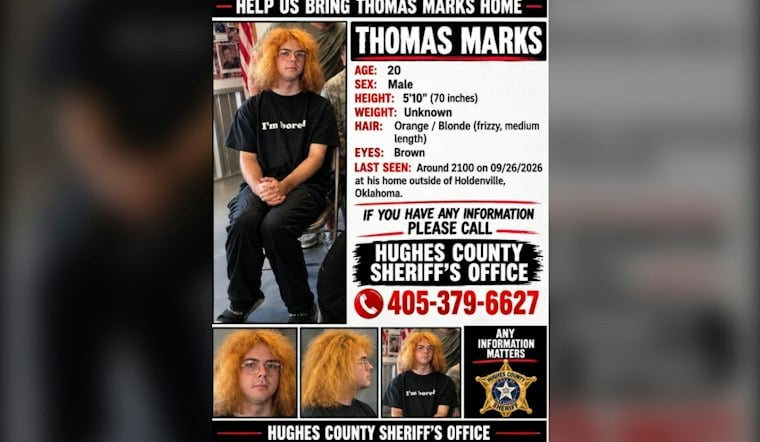
A 20-year-old man with autism has been missing from Hughes County since Saturday night, last seen around 9 p.m. at his home just outside Holdenville. He has medium-length, frizzy blonde hair, brown eyes, and stands 5 feet 10 inches tall, and his mother says people are looking for him.
The Hughes County Sheriff's Office posted a notice on Facebook alerting the public to the man's disappearance, according to News9. His mother told the station simply that people are looking for him, a brief but urgent plea as the search stretches into its second day. Anyone with information is asked to call the Hughes County Sheriff's Office at (405) 379-6627 or 911.
Drones Join the Ground Search
Drones have been used to help in the search, according to the same News9 account.
Hughes County, where Holdenville serves as the county seat, is the kind of place where that technology matters. The county covers roughly 805 square miles of land and 10 square miles of water, with a population density of only about 16.6 people per square mile as of the 2020 Census, according to U.S. Census Bureau data cited by Wikipedia. That kind of wide-open, sparsely populated terrain can turn a search for one missing person into a slow, grinding effort even with modern tools.
Why Wandering Poses Such High Stakes
Elopement, or wandering away from a safe environment, is a well-documented behavior among autistic people. A landmark study published in the journal Pediatrics found that about 49% of children and youth on the autism spectrum attempt to wander after age four, with 53% going missing long enough to cause serious concern, according to research archived by the CDC.
The risks tied to that behavior are severe. Research compiled by the National Autism Association found that accidental drowning accounts for 71% of lethal outcomes in autism-related wandering cases nationwide, with fatal traffic injuries close behind at 18%, per the National Autism Association. In 2024 alone, 82 children with autism who wandered died, and 75 of them drowned, according to data reported by the National Center for Missing & Exploited Children, a grim statistic that helps explain why searchers in cases like this one move quickly to check nearby waterways.
Communication barriers can compound the danger. The National Autism Association has also reported that more than a third of children with autism who wander are rarely or never able to verbally communicate their name, address, or phone number to first responders or bystanders who might otherwise help them get home safely.
Oklahoma's Alert Framework
Oklahoma law lays out several overlapping tools for notifying the public about missing and endangered residents. Under Title 63, the Kasey Alert Act governs statewide notifications for critically missing adults ages 18 to 59, operating alongside the state's Silver Alert Act for seniors and Endangered Missing Advisories managed by the Oklahoma Highway Patrol, according to Justia Law. It remains unclear whether a formal statewide alert has been activated in this case beyond the sheriff's office's Facebook notice.
This search is the latest in a string of recent Oklahoma cases involving vulnerable missing residents. Hoodline previously reported on a Kasey Alert for an Oklahoma City man and on a South Oklahoma City Silver Alert for a 67-year-old autistic man missing since August 31. In August, an intensive search for a missing 7-year-old autistic boy near Tulsa ended when he was found dead near a creek, a tragedy that underscored just how quickly these searches can turn dire.



