

























































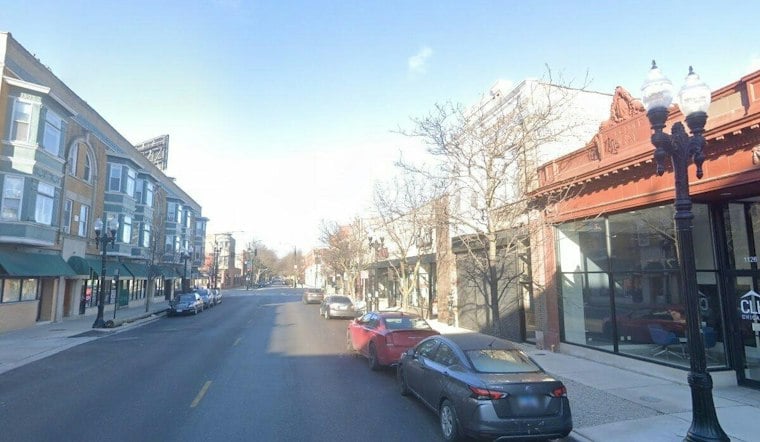
Crews are breaking ground on Chicago's first pedestrian hybrid beacon, a stoplight pedestrians can trigger themselves at the notoriously tangled five-way intersection of Ridge, Hollywood and Wayne avenues in Edgewater. After a pedestrian presses a button to cross, the device is designed to flash yellow, turn solid yellow and then display two red lights for drivers.
CBS News covered the project's groundbreaking. According to Block Club Chicago, Chicago Department of Transportation officials proposed the pedestrian hybrid beacon for the busy junction, and it would be the first installation of its kind anywhere in the city.
The $1.3 million project draws on a mix of city and state funding, the outlet reported. Ridge Avenue alone carries about 30,000 cars a day, according to the city's own figures cited in that reporting, making the crossing a daily gauntlet for anyone on foot trying to navigate where Ridge, Hollywood and Wayne all converge.
How the New Beacon Will Work
Unlike a standard traffic signal, the pedestrian hybrid beacon stays dark until someone actually wants to cross. Per Block Club Chicago's reporting, after a pedestrian presses a button, the beacon flashes yellow, turns solid yellow and then displays two red lights for drivers, rather than cycling through red and green on a fixed schedule.
The redesign isn't limited to the beacon itself. Block Club Chicago reported that the plan also calls for eliminating southbound access to Wayne Avenue from Ridge Avenue and building out additional curb extensions, changes aimed at addressing neighbors' pedestrian-safety concerns and the quick turns drivers take at the confusing five-way convergence.
Roughly three dozen neighbors turned out for a presentation on the project, and the outlet's report noted that almost all of them voiced support for the proposal and the safety improvements it promised. City officials did not offer an exact installation timeline at the time, though the project manager said he expected the beacon to be installed that year, per the same account.
The Numbers Behind the Push for Safer Crossings
The federal government has data backing the technology behind the new beacon. The Federal Highway Administration has found that pedestrian hybrid beacons produce a 55 percent reduction in pedestrian crashes, a 29 percent reduction in total crashes and a 15 percent reduction in serious injuries and fatal crashes, according to figures cited by Block Club Chicago. A separate Federal Highway Administration summary states that studies of beacon locations found 97 percent of drivers yielded to pedestrians, with reductions in total crashes, pedestrian-involved crashes and severe rear-end crashes.
The Edgewater project lands amid a broader citywide struggle with traffic deaths. Chicago logged 109 deaths on the road in 2024, including 38 pedestrians, two cyclists and 69 people in vehicles, according to the Chicago Sun-Times. The year before, the city recorded 186 traffic deaths, more than any year in the previous decade, and more than 23,000 people were injured in crashes in 2023, an 8 percent increase from 2017, the Sun-Times reported.
Against that backdrop, the city has been leaning on smaller-scale fixes across many intersections at once. Chicago upgrades around 400 dangerous intersections every year with curb bumpouts and pedestrian islands, per the Sun-Times report, though the Ridge, Hollywood and Wayne beacon stands apart as the first of its specific kind to go in anywhere in the city.
The Chicago Department of Transportation tracks fatal traffic crashes and safety issues across the city, publishing monthly fatal crash reports and related datasets. For Edgewater residents who use the Ridge, Hollywood and Wayne crossing daily, the ground now breaking there represents the first tangible step toward a fix that was proposed more than a year ago and is only now taking physical shape.


