

























































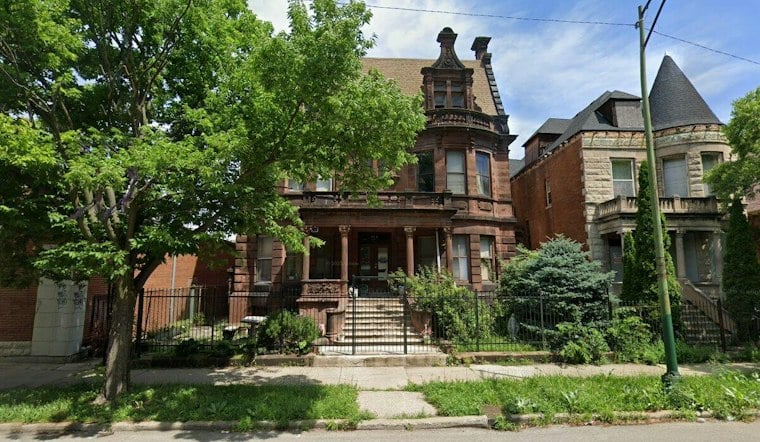
A vacant, dilapidated mansion at 726 W. Garfield Blvd. in Englewood is now caught between demolition court and a last-ditch preservation effort, as advocates argue the crumbling Renaissance Revival home built by the son of Mrs. O'Leary deserves protection before it's too late. The building has racked up numerous code violations, and inspectors have deemed it dangerous.
Preservation Chicago and Landmarks Illinois told the Commission on Chicago Landmarks' program committee that landmark status is needed to protect the mansion from demolition, according to the Chicago Sun-Times. The program committee has since forwarded the O'Leary mansion, along with other public landmark recommendations, to the Department of Planning and Development's Historic Preservation Division, which may either reject the recommendation or prepare a report seeking preliminary designation. Notably, the mansion's owner was absent from the program committee meeting.
A Family With Ties to Chicago's Most Infamous Rumor
The mansion was built by James “Big Jim” O'Leary, one of Patrick and Catherine O'Leary's five children, who lived in the home and ran a gambling house and saloon at or near 41st and Halsted streets — a business that later burned down in the 1910 Union Stock Yards fire. O'Leary died in the mansion in 1925 at age 56. His mother, Catherine O'Leary, was long and falsely blamed for starting the Great Chicago Fire of 1871 with her cow, a story that was later debunked; per the same account, the man responsible for the rumor was a local reporter who eventually confessed to making it up. Catherine O'Leary died in 1895.
Frank Butterfield, interim president and CEO of Landmarks Illinois, said the landmark case rests on the mansion's architecture, its architect, and the people associated with it. The Sun-Times reports the home was designed by Zachary Taylor Davis, the architect behind the old Comiskey Park and Wrigley Field. Garfield Boulevard itself once held a stretch of high-style homes and apartment buildings built for wealthy residents between Wells Street and Western Avenue, the newspaper's report notes.
Distinctive Features, Conflicting Details
The mansion's Renaissance Revival design includes a red sandstone front, turrets, an ornate circular attic window, two-story bay windows, and a prominent four-columned front porch — plus James O'Leary's initials worked into the terra-cotta facade detail, according to the Sun-Times. ArchitectureChicago PLUS similarly notes that O'Leary's initials were incorporated into ornament on the porch. Block Club Chicago has reported that the property also includes two large vaults, a coach house that once sheltered the O'Leary family's horses and carriages, and a sealed tunnel that formerly connected the mansion to a neighboring home.
Sources disagree on some of the mansion's basic facts. The Sun-Times reports the home was built in 1901 and is 125 years old with 33 rooms, while Block Club Chicago has cited a listing that said 1885 and a Cook County Assessor record putting construction at 1891. Room counts vary too: the Sun-Times cites 33 rooms and 6,200 square feet, while realtor.com previously described 33 rooms including 12 bedrooms and 5.5 bathrooms, and Block Club Chicago cited a listing describing 6,720 square feet with 18 bedrooms and 10 bathrooms.
What Landmark Status Would Mean
Preliminary landmark designation would protect the building from demolition and non-historic alterations, per the Sun-Times report. Ward Miller, executive director of Preservation Chicago, said his organization hopes a responsible steward will step in to adopt and restore the building and consent to landmark designation. Miller added that Preservation Chicago will support the building before the committee and in court in the coming weeks.
The push for protection comes after years of the mansion cycling through the real estate market. It was listed for $599,877 in 2020, according to realtor.com, which also reported the home was being sold as-is and needed repairs including work on cracked plaster walls. By 2021, Block Club Chicago reported the asking price had dropped to $535,770, while Pricey Pads separately reported figures of $475,000 and $499,000 that same year. Redfin listing details cited by the Sun-Times put the price at $450,000 in 2024. Miller told Block Club Chicago in 2021 that if condominium conversion turned out to be the only means of preserving the mansion, it would need to be done carefully, with certain interior rooms kept intact.





