

























































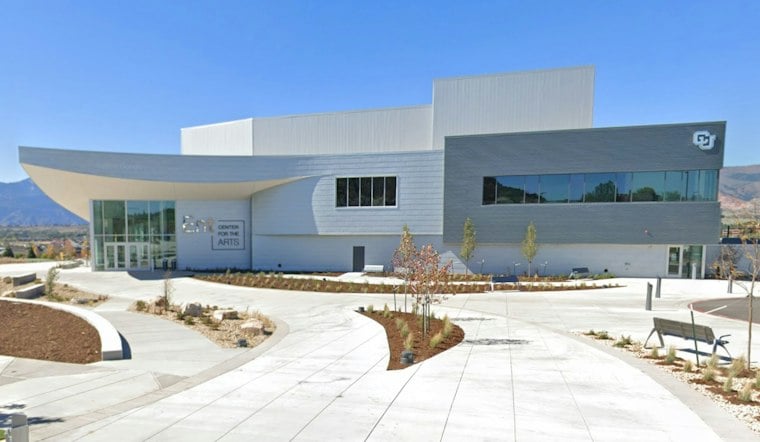
Ben Brantley, the former longtime chief theater critic for The New York Times, sits down for a public conversation in Colorado Springs Sunday at 2 p.m., speaking about criticism and Stephen Sondheim with University of Colorado at Colorado Springs professor Kevin Landis. The talk lands at the Chapman Foundations Recital Hall at the Ent Center for the Arts, 5225 N. Nevada Ave. It's free, though organizers say advance registration is required because space is limited.
The visit comes as TheatreWorks stages Sweeney Todd: The Demon Barber of Fleet Street at the Ent Center for the Arts, running through October 4, according to The Denver Gazette. Brantley saw the original 1979 Broadway production of Sweeney Todd starring Angela Lansbury and Len Cariou, and he first encountered Sondheim's work at 16, when he saw Follies on Broadway in the 1970s. He has praised actress Annaleigh Ashford's original interpretations and what he called her heartfelt performance; Ashford, a Wheat Ridge High School graduate, has starred in Broadway productions of both Sweeney Todd and Sunday in the Park with George and won a Tony Award for You Can't Take It With You. Sondheim died in 2021.
A Critic's Career Bookended by Mentorship
The Gazette's own senior arts journalist, John Moore, wrote the piece announcing Brantley's appearance, noting that he and Brantley both spent years as daily theater critics. Moore has said that Frank Rich, The New York Times' chief theater critic from 1980 to 1993, advised him in 2001 to accept the Denver theater critic job — advice Moore says came directly from a mentor. Brantley has said Rich was the reason he went to the Times, where he was hired in August 1993 and, by 1996, had become what the Gazette's report describes as the most influential theater journalist in America.
Moore became The Denver Post's chief theater critic in 2012. He has said that when he left the Post that year, he became the last salaried critic fully dedicated to covering live theater in Colorado — a status that, per the Gazette's reporting, still holds for the state today. Brantley, for his part, left professional theater criticism during the pandemic shutdown. He has said that the gates of theater criticism are now open, and that social media and the internet have eroded the influence of professional critics like the one he once was.
An Industry That Kept Shrinking After Moore Left
The thinning of arts journalism in Colorado didn't stop with Moore's 2012 departure. Moore, who now works as the Denver Gazette's senior arts journalist after accepting a full-time role in February, has described a stark before-and-after: when he left The Denver Post, 14 writers covered arts, culture and entertainment full time there, he has said, and now there is only one, according to the Colorado Theatre Guild. A separate count, cited by Colorado Media, found Moore tallying 17 writers and editors covering arts, entertainment and features at the Post on his final day there — a figure that may reflect a broader group than the full-time arts, culture and entertainment writers he separately counted.
Today, the paper's report notes, The Denver Post has just one full-time writer covering the arts as a whole, while the Denver Gazette and Colorado Public Radio each employ a single journalist with broad arts responsibilities. Moore now provides a weekly arts news roundup for the Gazette every Thursday and is looking to add freelance arts journalists to the team for individual assignments, though he has said he won't have the capacity to write many of the individual show advances he once produced or return as a dedicated theater critic. During his Post tenure from 2001 to 2012, American Theatre Magazine listed him as one of the twelve most influential theater critics outside New York City.
The Money and the Meaning Behind the Beat
The stakes of that erosion, in Moore's telling, go beyond nostalgia. He has pointed out that the Denver metro area's arts, culture and scientific organizations generate $2.6 billion in annual economic activity, according to Colorado Business Committee for the Arts Executive Director Christin Crampton Day, cited in his earlier Denver Gazette essay. He has also noted that Germinal Stage-Denver's 1976 production of Offending the Audience drew 11 different local newspaper reviews — a level of scrutiny unimaginable for most productions today, when, as he put it, arts journalists left in the state are all generalists now.
The pattern is not unique to Colorado. The American Theatre Critics Association has said only about a dozen full-time theater critics remain in the entire country, per the same Colorado Media account. Nationally, jobs and space for theater criticism have been vanishing for years, according to American Theatre, with some in the industry pointing out that reviews simply do not draw the same engagement as a stranger's opinion posted on Facebook. The Columbia Journalism Review has reported that critics at newspapers are dying off even faster than print journalism itself, noting that roughly a hundred staff theater critics worked at papers two decades ago, compared with a number now small enough to count on one's fingers.
Other newsrooms have told similar stories. The New York Times itself reduced its theater criticism operation down to one full-time critic supplemented by freelancers, according to Arts Fuse, and The Washington Post's longtime critic Peter Marks left that paper at the end of 2023 after taking a buyout. Not everyone frames the shift purely as loss — the Reuters Institute has argued the discussion should center on the changing nature of journalism rather than its disappearance, though it acknowledges serious criticism is endangered as print space for arts coverage keeps shrinking.
Sondheim's Local Footprint Continues
Sondheim's work isn't leaving Colorado stages anytime soon. Platte Valley Theatre Arts will present Sweeney Todd in Brighton beginning October 9, running through October 18, and UCCS theater students are slated to perform Company in 2027. For Brantley, who has said he loves seeing young people perform Sondheim and respond well to his work, Sunday's conversation offers a rare chance for Colorado audiences to hear directly from a critic whose career traced the arc from Frank Rich's New York Times dominance to an era when, as Brantley has put it, the gates are now open to anyone with an opinion.





