

























































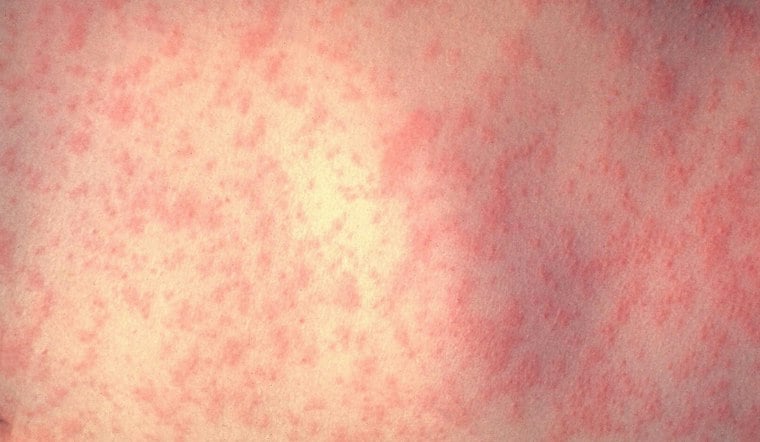
Five siblings in a Jasper County family have tested positive for measles, Georgia health officials confirmed Wednesday, in a cluster involving children who were unvaccinated or under-vaccinated against the disease. At least one of the infected children had recently traveled out of state, and state investigators are now working to trace anyone who may have crossed paths with the family while they were contagious.
The Georgia Department of Public Health confirmed the five cases among the siblings, according to WSB-TV. The station reports the children were unvaccinated or under-vaccinated, and that at least one sibling had a history of out-of-state travel. Fox 5 Atlanta reports the information came from a Georgia Department of Public Health news release issued Wednesday, though investigators have not released the specific places the siblings visited while contagious.
State health officials say contact-tracing efforts are underway to identify anyone who may have been exposed, per the same WSB-TV report. Officials have said the Jasper County cases are not connected to an earlier measles outbreak in Cobb County, according to Fox 5 Atlanta.
How the Virus Spreads and What Symptoms Look Like
Measles spreads through the air when an infected person coughs or sneezes, and the virus can remain infectious in the air or on surfaces for up to two hours after that person has left a room, the station's report notes. Initial symptoms typically include a high fever, cough, runny nose and watery eyes, followed by a rash of tiny red spots, and symptoms generally appear between seven and 14 days after exposure, though the incubation period can stretch to 21 days.
Anyone experiencing measles symptoms should call a health care provider before showing up at a doctor's office, clinic or emergency room, officials advised, a step meant to keep the virus from spreading further inside waiting rooms. The CDC recommends children get their first MMR vaccine dose between 12 and 15 months of age and a second dose between ages 4 and 6. A single dose provides over 95% protection against measles, while a second dose raises that protection to approximately 98%, according to the same account.
A Statewide Case Count That Depends on Who's Counting
Just how many measles cases Georgia has logged in 2026 depends on the source. WSB-TV reported that the new Jasper County cases bring the state's total to 21 confirmed cases this year, while the Fulton County Board of Health put Georgia's 2026 total at 16 confirmed cases as of Tuesday. Either figure represents more than double the 10 confirmed measles cases Georgia recorded in all of 2025, per WSB-TV.
The Jasper County cluster is not the only active measles activity in the state this year. The Fulton County Board of Health also reported two additional measles cases tied to an outbreak at a metro Atlanta daycare, bringing that separate outbreak's total to 10 cases. Georgia's Department of Public Health had confirmed four additional measles cases in late August described as close contacts of a case confirmed the previous week, and the agency reported three new cases in May that brought the state's count at that point to five.
A National Backdrop of Slipping Vaccination Rates
Georgia's cases are surfacing amid a broader national trend. U.S. states reported more than 3,800 measles cases from January 2025 through the end of March 2026, according to KFF. Measles has officially been considered eliminated in the United States since 2000, but KFF notes that estimated national two-dose MMR coverage among children entering kindergarten was 92.5% in 2024, down from 94.7% in 2011 — a slide that health researchers have linked to the disease's resurgence. Two doses of a measles-containing vaccine are estimated to be 97% effective at preventing infection, per KFF.
For now, Georgia health officials are focused on tracing who the Jasper County siblings may have exposed rather than on resolving the state's conflicting case counts. Parents and caregivers who suspect a child has been exposed are urged to call ahead before visiting any medical facility, giving staff time to prepare and limit further spread.




