

























































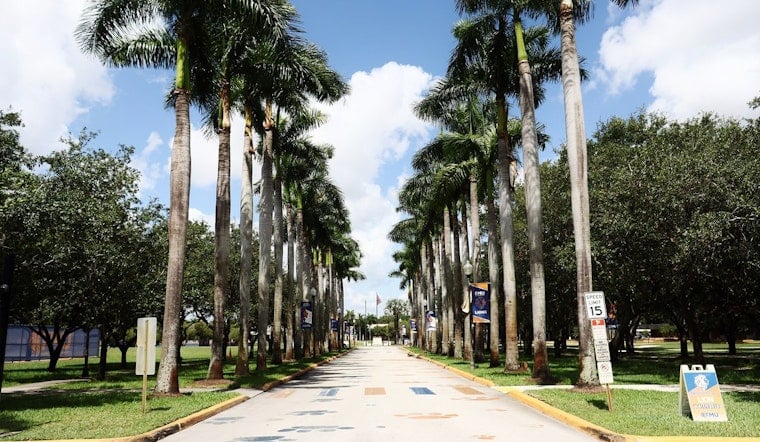
Florida Memorial University just logged the largest enrollment in its 147-year history, with 2,556 students enrolled for Fall 2026 — a 100 percent jump over the previous year. The milestone marks a stunning turnaround for South Florida's only historically Black college or university, but it lands alongside an accreditation probation and a financial-risk ranking that continue to shadow the Miami Gardens campus.
University President William Cullen McCormick Jr. is FMU's 15th president and its first alumnus to hold the office. No verifiable public record or news report indicates that McCormick gave the cited interview to The Olympian in September 2026.
McCormick also said the growth would strengthen rather than compromise the quality and rigor of FMU's academic experience, per the same report. Dr. Tymon M. Graham, the university's vice president for student affairs, said students and families are choosing FMU because they see a pathway to opportunity, excellence and success. Graham attributed the growth to a focused recruitment strategy, stronger community partnerships and a university-wide commitment to student success, according to the outlet's account, which also linked the surge to renewed stability following public scrutiny and expanded recruitment initiatives.
A Historic Recovery From a Decade of Decline
The scale of the rebound becomes clearer against FMU's recent enrollment history. Student enrollment at the private four-year HBCU peaked at 1,878 students in 2012 before sliding for a decade to a low of just 915 students in 2021, according to HBCU Buzz. Enrollment then crept back up to roughly 1,100 to 1,300 students between 2022 and 2025, making this fall's jump to 2,556 students a genuine historic recovery rather than a modest bump.
Founded in 1879, Florida Memorial University carries a legacy that stretches well beyond enrollment charts. The hymn “Lift Every Voice and Sing,” widely known as the Black National Anthem, was set to music in 1900 by faculty member J. Rosamond Johnson while he taught at Florida Baptist Academy, a direct institutional predecessor of FMU, according to WFSU News. The song's lyrics were written as a poem by Johnson's brother, James Weldon Johnson, who served as the academy's board chairman. The school's history also includes multiple forced relocations across Florida — from Live Oak to Jacksonville after shots were fired into campus buildings in 1892, then to St. Augustine in 1918, and finally to Miami Gardens in 1968 amid Civil Rights Movement activism and Ku Klux Klan intimidation, per the United Negro College Fund.
Accreditation Probation Looms Over the Growth Story
The enrollment record arrives while FMU is under fresh scrutiny from its regional accreditor. In December 2025, the Southern Association of Colleges and Schools Commission on Colleges placed Florida Memorial University on accreditation probation over failures to meet standards tied to financial health, fiscal controls, and federal and state compliance obligations, according to The Journal of Blacks in Higher Education. The university remains fully accredited throughout the probationary review, which is set to conclude in December 2026.
It is not the first time FMU has faced this exact sanction. The school endured a yearlong SACSCOC probation beginning in June 2021 that forced administrators to eliminate 16 undergraduate degree programs — including English, sociology and education — remove 15 faculty positions, and cut employee salaries by 10 percent before good standing was restored in June 2022, the Journal of Blacks in Higher Education notes. The university later pursued recruitment efforts under McCormick's administration.
External financial analysts have also raised concerns even as enrollment climbs. An August 2026 higher education ranking developed by Johns Hopkins educator Dan Ye placed Florida Memorial University 122nd out of 1,375 evaluated U.S. colleges for financial risk, categorizing the institution as financially distressed, according to the Miami Times. The ranking assesses the likelihood of institutional failure using enrollment and admissions data, meaning FMU is drawing bigger classes just as outside observers flag its fiscal footing as shaky.
According to the U.S. Department of Education's Fiscal Year 2025 Agency Financial Report, the department had approximately $839 million in outstanding Federal Financing Bank borrowing to support loans made to HBCU institutions and $976 million in outstanding borrowing overall. The U.S. Department of Education's Fiscal Year 2025 Budget Summary said the proposed funding would support 98 HBCUs, underscoring the broader federal financing context for historically Black colleges.
Growing Pains Inside the Dorms
The rapid influx of students has also strained campus infrastructure that was already under fire earlier this year. A Miami-Dade Health Department inspection in February 2026 substantiated student complaints of visible mold, bacteria in laundry equipment and broken furniture inside FMU dormitories, Hoodline previously reported. Health officials issued corrective action notices after students and local media brought the housing conditions to light.
To pair its enrollment push with career-focused offerings, FMU has opened the Technolij Innovation Center on campus and established the FMU-Miami Construction Trade Program, which has trained and graduated more than 200 participants into local industries, per Mightycause. The university has also expanded its offerings in STEM, aviation and health sciences alongside trade certifications, reinforcing the case that its growth strategy extends beyond recruitment marketing into workforce partnerships.
A Campus Woven Into Miami Gardens' Civic Life
FMU's identity is closely tied to its host city of Miami Gardens. The university's Lions football team plays its home games at the city's Betty T. Ferguson Recreational Complex.
For now, the university is leaning into its record-setting semester as proof of momentum. Graham said the growth is supported by academic integrity, institutional investment and student success, according to The Olympian's report, while McCormick has framed the moment as the start of a new standard for the 147-year-old institution. Whether that momentum can hold through the remainder of SACSCOC's review — and whatever comes of the financial-distress ranking — remains an open question the university has yet to answer publicly.





