

























































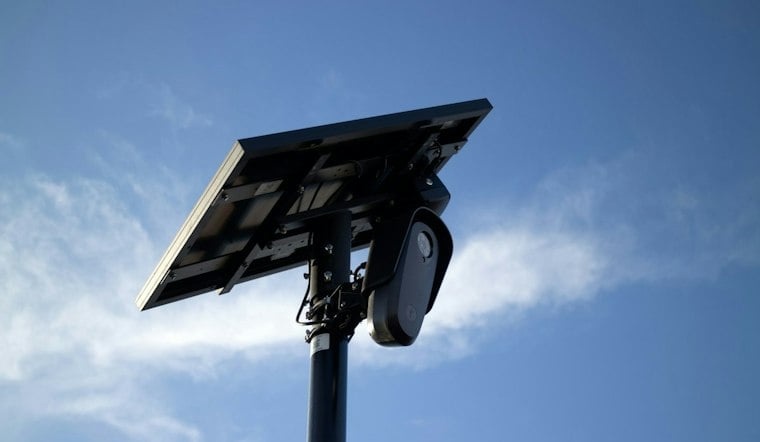
Folsom is pulling the plug on its Flock Safety license plate cameras, according to two city council members who say Police Chief Adam Green has decided the department will discontinue using the devices. The city currently has 17 Flock cameras installed around town, but officials say Folsom will lean instead on its existing network of 27 Motorola license plate readers going forward.
Council member Sarah Aquino said Folsom is in the process of discontinuing its use of Flock cameras, and that Green is reviewing and updating the police department's policies as part of the shift, according to The Sacramento Bee. Aquino said Green plans to present more details to the Folsom City Council within about a month. A city spokesperson separately confirmed that the police department is reviewing its contract with Flock.
Council member Mike Kozlowski said plainly that Folsom is discontinuing its use of Flock cameras, and pointed to the company's reputation as a factor. He said Flock's negative attention has discouraged Folsom from continuing its use of the system, and added that the city has not configured its license plate-reader system so that anybody can access its data. Folsom wants to ensure that reader data can only be reached by its own police department and partner agencies, per the same account.
A $76,400 Contract Under Scrutiny
Folsom first contracted with Flock in March 2023, signing an initial deal valued at $76,400 that covered 12 cameras, access to Flock's AI-powered advanced search software, and extended data storage for two years. The contract also carried a two-year renewal term and an annual recurring cost of $36,100. Deflock Sac Metro, a local advocacy group, obtained a copy of that contract through a public records request, the same reporting notes.
Two of Folsom's Flock cameras were damaged in August, around the same time resident Lindsey Halsell raised concerns about surveillance and privacy in the city. Halsell said people should be able to go about their lives without constant observation, and argued that Flock cameras effectively place people under surveillance as crime suspects without warrants or stated charges. She also said the cameras' AI-enhanced capabilities are ripe for misuse.
Part of a Wider Northern California Retreat
Folsom's move follows a similar decision in Nevada County, where the Grass Valley Police Department indefinitely suspended its Flock camera program and removed 81 units in August after intense public opposition over warrantless tracking, according to CBS News. The following month, Grass Valley police discovered that Flock had reinstalled several of the removed cameras, which the vendor attributed to an automated system error before the units were taken down again, as reported by TechRadar. Hoodline covered Grass Valley's exit and neighboring Yuba County's response in August.
Nearby Rancho Cordova saw its own uproar earlier this year, when residents launched a “Deflock Rancho Cordova” campaign opposing the city's $1 million, 53-camera Flock deployment over fears of warrantless tracking and out-of-state data exposure, a fight Hoodline detailed in its Rancho Cordova camera battle coverage. Woodland police, by contrast, defended their 38 Flock cameras in September amid local calls to cancel the contract, while Elk Grove was mentioned as a regional location for ALPR technology.
State Law Bars Sharing, But Enforcement Gaps Remain
California's Senate Bill 34, enacted in 2015, legally prohibits public agencies from selling license plate reader data or sharing it with out-of-state or federal law enforcement agencies, according to California legislative records. The law also requires public agencies to maintain and post strict usage and privacy policies online. Even so, California Attorney General Rob Bonta issued formal guidance in October 2023 clarifying that local agencies sharing that data across state lines or with federal agencies violate state law, after civil liberties groups raised concerns about California police departments' data-sharing practices, according to the ACLU.
Statewide legislative fixes have been under consideration. Flock Safety itself announced nationwide policy changes in August, shortening its standard default data retention period from 30 days to seven unless records are tied to an active case file, per the same outlet. Police and sheriffs' departments across California deploy license plate reader systems.
The stakes of misuse were underscored the same day Folsom's plans became public, when the San Jose Police Department fired an officer after a criminal investigation found he used license plate reader database access on a personal device, while off-duty, to help a relative track a domestic violence victim, according to CBS News. The incident led to criminal charges and the officer's firing. Nationally, Flock contracts have also drawn scrutiny over external access to camera networks.
License plate-reading cameras broadly have drawn nationwide scrutiny over surveillance, privacy and artificial-intelligence vehicle tracking. Folsom's retention of its 27 Motorola cameras suggests the city isn't abandoning the technology altogether, but is instead distancing itself specifically from Flock as scrutiny of the vendor mounts. Green is expected to bring more details to the Folsom City Council within the coming weeks.



