

























































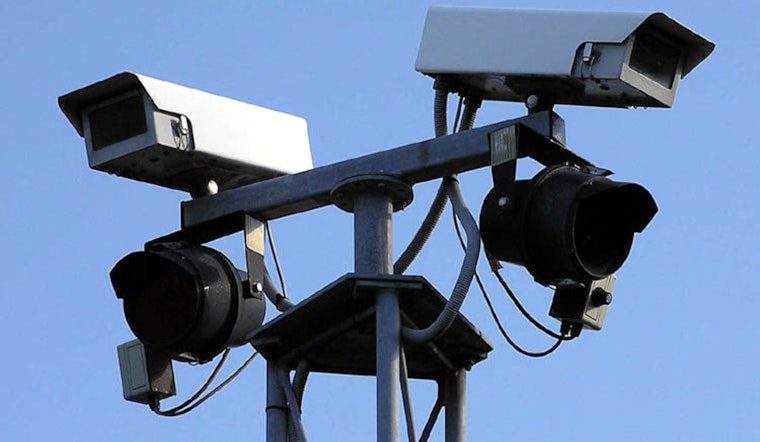
Yuba County sheriff's officials laid out exactly how their license plate reading cameras work during a Board of Supervisors meeting in Marysville, part of an effort to get ahead of the kind of backlash that just forced a neighboring police department to shut its own program down. The presentation detailed camera counts, data retention rules, and a public audit log, all aimed at addressing community fears about warrantless tracking and outside access to driver data.
The timing was hard to miss. Just days earlier, the Grass Valley Police Department announced during a city council meeting that it was indefinitely suspending its Flock Safety camera program and would remove all 81 units by the end of the week, following intense public opposition over Fourth Amendment concerns, warrantless tracking, and worries about out-of-state data sharing, according to CBS News. Grass Valley, in neighboring Nevada County, had been using Flock cameras since 2021. As the Sacramento Bee reports, Yuba County signed its own contract with Flock Safety back in 2022, and the sheriff's department has been working to ease community concerns about how that system is used ever since scrutiny intensified.
Undersheriff Nick Morawcznski told supervisors the presentation was meant to dispel inaccurate information circulating online and in the community, per the Sacramento Bee's reporting. He called Flock technology an invaluable tool but stressed it is never used alone. Flock is an investigative tool used with many other investigative tools, Morawcznski said, adding that the cameras have helped the sheriff's department in kidnapping, homicide, and bike theft cases.
What Yuba County's Camera Network Actually Looks Like
According to the sheriff's department's presentation, Yuba County operates 33 Flock license plate cameras on public roads in unincorporated areas, along with five live-feed cameras, two dedicated to election security, and three more positioned around Grays Beach. Flock Safety, the Atlanta-based company behind the technology, is used by more than 5,000 law enforcement agencies nationwide and by more than a dozen agencies in the Sacramento region alone, the Sacramento Bee notes. The cameras record information about passing vehicles into a searchable database that law enforcement agencies use to find vehicles connected to crimes.
Yuba County's system retains license plate information for 30 days and keeps a permanent record of every search carried out in the county — logging who ran the search and what was being investigated. That audit function is meant to prevent misuse and increase transparency, the sheriff's office says. The county has also built a public-facing transparency portal, one of the customizable options Flock Safety offers its client agencies, that includes the number of plates scanned, the number of plates appearing on law enforcement hot lists, a 30-day audit log, and a list of every outside agency with access to the county's data.
Why Out-of-State Access Is the Flashpoint
Much of the public anxiety driving this debate centers on whether license plate data can end up outside California's borders. Under California Civil Code § 1798.90.5, enacted through Senate Bill 34 in 2015, state law enforcement agencies are strictly barred from selling, sharing, or transferring automated license plate reader data to federal or out-of-state agencies. The California Department of Justice reinforced that rule in an October 2023 bulletin explicitly warning that sharing data through third-party vendor cloud networks also violates state law.
Those warnings have not been merely theoretical. In October 2025, Attorney General Rob Bonta sued the City of El Cajon over allegations it illegally shared license plate data with out-of-state agencies in violation of SB 34, with Bonta emphasizing that such sharing strips away California's oversight of resident data. Closer to home, the Chico Police Department restricted its own Flock data access exclusively to California agencies in July 2026 after records requests revealed federal immigration authorities had previously accessed its surveillance records, according to reporting from ACoM. A 2020 California State Auditor report, cited by the ACLU, found that multiple agencies statewide had failed to properly audit searches or maintain required privacy policies — a finding that helps explain why residents keep demanding searchable logs like the one Yuba County now offers.
A Regional Pattern of Pushback and Payoff
Yuba County is far from alone in navigating this tension. In March 2026, Rancho Cordova approved a $1 million, five-year contract for 53 Flock cameras, a move that sparked resident protests and a grassroots opposition group, per CBS Sacramento. Meanwhile, law enforcement agencies continue pointing to fast results as justification for the technology: on August 8, Galt police used Flock camera alerts to locate and arrest a felony kidnapping suspect within five minutes of receiving vehicle details from another California agency, according to ABC10.
State lawmakers are also weighing in. California legislators are considering Senate Bill 1013, a proposal that would establish stricter statewide deletion schedules, search audit trail requirements, and default access controls for license plate reader systems statewide. Yuba County's Board of Supervisors previously approved an expanded services agreement with Flock Group Inc. in August 2025 to widen camera deployment for the Three Rivers Levee Improvement Authority and county public works, showing the technology's footprint in the county extends beyond routine sheriff's patrols. For now, county officials appear to be betting that transparency tools — audit logs, public portals, and detailed presentations to supervisors — can keep Yuba County from following Grass Valley's path toward shutting the cameras off entirely.





