

























































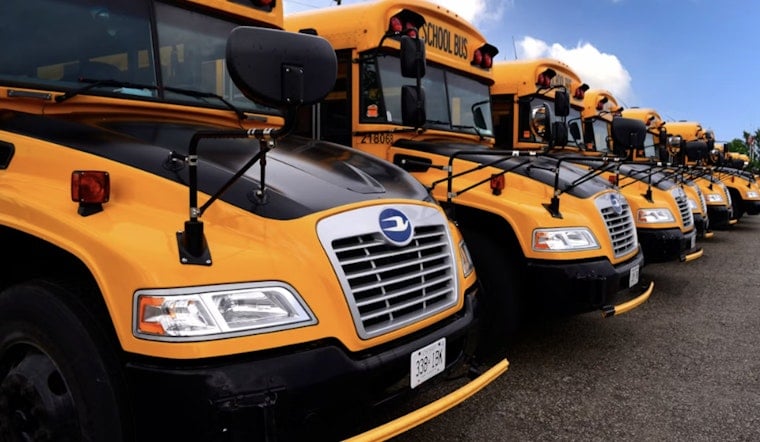
For 12 days after the start of the new school year, 10-year-old Lincoln went without a ride to the Fort Bend ISD school where he attends a special program outside his family's normal attendance zone. His mother, Erin Houston, says she called and called, got the same answer from the principal, and heard nothing back from the district's transportation department — until she asked a news investigative team for help.
A Mom Reaches Her Breaking Point
Houston says Lincoln requires school transportation as part of his educational accommodations, since the special program he attends falls outside his family's attendance zone. According to Click2Houston, Houston contacted school officials and the Fort Bend ISD transportation department repeatedly, only to receive the same response from the principal and silence from transportation staff. She said she felt Lincoln was being ignored, and after exhausting her options, she reached out to the station's 2 Helps You consumer help desk for assistance.
Once 2 Helps You brought Lincoln's transportation situation directly to Fort Bend ISD leadership, district officials moved to address the issue immediately, the outlet reported. Lincoln rode a school bus just one day after that outreach to district leadership — meaning the fix came only after 12 days without one. Investigative reporter Mario Díaz and photojournalist Anthony Peavie covered the story for the station.
Why the Wait Dragged On
The delay unfolded against a backdrop of district policy that gives families little room for a quick resolution. Under Fort Bend ISD's own special needs transportation guidelines, when an Admission, Review, and Dismissal committee meeting or placement change happens after the school year starts in August, parents are instructed to transport their child themselves for the first five days while the transportation department processes paperwork — and officials are then given up to 10 days to call and establish bus service. Houston's 12-day wait fell just past that internal window.
That timeline sits uneasily next to federal law. Under 34 CFR § 300.34(c)(16) of the Individuals with Disabilities Education Act, transportation is defined as a mandatory “related service” that school districts must provide at no cost to families when an Individualized Education Program team determines it is necessary for a free appropriate public education. In Texas, Section 29.001 of the Texas Education Code and Title 19 TAC Chapter 89 similarly establish that a student's ARD committee holds full authority to mandate specialized transportation, including door-to-door service and out-of-zone route arrangements, according to Texas SPED Support.
A District Already Stretched Thin
Fort Bend ISD's transportation woes are not new. To combat chronic staffing deficits that left 30 to 40 bus routes without permanent drivers each school year, the district's Board of Trustees approved a five-year, $31.65 million contract with private provider GoldStar Transit in May 2025 to staff up to 130 routes through July 2030, per Community Impact. At the time, the district employed 201 drivers, including 46 part-time, but still had 49 uncovered routes that forced dispatchers, mechanics, and trainers to fill in behind the wheel, while GoldStar's $21.50 hourly wage undercut the district's own $20.41 starting rate for recruiting.
Special education routes carry extra operational demands on top of that staffing gap. Fort Bend ISD rules require drivers on special needs routes to wait up to two minutes at designated stops for a student to load, a requirement that does not apply to regular education routes. The district's special education department also entered the 2025-26 school year having just cleared a backlog of more than 1,060 student evaluations, while 60% of surveyed special education staff reported that new administrative software increased their paperwork time at the expense of direct student support, according to Community Impact.
Lincoln's case was not an isolated bump at the start of the school year. Just a week before this story, Fort Bend ISD faced scrutiny after a nonverbal special education high school student boarded an unassigned bus and went unaccounted for, due to missing student ID badge scans and an absent bus attendant — a breakdown Hoodline previously reported prompted district executive directors to meet with that family on safety protocols. Ahead of this school year, the district had also rolled out a new S.T.A.R.T. active-threat-response training program alongside CPR, first aid, and student behavior de-escalation training for all bus drivers and monitors.
A Nationwide Shortage Behind Local Delays
Fort Bend ISD's struggles mirror a national pattern. Nationwide public school bus driver employment in August 2025 remained 9.5% below 2019 pre-pandemic levels, a loss of 21,200 drivers, while 81% of surveyed U.S. school districts reported active driver shortages entering 2026, according to data reported by Bytecurve.
For Houston, the resolution came with relief but also a warning for other families. She said she fought to make sure Lincoln received the education and accommodations he is entitled to, and she advised parents in similar situations to seek out advocates when they need help, noting that advocates can step in for parents who lack the time or mental capacity to fight for their kids on their own. 2 Helps You has encouraged families facing similar struggles to contact its help desk for assistance.
Asked about his first day of school, Lincoln simply said, “Real good!” He thanked 2 Helps You for helping his mother get him on a bus.





