

























































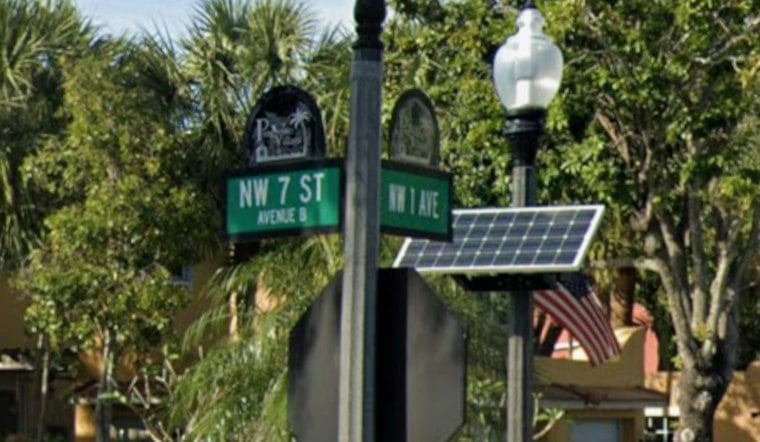
Fort Lauderdale's City Commission has signed off on a considerably bigger version of Astor Progresso Village, an apartment building at 4 NW 7th Street that now carries 249 residential units, 81 more than developer Midtown Capital Partners originally proposed. To get there, the Miami-based firm won city approval to shrink required parking, exceed the standard building floorplate, and slash the setback along the adjacent Florida East Coast Railroad tracks from 30 feet down to just four.
The approval, reported by The Real Deal, follows the site's 2023 approval, subsequent redesign and 2026 approval. The 1.3-acre triangular site sits along NW 7th Street with NW 1st Avenue to the west and the railroad to the east. Midtown Capital Partners, led by managing partners Alejando Velez and Alexander Saieh, paid $9.4 million for the parcel in 2022, when it was still a former salvage yard. The company first secured approval for a 168-unit project in August 2023 before shelving that version and coming back with the larger 249-unit plan now greenlit by the commission.
Bigger Building, Fewer Parking Spots
The numbers tell the story of just how much flexibility the city extended. Astor Progresso Village would ordinarily need 386 parking spaces under the applicable code, but the commission approved roughly 30 percent fewer than that requirement, per the same Real Deal report. Traffic engineering firm David Plummer and Associates had estimated that 269 spaces would actually be needed based on the building's bedroom count, a figure well below the code minimum but still above what the city ultimately signed off on.
The Fort Lauderdale City Commission also approved a 24,645-square-foot building floorplate, well beyond the standard 12,000-square-foot maximum, alongside the narrowed railroad-side setback. Architecture firm CUBE 3 designed the L-shaped structure to rise above a landscaped podium, according to Florida YIMBY, with off-white and dark teal stucco, golden pecan louvers, deep balconies, and street-level murals meant to soften the mass along NW 7th Street. The site falls within the Northwest Regional Activity Center – Mixed Use East zoning district, according to the Connect CRE report on the project.
Mostly Studios, With Rooftop Pickleball
The unit mix leans heavily toward compact living. Connect CRE reports the building will include 180 studio apartments ranging from 407 to 551 square feet, 8 junior one-bedrooms, 22 standard one-bedrooms, and 39 two-bedroom units as large as 1,267 square feet, meaning studios alone make up more than 72 percent of the residential floor plan. The project also includes 1,665 square feet of commercial space at street level, according to The Real Deal's reporting.
Amenities are geared toward the kind of urban renter the studio-heavy layout targets. Florida YIMBY reports the plans call for a fourth-floor pool deck with cabanas, a yoga lawn, a gym, lobby coworking space, and a rooftop pickleball court paired with a bar pavilion positioned along the eastern railway edge to help buffer the tracks. Midtown's development-permit application, represented by law firm Greenberg Traurig, included the alternative design and parking reduction that the Fort Lauderdale Development Review Committee ultimately approved.
Studios as a Hedge Against Costs
The project has a heavy tilt toward studios, while construction costs have squeezed South Florida projects in recent years. Midtown Capital Partners has co-financed South Florida residential projects through a private investment fund with DeLand-based Prospect Real Estate Group, which controls 40 percent of that fund and manufactures its own concrete in Fort Lauderdale, according to Fort Lauderdale Magazine. That in-house concrete production is meant to insulate projects from regional material supply bottlenecks that have driven up costs elsewhere.
Astor Progresso Village lands amid softening rents that complicate the math for market-rate infill housing. Fort Lauderdale's average apartment rent sits above $2,200 a month, but per The Real Deal's citation of apartments.com data, the metro's average rent actually declined 0.3 percent from May to June 2026, even as the nationwide average rose 0.1 percent to $1,742 that same month. Rent grew in 41 of the nation's 50 largest rental markets during that stretch, meaning Fort Lauderdale's rent growth has been lagging behind most major metros, according to apartments.com.
A Corridor Filling In Fast
Astor Progresso Village is not the only mid-rise chasing density along this stretch. Home Venture Investments has its own 8-story, 422-unit development planned nearby at 312 NW 7th Street that reserves 10 percent of its units as affordable housing, according to city records reviewed by Hoodline. The project is planned at 312 NW 7th Street.
The site's history underscores how quickly density targets have escalated here. Before Midtown's involvement, the property was approved in August 2023 for a 168-unit project. Midtown Capital has been active elsewhere in South Florida too, recently securing an $84 million bridge loan for its Astor Park Flagler Village apartment project, while institutional buyers keep circling finished product nearby — New York-based Journey Capital paid $108 million for the 348-unit Rise Flagler Village tower in April, a deal Hoodline valued at roughly $310,000 per unit despite the cooling regional rent picture.



