

























































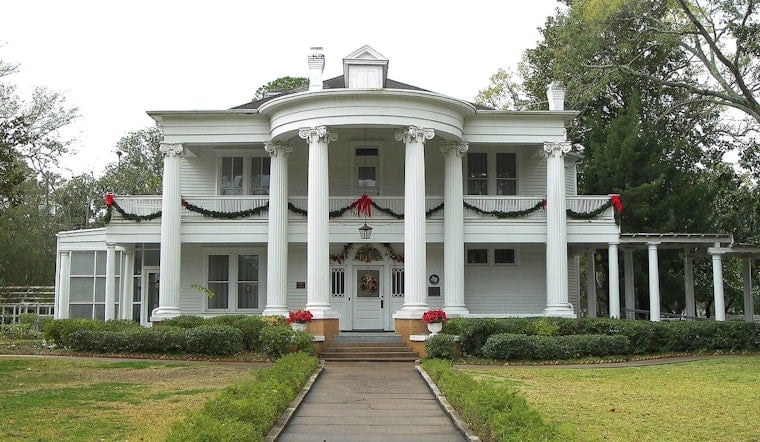
A family of four raccoons has set up housekeeping in the attic of Richmond's 143-year-old Moore House, and the museum that owns the property says the uninvited guests never signed a lease. The Fort Bend Museum's associate director set up a game camera over the weekend that captured the raccoon family on video, confirming what staff suspected was living above the historic home's ceilings.
According to Chron, the Fort Bend Museum posted that four raccoons were found in the attic of the John M. and Lottie D. Moore House, located at 406 S. Fifth St. in Richmond. The museum joked that the animals were named “Jimothy Moore and family,” a playful nod to the mansion's original owners, even as staff move forward with plans to safely remove them from the structure. Per the same account, the museum described the raccoons simply as uninvited guests living in the attic who never signed a lease.
A Mansion With Deep Texas Roots
The Moore House itself is no ordinary attic. Built in 1883 as a Victorian-style wedding gift for Lottie Dyer Moore, the mansion was designed by architect Thomas Culshaw and originally featured four bedrooms, a central tower, and a cupola, according to Wikipedia. In 1905, U.S. Representative John M. Moore hired the Austin firm C.H. Page and Brothers to remodel the home into its now-familiar Classical Revival style, adding six white front columns, new hardwood floors, and seven coal-burning fireplaces, per absolutely Brazos!.
The home also served a civic purpose in its early years. The First Baptist Church of Richmond was founded inside the Moore House in 1883, holding congregation services there until the church moved into its own building in 1889, Wikipedia notes. The property's roots stretch back even further, tracing to original owner Lottie Dyer Moore's grandmother, Nancy Gray Spencer Barnett, who received a land grant in Fort Bend County in 1824 as one of Stephen F. Austin's original “Old Three Hundred” Texas colonists.
A Family Line of Political Power
John Matthew Moore's own political career extended beyond his time in the U.S. House to the Texas House of Representatives, and he served as president of the Fort Bend County Jaybird Democratic Association from 1888 to 1892, placing him at the center of the politically violent Jaybird-Woodpecker War, according to absolutely Brazos!. That conflict culminated in the August 1889 Battle of Richmond around the county courthouse. The family's influence didn't end there — John and Lottie's son, Hilmer Moore, served as mayor of Richmond for 30 terms starting in 1949, making him the longest-serving elected official in United States history upon his death in 2012.
The Moore family kept the home in private hands for 92 years, until the last surviving family heir passed away in 1975 and deeded the estate to the Fort Bend History Association, Wikipedia reports. The house was designated a Texas historic landmark in 1962 and was later added to the National Register of Historic Places in 2000. Today the Fort Bend Museum, established in 1967, manages the Moore House along with several other historic properties in downtown Richmond along the Brazos River, including the 1850s McFarlane House administrative building and the Long-Smith Cottage, according to the City of Richmond.
Why Removing Raccoons Isn't Simple in Texas
Kicking out a raccoon family isn't as simple as opening the attic door. Under Texas Administrative Code Rabies Control and Eradication regulations, raccoons are classified as high-risk rabies vectors, and unauthorized transport or relocation of live raccoons is a Class C misdemeanor statewide, according to the Texas Department of State Health Services. Permitted pest management professionals or licensed rehabilitators who capture raccoons must release them within a 10-mile radius inside the same county where they were caught.
That means any humane removal effort at the Moore House has to follow strict legal boundaries, keeping the raccoon family within Fort Bend County even after they're relocated. The museum has said it plans to safely remove the four raccoons from the historic home, part of a broader preservation effort that includes preventing unwanted guests from damaging the structure. Chron's report did not specify whether the raccoons caused any structural or insulation damage inside the attic, nor did it detail a timeline for completing repairs or name the licensed wildlife contractor handling the trapping and transfer.


