

























































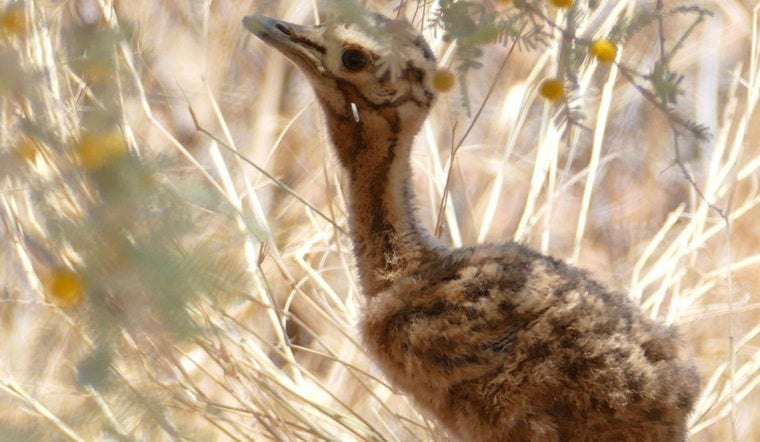
A kori bustard chick hatched at Franklin Park Zoo on August 1, marking the Jamaica Plain zoo's first successful hatch of the species since 2003. The chick has grown from a mere 83 grams at birth to more than 300 grams today, and zoo staff say it is eating well and steadily gaining weight.
The hatch, the result of a recommended breeding pairing, came from the zoo's trio of kori bustards: a male named Onyx and two females, M'guu and Kibibi, according to WJAR. Because the chick is being hand-raised by the Franklin Park Zoo animal care team rather than by its parents, keepers visit it throughout the day to make sure it hits key developmental milestones. That includes a rigorous exercise regimen, since long-legged birds like kori bustards depend on daily movement to build the muscle and skeletal strength they'd otherwise develop by walking alongside adult birds across open grasslands.
Why Exercise Matters for a Growing Giant
Zoo New England Area Curator Bill Robles said the zoo's exercise schedule for the chick is designed to emulate the behavior of wild kori bustard chicks, which continuously follow their parents across grasslands and plains. Robles said exercise is essential for the proper development of long-legged birds' legs, muscles, and behavior, a protocol that also applies to cranes and storks raised at the zoo, according to Zoo New England. In the wild, male kori bustards play no role in incubation or chick-rearing at all — females alone incubate one or two camouflage-mottled eggs laid in simple ground scrapes, a process that takes 23 to 24 days, per the Birmingham Zoo.
Kori bustards are native to the open grasslands and lightly wooded savanna of southern and eastern Africa. The species is known for extreme size differences between males and females: adult males can stand up to 4.5 feet tall and weigh between 30 and 42 pounds, while females reach only about 2.25 feet and roughly 15 pounds, per the Birmingham Zoo. Adult kori bustards can weigh more than 40 pounds, making them among the heaviest birds in the world still capable of powered flight, the station notes.
A Species Under Pressure in the Wild
Kori bustards are classified as near threatened, facing habitat loss driven by human activity, according to the station's report. Beyond agricultural expansion and habitat destruction, high-voltage electrical transmission lines pose one of the biggest human-made threats to wild populations, since the birds fly infrequently and heavily, making it difficult for them to navigate around overhead power lines, according to EcoTraining. Wild kori bustards also face poaching pressure from hunters who harvest their distinctive feathers for commercial fly-tying markets.
Franklin Park Zoo has built a conservation response around that exact threat. The zoo participates in the Kori Bustard Molted Feather Project, which collects naturally shed feathers from its captive birds and distributes them free of charge to fly fishermen for lure-making, according to Zoo New England's conservation program page. The zoo runs a similar effort for its brown kiwis, sending shed feathers to New Zealand, where they're used in traditional Māori cultural weaving.
Part of a Broader Track Record With Rare Birds
The kori bustard hatch adds to a list of difficult avian breeding milestones at Franklin Park Zoo. In January 2021, the zoo successfully hatched a brown kiwi chick for the first time in its history, a species that requires specialized artificial incubation techniques. Zoo staff have not shared the new chick's name, and once it is old enough, it will move to another Association of Zoos and Aquariums-accredited institution as part of the species' broader Species Survival Plan.
Founded in 1912 within Boston's Frederick Law Olmsted-designed Emerald Necklace park system, the 72-acre Franklin Park Zoo has been operated since 1991 by the nonprofit Commonwealth Zoological Corporation, doing business as Zoo New England. The organization also runs Stone Zoo in Stoneham and recently completed a wave of capital investment, including the new $21 million Penguin Coast habitat that debuted earlier this year. Zoo New England also raised a record $955,000 at its 2026 Zootopia fundraising gala, money that supports education, research, and animal care programs across both of its Massachusetts locations.




