

























































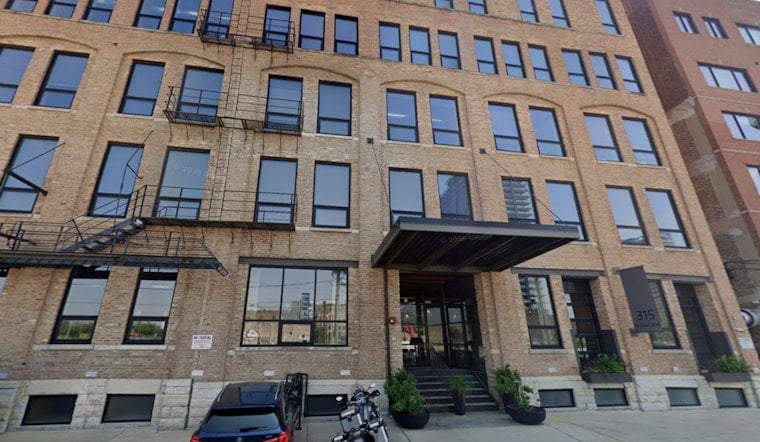
A 95,000-square-foot loft office building at 315-317 N. Racine St. in Fulton Market has changed hands for $27.5 million, marking developer Joseph Panfil's exit from a property he held for two decades. The buyer, addiction treatment nonprofit Alpharus Health, is moving into a corporate workspace built out to its own specifications inside one of Chicago's hottest office submarkets.
Aberdeen Development, the firm tied to Panfil, sold the five-story building to Alpharus Health, according to The Real Deal. An Aberdeen Development affiliate originally acquired the real estate for just $2.8 million back in 2006, meaning the sale price represents nearly a tenfold increase over two decades, per the outlet's reporting. Jeremy Kelmanski represented Alpharus Health in the deal, while Joey Panfil represented Aberdeen Development as seller.
The sale is notable in part because it is Aberdeen Development's first property disposition in more than a decade — the firm's last recorded sale came in late 2012, when it partnered with Michael Scoby to sell 945 W. Fulton St. for $6.3 million, the same outlet reported. Aberdeen Development is now working to unwind other long-held real estate holdings as it shifts focus elsewhere in the city.
Why Panfil Needed the Cash
The Racine Street building carried a complicated debt history that helps explain the timing of the sale. Panfil originally took out a $10 million construction loan from Busey Bank against the property, then Aberdeen Development secured an $18 million mortgage from City National Bank in February 2020. That loan was later replaced in 2025 with a $16.5 million mortgage from an entity controlled by Flossmoor-based investors John and Renee Michelon, according to the same reporting.
Crucially, Aberdeen Development had cross-collateralized the Racine Street property with its development site at 2101 W. Pershing Rd. in the McKinley Park neighborhood on Chicago's Southwest Side. That six-acre site, which sits inside the historic Central Manufacturing District established starting in 1917 as part of the nation's first planned industrial park, according to Preservation Chicago, is where Aberdeen Development plans to build a 500,000-square-foot mixed-use project. The Pershing Road site covers a six-story, 520,000-square-foot masonry building alongside a two-story commercial building, per a LoopNet listing, and the project still requires financing before it can move forward. Freeing the Racine Street property from its cross-collateralized debt structure gives Aberdeen Development more room to focus on building out the McKinley Park project.
A Nonprofit's Fresh Start in Fulton Market
Alpharus Health rebranded from Gateway Foundation on August 18, just weeks before the deal closed, to reflect its expanding scope across addiction treatment, mental healthcare and public policy advocacy, according to Becker's Behavioral Health. Founded on Chicago's South Side in 1968, the organization grew over nearly six decades into one of Illinois' largest nonprofit substance use disorder treatment providers, operating more than 80 sites across eight states, per Cause IQ. A spokesperson for the nonprofit confirmed the acquisition of the building.
The Racine Street building dates to 1912, when it was constructed within what is now the Fulton Market Historic District to serve the Bunge Vinegar & Yeast Company, according to Aberdeen Development Chicago's own property history. It later hosted a Regus-branded flexible office location operated by IWG, which announced plans in May 2024 to open there as part of a seven-location expansion across the Chicago region, per CoStar. Now the space has been customized as move-in-ready corporate workspace suited to Alpharus Health's specifications.
Fulton Market Keeps Defying the Downturn
The sale lands amid a broader pattern of strength in Fulton Market even as much of downtown Chicago's office market struggles. The submarket recorded a direct office vacancy rate of 17.8% in mid-2026 — the lowest among all downtown Chicago submarkets — while overall Central Business District vacancy hovered around 27% to 28%, according to Lobi Space. Fulton Market was also one of only two central business district submarkets to log positive office net absorption through mid-2026, gaining 259,000 square feet of net corporate occupancy, per Cushman & Wakefield.
Fulton Market has transformed from an industrial meatpacking district into a corporate enclave anchored by tenants like Google and McDonald's, with recent additions including the 369,007-square-foot Class A tower at 919 W. Fulton St., delivered in 2026 and anchored by Harrison Street Asset Management, according to REJournals. Hoodline previously reported that the submarket's resilience has drawn a wave of investor interest, including an Italian buyer's Fulton Market purchase earlier this year. The contrast with the rest of downtown Chicago has been stark: as Hoodline reported in June, the Loop tower at 500 W. Monroe St. sold for nearly $100 million — a $300 million drop from its pre-pandemic valuation — even as Fulton Market assets like Panfil's Racine Street building commanded near-tenfold returns.
That divergence underscores a theme playing out across the deal: office demand overall remains constrained by remote work, yet end-user buyers are still willing to deploy capital for tailored space in prime submarkets. Alpharus Health's move into a fully built-out Fulton Market headquarters, financed through its own capital rather than a leveraged purchase, reflects that willingness. Whether Aberdeen Development can now secure financing to break ground on its McKinley Park mega-project remains the open question hanging over the developer's next chapter.




