

























































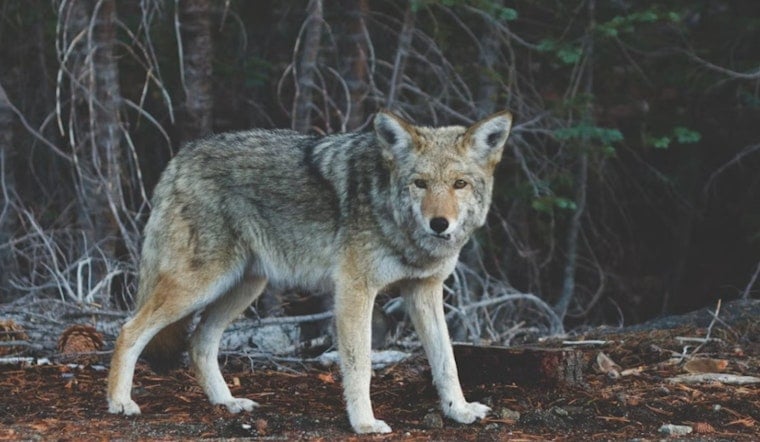
A lone gray wolf photographed near Lake Pillsbury in northern Lake County late last month has become the first confirmed sighting of the species west of the Sacramento Valley in modern history, according to state wildlife officials. Local residents captured the images around August 25 or 26, and biologists later located tracks confirming the animal's presence in the Mendocino National Forest.
State wildlife officials confirmed the sighting after residents' photos surfaced, and biologists subsequently found tracks in the area, according to kwine. Madeline Cline said the California Department of Fish and Wildlife had confirmed the wolf's presence, as reported by the Sacramento Bee, in an article by Darrell Smith. Axel Hunnicutt, the department's state gray wolf coordinator, said it is the only confirmed sighting west of the Sacramento Valley, per the same account.
A Wolf on Its Own, Looking for Company
Wildlife officials believe the wolf is dispersing and searching for other wolves, and it may have traveled from Oregon or from one of California's established packs — including the Whaleback pack, based in central and eastern Siskiyou County. Officials say the animal could go on to establish a territory, build a pack of its own, and raise young in the region, though it's also possible it continues moving south or that this sighting remains a one-off. The sighting itself expands the species' potential range in California, wherever the animal ultimately settles.
Interstate 5 has long served as a dangerous barrier for gray wolves moving through the state, according to the Sacramento Bee's reporting. West of that highway, the landscape offers something wolves need: abundant elk and other natural prey. The Lake Pillsbury basin specifically supports a resident herd of native Tule elk alongside black-tailed deer, according to a Visit Lake County post, a prey base that reduces the likelihood wolves will turn to livestock instead. Mendocino and Lake counties also have a greater diversity of elk and deer than the cattle country of northeastern California, and the area west of I-5 has historically seen fewer conflicts with humans or livestock, per the Sacramento Bee.
A Century of Absence, Then a Sudden Return
Gray wolves were wiped out in California by the 1920s, following systematic eradication by hunters and trappers; the state's last known wild wolf was killed in Lassen County in 1924, according to a Facebook post from Active NorCal. Wolves returned to the state on their own, without any government reintroduction program, after OR-7 crossed into California from Oregon in 2011. The Shasta pack became California's first modern wolf pack in 2015.
The state's protections followed close behind. The California Fish and Game Commission voted 3-1 on June 4, 2014, to grant gray wolves state endangered status under the California Endangered Species Act, overriding a recommendation from its own wildlife staff that state listing was not yet warranted, according to the Los Angeles Times. Gray wolves remain protected under that state law today, and wolf recovery has benefited from those legal protections, per the Sacramento Bee.
Explosive Growth Across the State
The Lake County wolf arrives amid what wildlife officials describe as the fastest pack expansion since wolves returned to California. The number of confirmed packs jumped from nine to 12 in a single quarter between April and June 2026, according to California Today. As of July 2026, California wildlife officials counted a minimum of 50 wolves across 11 confirmed packs, per the Sacramento Bee. Wolves have also been dispersing far beyond their historic range: a collared female wolf known as BEY03F completed a 370-mile journey from Plumas County to Los Angeles County in February, becoming the first wild wolf confirmed in L.A. County in over a century, as Hoodline previously reported. Roads remain deadly for dispersing wolves, and vehicle strikes are the leading known cause of wolf mortality in the state.
Ranchers, Task Forces, and the Limits of the Law
The prospect of wolves establishing territory west of I-5 has already reached local government. Mendocino County officials discussed the wolf at a September 1 Board of Supervisors meeting, and the office of Angela Godwin was exploring a bi-county wolf task force with Lake County that would prepare for potential livestock predation, according to the Sacramento Bee. Officials at that meeting noted that state regulations permit ranchers and property owners to conduct non-injurious hazing — including shouting, air horns, spotlights, and non-lethal warning shots — if a wolf comes within a quarter mile of livestock or within 100 yards of a dwelling or agricultural structure, according to MendoLocal.
What ranchers cannot do is kill or capture a wolf, even one threatening livestock. Under the California Endangered Species Act, intentionally taking, chasing, capturing, or killing a gray wolf is illegal anywhere in the state, regardless of the circumstances, according to the California Department of Fish and Wildlife. The department has tried to soften that burden with money: it awarded $2 million in grants in July 2026 to four regional organizations, including the California Bountiful Foundation and regional resource conservation districts, to help ranchers pay for non-lethal deterrents, range riders, and conflict-mitigation training. But an earlier pot of state money has already run dry — the Legislature's $3 million Wolf-Livestock Compensation Pilot Program, created in 2021, had been fully exhausted across 109 grants to ranchers in wolf-impacted counties, the department reported in April 2024.
A Federal Wildcard
Hovering over all of this is a federal review that could reshape the rules. President Donald Trump issued an executive order directing a review of federal wolf protections, and while that order does not remove existing federal Endangered Species Act protections for gray wolves, it does direct the Interior Secretary to determine within 90 days whether gray wolves and Mexican wolves meet recovery criteria, and it requires review of federal programs that compensate producers for wolf-attributed livestock losses, along with criteria for authorizing lethal removal of wolves that threaten livestock or human safety. If recovery criteria are met, the order directs the department to begin the delisting process, which could lead to removing or reducing federal protections, per the Sacramento Bee's reporting.
For now, wildlife advocates are treating the Lake County sighting as good news. Amaroq Weiss called the sighting exciting news for wolf recovery, and Shannon LaBuschagne, an associate attorney at the Center for Biological Diversity, was also quoted in coverage of the find. State fish and wildlife teams are working with Mendocino National Forest experts to learn more about the animal, and officials are urging anyone who spots the wolf to leave it alone and let it move on safely.


