

























































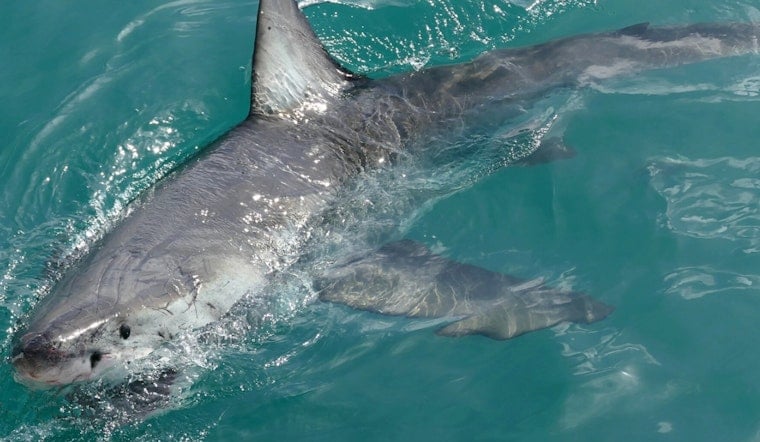
A great white shark surfaced roughly 200 yards off Wells Beach on Labor Day, and the town's fire department had a blunt warning for anyone thinking about a late-season dip: there were no lifeguards watching the water. Staffing had already wound down for the season, leaving swimmers largely on their own if they went in.
The Wells Fire Department reported the sighting, according to NBC Boston, though no further details were available about the shark's size or how long it lingered near shore. It marks the second confirmed great white sighting at Wells Beach within about four weeks, following an August 12 encounter that prompted officials to ban swimming and fly a purple warning flag after a roughly 10-foot juvenile great white was spotted within 500 yards of the beach, as reported by NEWS CENTER Maine. That earlier closure lifted the following day after no further sightings were confirmed.
A Summer of Close Encounters Along Southern Maine
The Labor Day sighting caps a summer in which white sharks made themselves unusually visible along the southern Maine coast. Just up the shore in Scarborough, a 71-year-old lifeguard at Scarborough Beach State Park was dragged five to six feet underwater on August 8 when a great white grabbed his plastic rescue buoy; he unstrapped the flotation device and swam back to shore unharmed, per CBS News. Days earlier, public safety officials and drone operators in Scarborough documented an unprecedented gathering of up to nine juvenile white sharks feeding in shallow waters near Pine Point Beach, a scene Hoodline detailed in its earlier report, A Dozen Sharks Swarm Scarborough.
Farther south, a shark sighting also closed Cohasset's Sandy Beach in Massachusetts to swimmers, part of a broader wave of regional closures Hoodline has tracked this season. The pattern isn't confined to one town: sightings have prompted beach warnings and safety measures up and down the North Shore of Massachusetts and southern Maine for more than a year now.
Why Sharks Keep Showing Up in Shallow Water
Biologists with the Maine Department of Marine Resources say nearshore white shark sightings typically peak between July and September, driven by recovering seal populations protected under federal law and by Gulf of Maine waters warming faster than 99% of the global ocean, according to 930 WFMD. A peer-reviewed study analyzing tracking data from 2012 to 2023 identified 107 tagged white sharks off Maine, mostly juveniles and subadults, concentrated in shallow nearshore waters between May and December, according to the Maine Department of Marine Resources. Separately, state data shows that 23% of white sharks tagged off Massachusetts by state biologists and the Atlantic White Shark Conservancy have later been detected on Maine's acoustic receiver network, according to the Bangor Daily News, underscoring how closely linked Cape Cod's shark population is to Maine's coastline.
This month, Maine researchers tagged an 8-foot female juvenile white shark named Bug, marking the state agency's first successful in-house white shark tagging effort, the Bangor Daily News reported. The tag feeds into a tracking array of more than 35 underwater acoustic receiver sites deployed from Ogunquit Beach to the U.S.-Canada border, according to the Island Institute, giving officials a clearer picture of where tagged sharks are moving along the coast after the data are physically retrieved, rather than providing real-time tracking.
Balancing Warnings Against a Rare but Real Risk
Maine's only confirmed fatal shark attack happened in July 2020, when 63-year-old swimmer Julie Dimperio Holowach was killed by a great white off Bailey Island in Harpswell, according to the Associated Press. That tragedy, once considered a statistical anomaly in a state with almost no recorded shark encounters, reshaped how Maine towns think about warning swimmers. In Harpswell, officials adopted a policy this summer of flying purple shark warning flags continuously at municipal beaches all season, rather than only after reported sightings, citing how quickly sharks can move along the coast, per the Harpswell Anchor.
Wells Beach's Labor Day encounter highlights a different kind of tension: what happens when a sighting occurs just as seasonal lifeguard staffing tapers off. With no lifeguards on duty and limited details about the shark itself, the fire department's warning served as the primary safeguard for anyone still drawn to the water as summer winds down. Nearshore sightings have surged across the region this year, but unprovoked bites remain extremely rare, even as state scientists continue tagging young sharks to better understand their movements along the Maine coast.



