

























































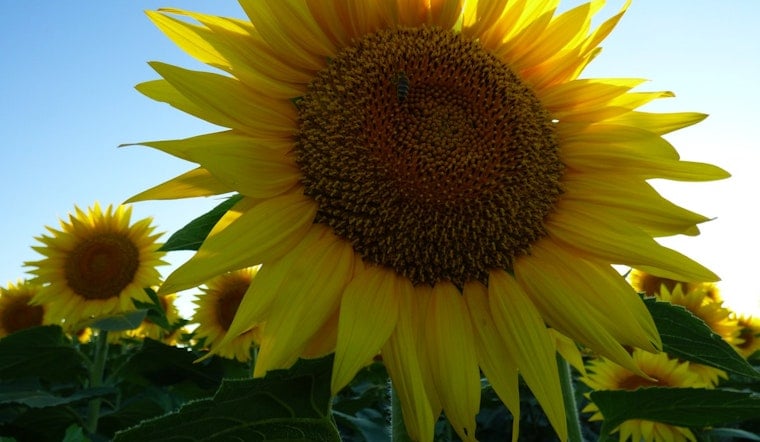
Thirty-five acres of sunflowers northeast of Lawrence are on the verge of exploding into full bloom just in time for Labor Day weekend, but the same heat wave drawing crowds outdoors could also be the thing that wilts the show early. Farmer Ted Grinter, who has planted sunflowers since the 1970s, predicts the entire field at his family's farm will be in bloom by Thursday.
Grinter Farms, located in Lawrence, Kansas, has become a late-summer tradition for shutterbugs and daytrippers, drawing thousands of visitors every year, including travelers from Nepal, China, Russia, Ukraine and across the United States, according to KCUR. The field, which is grown primarily for wild birdseed rather than as a tourist attraction, typically kicks off its bloom right around Labor Day weekend, and Grinter expects the flowers to be in full bloom throughout the holiday.
But the same station reports that a stretch of extreme heat may shorten the annual display this year. The National Weather Service says Kansas City-area temperatures will hold in the mid-90s to near 100 degrees, with heat index values ranging from 100 to 105 degrees and the potential to exceed 100 through Friday. Evening lows are expected to stay in the mid-70s and lower 80s, offering little overnight relief.
Why the Heat Speeds Up the Bloom-and-Fade Cycle
That kind of heat does double duty against the farm's brief flowering window. Extreme heat will dry out the sunflower blooms more quickly than usual, and the flowers may fade faster this season than in previous years, per the station's report. The same conditions that accelerate the bloom can also cut it short, leaving farmers and photographers racing the thermometer.
Kansas City photographer Roy Inman, who flew a drone over the field last season, predicted crowds might be thinner than usual if temperatures don't cool down. Eddie Davalos, a visitor featured in the KCUR piece, said he plans to return later in the week once the flowers reach full bloom, calling the fully blossoming field magical. Davalos said he intends to time his visit for just after sunrise, before the heat of the day sets in.
Morning Light, Not Just Cooler Air, Drives the Timing
That early-morning strategy lines up with the plant's own biology. Young sunflower buds actively track the sun from east to west each day, but once a head fully matures, it stops that heliotropic movement and faces permanently east, according to the Lawrence Journal-World. That means the blooms catch the best light, and the most pollinators, in the early hours, making sunrise visits less a matter of comfort and more a matter of getting the shot before mature heads face away from the midday sun.
Once the petals fade, the crop reverts fully to its original purpose. The sunflowers will be harvested for birdseed after the blooms are gone, part of Ted Grinter's broader farming operation. Grinter Farms is registered as an agritourism business under the Kansas Agritourism Promotion Act, according to Kansas Tourism, and the family has leaned into that role by opening Sunflower General, a gift and bake shop at 14755 243rd Street selling local honey, baked goods, and annual T-shirts designed by Kris Grinter.
A Working Farm, Not a Photo Studio
Despite the crowds and the marriage proposals, birthdays and weddings the field has hosted over the years, Grinter Farms charges no mandatory admission, relying instead on voluntary donation boxes and a $1-per-stem honor system for cut flowers, per Explore Lawrence. As Ted Grinter put it, income from the sunflowers includes visitors' smiles and memories as much as anything else.
Because the field still functions as active farmland with combine equipment moving through it later in the season, the family enforces strict visitor rules: no public restrooms, no trash cans, no street parking, and no carving or drawing on the seed heads, according to The Lawrence Times. Etching into the flower faces damages the mature seed crop that gets harvested for birdseed in the fall. The same outlet notes that visitors overwhelmed by crowds at Grinter's can try the smaller, six-acre Hunsinger Sunflower Patch south of Lawrence, which offers designated cutting and photo sections.
A Crop With Deep Kansas Roots
The sunflower's pull on Kansans goes beyond one family's field. The wild native sunflower was officially designated the state flower and floral emblem of Kansas by the 1903 Kansas Legislature, a distinction lawmakers gave the plant as a symbol of the frontier prairie and state heritage, according to the Kansas Office of Revisor of Statutes. Kansas farmers planted 24,000 acres of sunflowers in 2026, a 6% drop from the 25,500 acres planted in 2025, per USDA figures cited by the National Sunflower Association, and the state ranked fourth nationally in sunflower production behind North Dakota and South Dakota as of 2017 USDA data, with most large-scale commercial acreage concentrated in western Kansas.
For now, all eyes at Grinter Farms are on the thermometer and the calendar. With Ted Grinter expecting a full bloom by Thursday and forecasters warning the heat could push past 100 degrees through the end of the week, visitors hoping to catch the field at its peak may have a narrower window than in past years to see the 35 acres of sunflowers turn gold before the harvest begins.





