

























































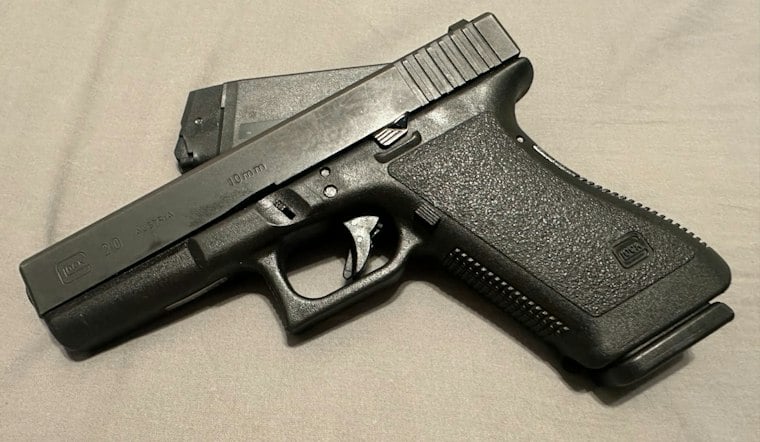
A coalition of gun rights groups has asked a federal court to stop Maryland from enforcing its new ban on Glock-style handguns, setting up a pivotal hearing in Baltimore more than three months before the rule is scheduled to reshape what dealers can sell statewide. The Second Amendment Foundation and allied groups filed a request for a preliminary injunction in Bathras v. Moore, seeking to freeze the law while the broader legal fight plays out.
The law at the center of the dispute, Senate Bill 334, was signed by Gov. Wes Moore and makes it illegal to manufacture, sell, buy, receive, or transfer handguns classified as machine gun convertible pistols, according to Tampa Free Press. Enacted as Chapter 771, the statute amends Title 4 of Maryland's Criminal Law Article to define that prohibited category as any semiautomatic pistol with a cruciform trigger bar that can be converted into a machine gun through a simple backplate swap, without machining, per the Maryland General Assembly. Hammer-fired handguns and striker-fired pistols without that trigger bar are explicitly exempted. The cruciform trigger bar is found in Glocks and similar handgun models, and the ban is scheduled to take effect January 1, 2027.
Hearing Set for Baltimore Federal Court
U.S. District Judge Richard D. Bennett has scheduled oral argument on the preliminary injunction motion for this Friday, September 25, at 11 a.m. in Baltimore federal court, according to the Facebook page of Maryland Shall Issue. The hearing lands just over three months before the law's implementation deadline, and its outcome will determine whether the retail sales ban takes effect on schedule or is paused while the underlying constitutional case continues, per Gun Talk's reporting on the case.
Bathras v. Moore and Duffy v. Moore are federal lawsuits challenging SB 334. The Bathras case includes individual plaintiffs and national gun rights organizations.
Who's Suing and Why
The Second Amendon Foundation sued Maryland after Senate Bill 334 was signed, joining the National Rifle Association, the Firearms Policy Coalition, Atlantic Guns, and two local residents in the case, per Tampa Free Press. Atlantic Guns, a Rockville firearms dealer that has operated since 1950, was added as a commercial plaintiff in a June 25 amended complaint, arguing the ban will eliminate a substantial portion of its retail inventory, according to AmmoLand. It joined individual plaintiffs David J. Bathras Sr. and Roslyn Mickens, a licensed firearms instructor and registered gun collector.
The plaintiffs argue Maryland is outlawing standard, legal handguns simply because criminals might illegally modify them into automatic weapons, even though converting a handgun into a machine gun is already a federal crime. Bill Sack said Glock-style handguns are protected by the Second Amendment and are widely used by civilians, police, and military personnel, adding that converting Glocks into machine guns and possessing the parts needed to do so are already federal crimes, Tampa Free Press reported. Under federal law, devices such as Glock switches or auto-sears are classified as machine guns under the National Firearms Act and 18 U.S.C. § 921(a)(23), with penalties of up to 10 years in prison for illegal possession, according to Orchid Advisors.
An Overreach or a Necessary Safeguard?
Maryland lawmakers passed a bill that applies to Glock-style handgun owners generally, rather than only the small fraction of owners who illegally alter their firearms, and the state does not claim the handguns are dangerous immediately after purchase, per Tampa Free Press. The plaintiffs' brief argues that an ordinary handgun protected under the Supreme Court's Heller decision cannot be deemed dangerous and unusual merely because it could later be converted with an illegal part or criminal alteration.
Alan M. Gottlieb called the Maryland law an overreach by Annapolis lawmakers, saying it places a major portion of the state's commercially available handgun market off limits to legal buyers, according to Tampa Free Press. The federal court has not yet ruled on the request to pause enforcement of the ban.
Manufacturers and Other States Respond
The fight in Maryland is part of a wider industry and legislative shift. Glock announced in October 2025 that it would discontinue most Generation 3, 4, and 5 handgun models by the end of that November and move to a redesigned V Series line engineered with modified trigger geometry meant to prevent aftermarket switch installation, according to Everytown for Gun Safety. The company's single-stack Slimline models remained in production.
Maryland's law follows a broader multi-state movement restricting convertible handguns with cruciform trigger bars, including California's AB 1127 in October 2025 and new 2026 laws in Connecticut and New York, Orchid Advisors reports. Connecticut's HB 5043 is a parallel measure aimed at stopping DIY machine guns. Hoodline has previously reported on a similar lawsuit against New York's ban, and on police testimony about seized converted handguns near Morgan State.
Current owners would not have to give up their handguns when the ban takes effect. Maryland State Police may publish a list of specific handgun models that meet the law's definition of a prohibited machine gun convertible pistol.





