

























































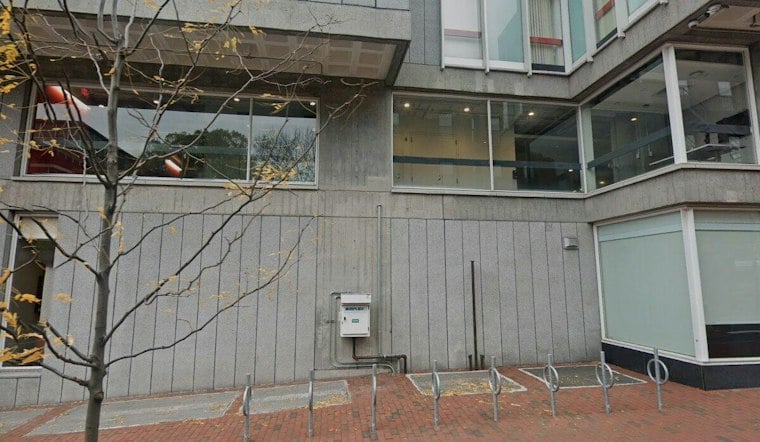
Harvard has begun taping off the plaza outside its Smith Campus Center every night after the building closes at 10 p.m., tying together tables and chairs so no one can sit or sleep there until 7 a.m. The move has displaced homeless residents who had used the Harvard Square plaza as an overnight gathering spot for years, scattering them to nearby streets, Cambridge Common, and the entrances of local businesses.
The plaza had been open to the public 24 hours a day, and Cambridge residents said they had never previously seen overnight access restricted, according to The Harvard Crimson. Anyone still on the plaza after closing must leave by midnight, and those removed cannot return until 7 a.m. Harvard University Police Department officers may remove people who stay after being told to go, and those who refuse can be arrested, the Crimson reported.
Richard P. McLeod said chaining up the chairs and closing off the area unfairly punishes the public, per the Crimson's reporting. Displaced residents have since moved to seating on Dunster and Holyoke streets, Cambridge Common, Winthrop Park, and the doorways of local businesses, the newspaper found.
A Building Designed as an Open Front Door
The Smith Campus Center, formerly known as the Holyoke Center, opened in its current form in September 2018 after a major redesign by Hopkins Architects that was explicitly intended to create a 360,000-square-foot public front door for Harvard, according to Dezeen. The surrounding plaza, long known as Forbes Plaza, had served for decades as a 24-hour gathering spot in Harvard Square for chess players, street performers, and unhoused community members, as detailed by Cambridge Day.
That history makes the new overnight restrictions a notable departure from the building's public-facing design. The Crimson's reporting notes the Smith Center opened in 2018 to serve both Harvard students and Cambridge residents, and remains one of the few year-round, climate-controlled public spaces in Harvard Square — a space homeless residents rely on for amenities including public restrooms.
Enforcement Numbers Climb
HUPD records show a sharp rise in enforcement activity at the Smith Center over the past two years, the Crimson reported. The department logged 107 incidents at the center involving unwanted persons, alleged trespassing, or disorderly conduct in 2025 — a record high. HUPD has made 33 arrests at the Smith Center since 2019, including 12 in the first nine months of 2026 alone; arrest logs described five of those 12 people as homeless, per the same report.
Harvard police issued 29 trespass warnings at the Smith Center in 2026 and 30 in 2025, the Crimson found. Steven G. Catalano said HUPD is committed to safe and secure campus policing while treating all individuals with dignity and respect, according to the newspaper's account. Patricia A. Contente described the crackdown as hard for community members, the Crimson reported.
Timing Collides With a Seasonal Shelter Gap
The restrictions land during what the Crimson described as a period of transition for many homeless residents of Harvard Square, as colder weather sends people searching for places to sleep. Harvard's two student-run homeless shelters will not open until October 15, 2026, per the newspaper's reporting, leaving a gap before the season's beds become available.
That gap reflects a broader pattern. The Harvard Square Homeless Shelter, run by undergraduates out of University Lutheran Church, offers 24 beds for unhoused adults as the nation's only student-run adult emergency shelter but operates seasonally from November through mid-April, according to the Harvard Gazette. Y2Y Harvard Square, founded in 2015 and based at First Parish Church, offers 22 to 27 seasonal beds for unhoused young adults ages 18 to 24 through a daily lottery, per the Harvard Independent. Both programs leave gaps during the early autumn transition before their winter beds open.
Cambridge's Alternative to Police Response
The city's Community Safety Department connects homeless residents with local shelters, writes referrals for social assistance programs, and provides basic necessities, the Crimson reported. Within that department, the Community Assistance Response and Engagement team deploys licensed social workers instead of armed police for certain emergency calls, prioritizing individual relationships with residents and connecting them with resources.
Cambridge launched the CARE team in July 2024 to send unarmed civilian responders to non-violent behavioral health and quality-of-life dispatches, according to the City of Cambridge. During its first full year of operation through late 2025, the team responded to more than 1,200 crisis calls and resolved 94% of them without police involvement, the city reported in a separate account.
A Regional Squeeze on Shelter Space
The displacement in Harvard Square is unfolding against a statewide surge in homelessness. Federal data released in December 2024 showed Massachusetts saw a 53.4% jump in its Point-in-Time homeless count between 2023 and 2024, placing it among three states that drove two-thirds of the national increase, per the U.S. Department of Housing and Urban Development.
Even so, unsheltered street homelessness remains relatively rare in the region. A 2024 study by Boston Indicators found just 6% of Greater Boston's homeless population is unsheltered, far below the national average of 40%, a gap the study attributed to state shelter mandates and local emergency facility networks. That dynamic helps explain why a visible plaza gathering spot like the Smith Center draws outsized public and institutional attention. Reporting from the Harvard Independent also connects the shift to police crackdowns on encampments elsewhere in Greater Boston, including at Boston's Mass and Cass intersection, which have pushed some unhoused individuals into neighboring business districts and transit hubs such as Harvard Square.
The Smith Center restrictions also arrive weeks after Harvard Square saw another high-profile disruption, when a machete-wielding suspect triggered an HUPD lockdown that Hoodline reported ended near Mount Auburn Hospital. For now, residents displaced from the plaza are left waiting out the weeks until the neighborhood's seasonal shelters reopen their doors on October 15.





