

























































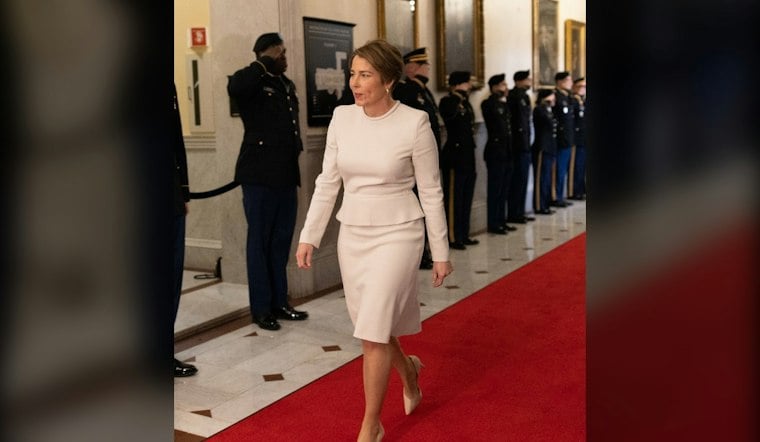
Governor Maura Healey used opening-day festivities at the Big E in Springfield to make her case for tougher artificial intelligence oversight, telling attendees that Massachusetts can regulate AI while continuing to lead in innovation. Her remarks came as state lawmakers weigh whether to add new safety guardrails to a major economic development bill still tied up in a legislative conference committee.
Healey asked Massachusetts lawmakers to create independent third-party evaluations of AI models and urged them to require companies to report AI safety incidents more quickly, according to MassLive. The push centers on the Mass WINS Act, an economic development bill currently under negotiation by a conference committee. In a September 17 letter to committee members regarding Section 164 of the bill, Healey asked lawmakers to define catastrophic risk as AI-related incidents resulting in a single human death or at least $10 million in property damage, according to a letter posted by the state.
In that same letter, Healey wrote that the pool of independent experts capable of rigorous frontier-model evaluations is limited, and she argued that AI companies cannot be allowed to self-assess their own models, per the letter. The governor pointed to Illinois, New York and California as states that have already passed similar AI legislation, per the same account relayed by MassLive.
A Bill Born From a Much Bigger Economic Push
The Mass WINS Act isn't just about AI guardrails. Healey filed it in April 2026 as a $305 million economic development package aimed at expanding state investment in applied AI, robotics, quantum computing and defense technology, partly offset by $254 million in capital deauthorizations, according to the Massachusetts Municipal Association. That funding push builds on Massachusetts' existing $100 million AI Hub, which the MassLive report notes helps hospitals and universities — including MIT, Harvard, Boston University and Northeastern — exchange information for practical use.
The AI Hub itself traces back to the $4 billion Mass Leads Act that Healey signed in November 2024, which was designed to fund applied AI research across healthcare, climate tech and university networks, according to a Chambers Practice Guide. Much of that research runs on computing infrastructure at the Holyoke-based Massachusetts Green High Performance Computing Center, which received $31 million in state grant funding in 2025 to build a shared GPU compute environment for university and startup AI research, per the Massachusetts AI Hub. The administration's AI policy planning dates back further still, to the 26-member Artificial Intelligence Strategic Task Force Healey created under Executive Order 629 in February 2024, co-chaired by Economic Development Secretary Yvonne Hao and Technology Services and Security Secretary Jason Snyder, according to the state government.
Illinois' Audit Mandate as a Model
Illinois offers the clearest template for what Healey is asking Massachusetts lawmakers to adopt. Governor JB Pritzker signed the Artificial Intelligence Safety Measures Act in July 2026, making Illinois the first state in the nation to mandate annual independent third-party audits for large frontier AI developers starting in 2028, according to a Skadden analysis of the law. California and New York have moved on parallel tracks: California enacted the Transparency in Frontier Artificial Intelligence Act in September 2025, and New York enacted the RAISE Act in late 2025, both creating state-level requirements for frontier model safety protocols and critical incident reporting, per KPMG International.
That momentum extends beyond individual statehouses. State lawmakers from California, New York and Illinois who authored those early AI laws issued a joint statement in September 2026 urging frontier AI labs to adopt an independently verified Mutually Agreed Pacing Framework to slow deployment until safety research catches up, according to the Office of California State Senator Scott Wiener. Healey has acknowledged that the AI industry currently has no agreement on how to evaluate advanced AI models, per MassLive's report on her remarks.
Healey Concedes a Federal Fix Might Be Better — If It Comes
Despite pushing hard for state-level rules, Healey recognized that a federal regulatory regime may be preferable to a 50-state solution, telling attendees that ai regulation left to the states is less tenable and that federal ai action is needed. Still, she said she will not foreclose state AI regulation while Washington remains on the sidelines, according to MassLive's account of her Big E remarks.
That tension isn't hypothetical. President Donald Trump signed Executive Order 14365 in December 2025 directing federal agencies to establish an AI Litigation Task Force to challenge state AI regulations in court and to condition federal grant funding on states not enforcing their own AI laws, according to a White House announcement. The order was intended to prevent a patchwork of 50 different regulatory regimes, per MassLive's reporting, and it created a task force specifically to challenge state laws that run contrary to federal policy. The White House followed up in March 2026 with a National Policy Framework for Artificial Intelligence calling on Congress to pass federal preemption legislation blocking state AI laws deemed to impose undue burdens on technology developers, according to Ropes & Gray.
Trump himself weighed in this week, saying that rogue AI was a hoax that benefits China's technology-development effort, according to MassLive's report on Healey's remarks. Healey's comments at the Big E — described in the MassLive report as the fourth-largest fair in the United States — placed her squarely at odds with that framing, even as she stopped short of rejecting federal involvement altogether. For now, the outcome hinges on whether the conference committee negotiating the Mass WINS Act incorporates her requested catastrophic-risk definition and audit requirements before the bill emerges from committee.





