

























































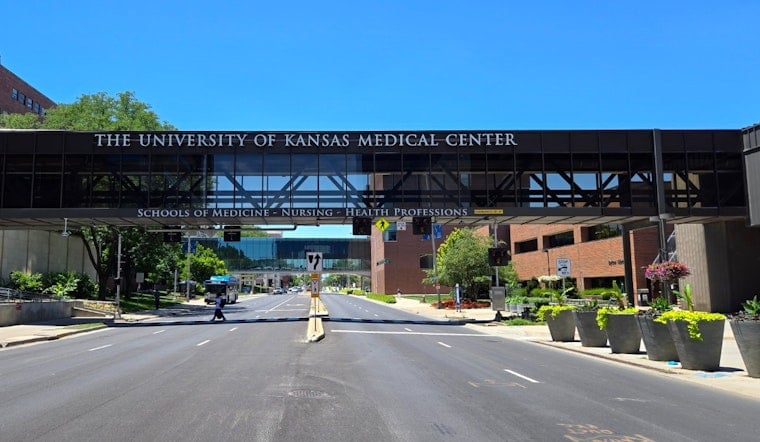
Colin Sample was two weeks away from graduating from the police academy when doctors told him he had leukemia — and not the kind he was supposed to have already beaten. The cancer had grown from the very donor cells that were meant to save his life years earlier. It was, doctors would later explain, an extremely rare twist in an already rare medical story.
Sample's ordeal began years before that diagnosis, when aplastic anemia forced him to leave the Navy at age 20, according to FOX4KC. Acquired aplastic anemia is a severe bone marrow failure disorder that strikes an estimated 500 to 1,000 Americans each year, according to the National Organization for Rare Disorders. The condition eventually led to a bone marrow transplant in 2020.
That transplant seemed to work. Dr. Joseph McGuirk said Sample initially did well after the procedure, per the same FOX4KC report. Sample married his wife, and the couple later welcomed a baby girl. He set his sights on a new career, enrolling in the police academy — and made it within two weeks of graduation before everything changed.
A Diagnosis Doctors Rarely See
Sample's care team started treatment and testing immediately once his health took a turn. What they found was startling: the donor cells used in his 2020 transplant had themselves become leukemia, an aggressive blood cancer growing inside him from tissue meant to heal him. Doctors discovered the cancer originated from the transplant donor rather than from a recurrence of his original disease, the station's report notes.
This condition, known as donor cell leukemia, is an extremely rare post-transplant complication, accounting for only about 0.1% of relapses after allogeneic stem cell transplants, according to research published in PMC. It happens when healthy donor cells undergo leukemic transformation inside the recipient's body — a fundamentally different problem than a patient's own cancer simply returning. Researchers have discussed genetic and other possible mechanisms for the phenomenon, according to the same PMC research.
Sample told FOX4KC that his chemotherapy was not working against the disease. With standard treatment failing, his care team turned to CAR T-cell therapy, a newer immunotherapy in which T-cells are removed from a patient's blood, genetically rewired in a laboratory, and infused back into the body to hunt down cancer cells.
How CAR T-Cell Therapy Bought Him Time
CD19-targeted CAR T-cell therapies like the one Sample received achieve complete remission rates of 80% to 85% in patients with relapsed or refractory B-cell acute lymphoblastic leukemia, compared to historical remission rates below 30% with standard chemotherapy alone, according to research summarized by OncoDaily. In Sample's case, the therapy put his leukemia into near complete remission, clearing the way for a second bone marrow transplant, this time from a new donor.
Sample said CAR T-cell therapy likely saved his life, and he now credits both the treatment and The University of Kansas Health System with pulling him through. He is studying to become a physical therapist and is now urging others to get tested and join the donor registry, along with encouraging donations to cancer research.
The federal government's regulators have not treated CAR T-cell therapy as risk-free. In January 2024, the U.S. Food and Drug Administration required class-wide boxed warnings on all six approved autologous CAR T-cell therapies over the potential risk of secondary T-cell malignancies, while affirming that overall treatment benefits outweigh those risks, according to the FDA. The agency also mandates 15-year long-term observational safety tracking for every patient who receives the cell therapies.
A Regional Hub for Advanced Cancer Care
Sample's care unfolded at an institution built for exactly this kind of complex case. The University of Kansas Cancer Center earned Comprehensive Cancer Center status from the National Cancer Institute in July 2022, the federal government's highest designation and one held by just 53 institutions nationwide, per KCUR. The center broke ground in May 2025 on a new Kansas City campus facility designed to combine clinical care and research under one roof, with completion targeted for late fall 2027, according to the University of Kansas Medical Center. The University of Kansas Medical Center says its cancer center was designated a Comprehensive Cancer Center by the National Cancer Institute in July 2022, making it one of just 53 centers. The medical center also describes its federal research portfolio and clinical-trial work.
Sample's push for donor registry sign-ups reflects a persistent gap in matching patients to transplants. Roughly 70% of patients who need a blood stem cell or bone marrow transplant do not have a fully matched donor within their own family and must rely on volunteers listed with unrelated registries, according to the Institute for Justice, citing figures from the National Marrow Donor Program. That organization, referred to here as NMDP, connects patients with more than 43 million adult volunteer donors worldwide. Volunteer donor registries remain important for patients seeking transplants.
Six CAR T-cell therapies now hold FDA approval, and the PMC research cited above examines donor-cell leukemia after transplantation. For Sample, the therapy was never framed as a cure on its own — it was the bridge that got him to a second, more definitive transplant, and eventually back to building a life with his wife and daughter.





