

























































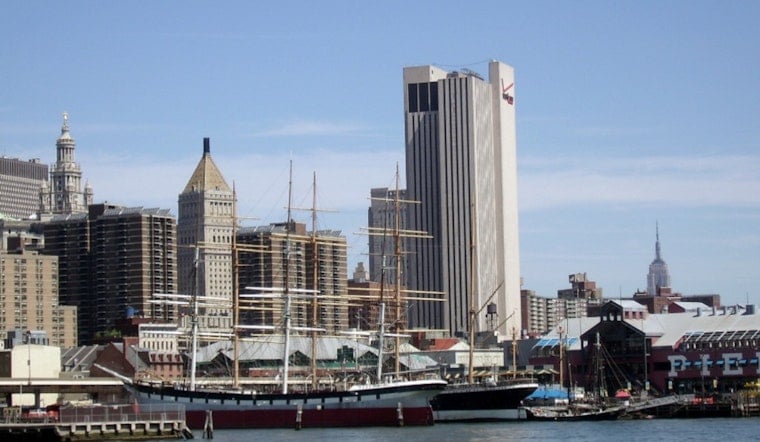
The South Street Seaport Museum will open the deck of its 1885 tall ship Wavertree to the public on September 23 for a free screening of climate documentaries, timed to Climate Week NYC and set inside a neighborhood still living with the scars of Superstorm Sandy. General admission tickets include access to the ship at Pier 16, the 1908 lightship Ambrose, two exhibitions in the Schermerhorn Row galleries, and Maritime City at A.A. Thomson & Co., though the ticket does not cover the museum's other historic ships and exhibitions.
The screenings, which begin at 6 p.m., are presented in partnership with the Climate Film Festival and the Waterfront Alliance, according to BroadwayWorld. Three short documentaries are on the bill: “Between Moon Tides,” which follows intergenerational citizen scientists in coastal New England racing to save the saltmarsh sparrow from extinction; “Refuge Keepers,” which depicts fishermen, women community leaders, and young conservationists in Celestún, Mexico, building a marine refuge; and “Holdfast Together: Keepers of California's Kelp,” which focuses on the collapse and attempted recovery of Northern California's kelp forests. The evening also includes a panel discussion and filmmaker Q&A, and organizers say audience members can expect conversation about climate change, potential solutions, and resilient waterfronts. Tickets are free with preregistration encouraged, though the museum says it will accommodate walkups as possible.
A Sparrow Running Out of High Ground
The saltmarsh sparrow storyline in “Between Moon Tides” isn't just a nature-documentary hook — it reflects a documented population crash. East Coast saltmarsh sparrow numbers have plummeted 87% over 30 years to roughly 28,000 individuals, according to research supported by federal wildlife agencies and cited by the Center for Biological Diversity, with the species at risk of extinction by 2060 as rising seas flood the high-marsh nesting grounds where it breeds. High tides are increasingly submerging nests before eggs can hatch. The stakes turned legal this year: the Center for Biological Diversity sued the U.S. Fish and Wildlife Service on February 11, 2026, over the agency's failure to make an initial Endangered Species Act protection determination for the East Coast saltmarsh sparrow, per the same organization's filing.
“Holdfast Together” tackles a parallel ecological unraveling on the opposite coast. Northern California kelp regions lost over 90% of kelp cover due to warming waters, disease, and kelp-eating purple sea urchins, per BroadwayWorld's account of the festival lineup. The collapse involved warming waters, disease, and kelp-eating purple sea urchins, with urchins overgrazing the kelp beds into barrens. Community divers, scientists, and local organizations are now working to restore the forests through urchin removal, ecological monitoring, and sunflower sea star recovery efforts. The restoration effort also includes sunflower sea star recovery work.
A Ship Built for the Open Ocean, Anchored in a Flood Zone
The venue carries its own resonance. Wavertree, built in 1885 in Southampton, England, is the last remaining iron-hulled three-masted full-rigged cargo ship, and it circumnavigated the globe at least three times during a 24-year sailing career before its listing on the National Register of Historic Places on June 13, 1978. The ship sits today at Pier 16 in the historic Seaport district, a neighborhood the South Street Seaport Museum has preserved since its 1967 founding as a testament to New York's history as a great port city.
That same district took on as much as six feet of floodwater during Superstorm Sandy in October 2012, with porous subsurface conditions, subway tunnels, and basements flooding before streets became wet, according to the CBS New York. The city has since moved on long-term fixes: in December 2021, the New York City Economic Development Corporation and the Mayor's Office of Climate Resiliency released the Financial District and Seaport Climate Resilience Master Plan, a multi-billion-dollar proposal to extend lower Manhattan's East River shoreline with an elevated waterfront designed to block storm surges and sea-level rise. The Seaport, in other words, is both stage and subject for the films it's about to show.
Climate Week Brings a City-Wide Backdrop
The Seaport screening is one node in a much larger citywide push. Climate Week NYC 2026 runs September 20 to 27 under the theme “Power On,” organized by the Climate Group in conjunction with the United Nations and the City of New York, and this year's edition returns with over 1,000 events, activations, campaigns, and engagement opportunities across the five boroughs. The screenings also trail the main Climate Film Festival slate, a New York City cultural organization founded in 2023 that soft-launched that year and now runs an annual festival alongside year-round programming and educational resources; its third annual festival runs September 18 to 21. The organization held a sold-out first look screening and panel during Climate Week NYC back in 2023.
Co-host Waterfront Alliance brings its own regional footprint to the evening. The group has advocated for coastal resilience, equitable waterfront access, and a connected working waterfront across more than 1,600 miles of coastline in the New York-New Jersey region, enlisting more than 1,100 alliance partners along the way. Separately during Climate Week, a “By Water, By Design” harbor boat tour on September 23 will showcase projects certified under its Waterfront Edge Design Guidelines, a national rating system for resilient coastal architecture. The Seaport museum and Waterfront Alliance have paired up before, having previously staged a climate art and science panel aboard Wavertree exploring how creative media can translate sea-level rise research for the public — using the ship's historic deck as an open-air venue for exactly that kind of conversation.





