

























































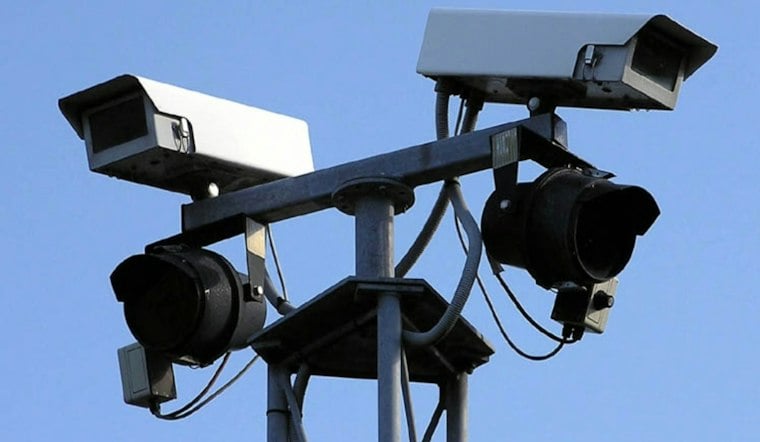
Holyoke is narrowing access to data collected by its automated license plate readers after records showed outside law-enforcement agencies using the city’s cameras for immigration-related searches. The revised policy limits sharing beyond New England, New York and New Jersey, while the City Council has begun a broader review of the technology and its privacy implications. MassLive reported the policy change after reviewing Flock Safety audit logs obtained through a public-records request.
The immediate question is access, not ownership
The records reviewed by MassLive showed that departments outside Holyoke searched data connected to the city’s cameras, including searches whose stated justifications referred to immigration or ICE. The records do not, however, establish from the publicly described material whether every search produced a useful result, led to an enforcement action or involved a direct request from a federal agency. Flock says local agencies can search connected cameras on behalf of federal partners even though Flock does not maintain a direct contract with U.S. Immigration and Customs Enforcement, according to reporting by The Shoestring.
Holyoke Police Chief Keenan told MassLive that he was unaware nationwide access had been enabled on the city’s cameras until recently. The department has since changed its sharing settings to limit access to police agencies in New England, New York and New Jersey. That is a narrower geographic rule, not a complete ban on outside searches: agencies within those areas may still be able to query Holyoke data under the system’s permissions and local policies.
Holyoke has two Flock cameras remaining, according to the city, and plans to let those contracts expire in 2027. Officials have said the city will likely replace them with automated license plate readers from another company, meaning the current dispute may affect the city’s vendor and access rules without ending plate-based surveillance altogether. The council’s review is expected to examine the contracts, operating policies and privacy safeguards rather than simply decide whether the existing Flock settings should be restored.
Other cities have used different safeguards
Dartmouth provides a useful comparison because it tried to control access before deciding to end its Flock contract. Town records say the 2023 trial restricted use to trained personnel, required monthly audits, retained data for 30 days and relied on formal requests for local sharing instead of automatic national lookup. Dartmouth notified Flock on Aug. 13, 2026, that the contract would end Sept. 29, citing cost, limited impact and privacy concerns. Town of Dartmouth records describe those measures and the decision to discontinue the system.
Cambridge took a more abrupt route. The city said it deactivated and removed 16 Flock cameras in October 2025, then terminated its contract after learning that two additional cameras had been installed by Flock technicians without the city’s awareness. The Cambridge account describes a contract and control failure, not an immigration-related search dispute, but it illustrates how concerns about vendor oversight can lead a municipality to end the relationship entirely. Cambridge’s statement said the unauthorized installations amounted to a material breach of trust.
Audit trails may not answer every question
The Holyoke episode also highlights the difference between having an audit trail and making that trail fully visible. InvestigateTV reported that, as of earlier summer 2026, Flock’s network-level logs no longer displayed the searching officer’s name, the queried plate or the open-text reason when one agency searched another agency’s cameras. Flock said those details remained with the originating agency and that the changes were made at the request of customer agencies. InvestigateTV reported the change.
That limitation matters for the council’s review. A geographic restriction can reduce the number of agencies with access, but it does not by itself specify how long images are kept, which employees may search them, what documentation is required, whether searches are audited independently or how violations are penalized. Dartmouth’s trial shows that retention limits, trained-user requirements, audits and formal requests can be written into a local operating model. Holyoke’s public discussion will need to clarify which of those protections apply now and whether they will carry over to a future vendor.
For now, Holyoke has responded to the immediate discovery by narrowing its data-sharing network rather than shutting down the cameras. The City Council’s review, the planned 2027 phase-out of the remaining Flock contracts and the prospect of a replacement system leave the central issue unresolved: who should be allowed to search information collected on Holyoke streets, under what justification and with what public oversight.




